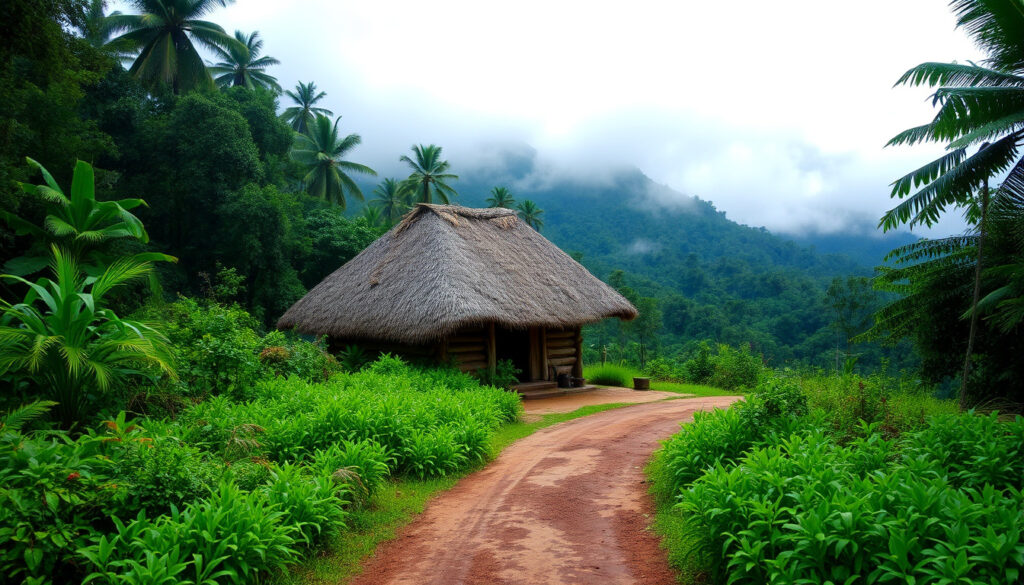
Papua New Guinea: Safety, Economy & Living Facts
Few countries pack as much complexity into one landmass as Papua New Guinea. With over 800 languages spoken across a rugged landscape of rainforests and highlands, the country defies simple description according to the Australian Department of Foreign Affairs and Trade. Yet the numbers tell a story of both extraordinary wealth and persistent poverty — a paradox that matters for anyone trying to understand the Pacific’s most diverse nation.
Population: ~11.78 million (DFAT Country Brief) ·
Land Area: 452,860 km² (DFAT Country Brief) ·
Official Languages: English, Tok Pisin, Hiri Motu (DFAT Country Brief) ·
HDI Rank (2024): 154th of 193 (DFAT Country Information Report)
Quick snapshot
- Land area: 452,860 km² (DFAT Country Brief)
- Population: ~11.78 million (DFAT Country Brief)
- Urban population: 15–20% (DFAT Country Brief)
- Over 800 languages (DFAT Country Brief) (World Bank)
- Most linguistically diverse country (World Bank)
- 80–85% rely on farming for livelihood (DFAT Country Brief) (World Bank)
- Lower-middle-income classification (DFAT Country Information Report)
- GDP per capita (2023): AUD 4,493 (DFAT Country Information Report)
- Minerals and energy drive export earnings (World Bank)
- US: Reconsider travel (U.S. State Department)
- Canada: Avoid non-essential travel (Government of Canada)
- Australia: Exercise high degree of caution (Australian Government Smartraveller)
Nine data points capture Papua New Guinea’s economic and social profile at a glance.
| Attribute | Value |
|---|---|
| Official Languages | English, Tok Pisin, Hiri Motu (DFAT) |
| Population (2023 est.) | ~11.78 million (DFAT) |
| Land Area | 452,860 km² (DFAT) |
| GDP per capita (2023) | AUD 4,493 (DFAT Country Information Report) |
| HDI Rank (2024) | 154th out of 193 (DFAT Country Information Report) |
| Urban Population | 15–20% (DFAT) |
| Fiscal Deficit (2024) | 3.2% of GDP (World Bank) |
| Livelihood from Agriculture | 80–85% (DFAT) |
| World Bank Classification | Lower-middle-income (DFAT Country Information Report) |
Is PNG safe for tourists?
Travel advisories from three major governments paint a consistent picture: Papua New Guinea carries serious safety risks for visitors. The U.S. State Department advises travelers to reconsider travel due to crime, civil unrest, and piracy. Canada’s government advises avoiding non-essential travel because of high crime levels, inter-ethnic violence, and civil unrest. Australia’s Smartraveller recommends exercising a high degree of caution overall.
What are the main safety concerns?
- High rates of serious crime, including armed robbery and carjacking, are reported in Port Moresby and Lae (U.S. State Department).
- Political instability and tribal conflicts can escalate quickly, especially in the Highlands region (Government of Canada).
- Piracy remains a risk in and around maritime areas (U.S. State Department).
Travel advisories for Papua New Guinea
The U.S. State Department has assigned Papua New Guinea a Level 3 advisory (Reconsider Travel) as of 2024, with specific warnings for the Autonomous Region of Bougainville and the Highlands provinces. Canada’s advisory distinguishes between low-risk areas (Port Moresby, tourist resorts) and higher-risk regions. Australia’s Smartraveller notes that tourists are vulnerable targets because they are perceived as wealthy.
Tips for safe travel in PNG
- Use registered tour operators and avoid wandering alone after dark.
- Stay in well-guarded accommodations; many hotels have private security.
- Heed local warnings about tribal violence and roadblock risks in rural areas.
- Register with your embassy or consulate upon arrival.
“Reconsider travel to Papua New Guinea due to crime, civil unrest, and piracy.”
The pattern: all three advisories converge on the same message – the country’s natural beauty can only be safely enjoyed with careful planning and high situational awareness.
What is the biggest problem in Papua New Guinea?
Papua New Guinea sits on vast mineral and energy wealth, yet the DFAT Country Information Report notes that it ranks 154th out of 193 countries on the UN Human Development Index. The central paradox is economic: the country is rich in resources but poor in infrastructure, governance, and service delivery.
Economic challenges and poverty
Despite a GDP per capita of AUD 4,493 in 2023 (DFAT), a large share of the population lives in poverty. The absence of a formal welfare system means that social safety nets are provided by churches and wantok kinship networks (DFAT). Agriculture, forestry, and fishing employ most of the labor force, but most jobs are informal and low-productivity (World Bank).
Resource wealth versus distribution
The World Bank highlights that minerals and energy extraction are the primary sources of export earnings and contribute significantly to GDP. Yet the benefits rarely reach rural communities. The country remains exposed to commodity price swings, foreign exchange shortages, and climate-change risks – pressures that amplify inequality.
Corruption and governance issues
The DFAT report describes Papua New Guinea as a fragmented nation – divided by terrain, history, culture, and language. Corruption at multiple levels of government weakens public services and deters investment. The fiscal deficit narrowed to 3.2% of GDP in 2024 (World Bank), but that improvement is fragile and depends on volatile resource revenues.
Papua New Guinea earns billions from LNG, gold, and copper – yet most of its citizens lack reliable electricity, clean water, or access to healthcare. The disconnect between national wealth and local reality is one of the sharpest in the Pacific.
What this means: the biggest problem isn’t a lack of resources – it’s that the growth generated by extraction hasn’t translated into broad-based development.
Is Papua New Guinea a nice place to live?
The answer depends heavily on location, income, and tolerance for uncertainty. For the 80–85% of the population that lives by farming (DFAT Country Brief), life is tied to subsistence agriculture and traditional village structures. Urban residents face high crime, weak infrastructure, and limited public services.
Quality of life indicators
With a Human Development Index rank of 154 (DFAT), Papua New Guinea ranks lower than most Pacific neighbours. Life expectancy, education levels, and access to formal employment all trail regional averages. The World Bank notes that the labor force is dominated by informal agriculture with low productivity.
Cost of living in Papua New Guinea
Imported goods are expensive due to poor transport links and reliance on foreign supply chains. Rent in Port Moresby for a secure, expat-grade apartment can cost several thousand kina per month – comparable to cities in Australia, despite lower average wages. On the other hand, rural subsistence living has very low cash costs.
Cultural and natural attractions
Papua New Guinea offers extraordinary cultural diversity: more than 800 languages, vibrant festivals, and living traditions that date back millennia. Its natural environment – coral reefs, volcanic islands, and rainforests – attracts adventurous travelers. But these positives are offset by the safety and infrastructure challenges discussed earlier.
“Avoid non-essential travel to Papua New Guinea due to high levels of crime, inter-ethnic violence, and civil unrest.”
For a foreigner considering a move, the choice is usually between a well-guarded compound in Port Moresby (with good pay and extremely limited mobility) or a simpler but less secure life in a smaller town. Few expatriates describe it as easy living.
The catch: Papua New Guinea is a place of vivid beauty and deep difficulty. The lived experience diverges sharply between those with means and those without.
Is Papua New Guinea considered Australia?
No – Papua New Guinea is a fully independent nation. It shares a maritime border with Australia and was formerly administered by Australia after World War I, but it gained independence on 16 September 1975. The Australian government’s country brief treats Papua New Guinea as a separate sovereign state and a key Pacific partner.
Geographic relationship with Australia
The two countries are connected by the Torres Strait, which separates the northern tip of Queensland from the southern coast of Papua New Guinea. At the closest point, only about 150 km of sea separates them.
Historical ties and colonialism
Papua New Guinea was under Australian administration from 1914 until 1975, after British and German colonial rule in the late 19th and early 20th centuries. Australia’s legacy includes its political institutions, education system, and language policy – English remains one of three official languages (DFAT Country Brief).
Common misconceptions about PNG’s location
Because the name includes “New Guinea” and because of its close proximity to Australia, some people mistakenly believe Papua New Guinea is part of Australia or a territory. In fact, it is a member of the United Nations and the Commonwealth of Nations in its own right.
The implication: while the two countries are deeply connected by geography and history, Papua New Guinea is politically and culturally distinct – a Pacific nation with its own government and identity.
Is LGBTQ legal in Papua New Guinea?
Homosexual acts are illegal in Papua New Guinea. The law criminalises male same-sex sexual activity, and there are no legal protections for LGBTQ people against discrimination. The legal framework, combined with strong social and religious stigma, means that LGBTQ individuals face significant risks of harassment and violence.
Social attitudes remain conservative, and there is no legal recognition of same-sex relationships or gender identity. Human rights organisations consistently document reports of discrimination, police abuse, and lack of access to justice for LGBTQ persons in the country.
What this means: for LGBTQ travelers and locals alike, the legal and social environment is hostile. The country remains one of a shrinking number of Commonwealth nations that still criminalise same-sex conduct.
Seven common questions about Papua New Guinea are answered below.
Related reading: Mount Lofty Guide: Hikes, Views & Visitor Info · RACV Torquay Resort: Prices, Golf, Spa & Ocean Views
csis.org, visitnatives.com, en.wikipedia.org, epicexpeditions.co, papuanewguinea.travel, iwgia.org
Frequently asked questions
What is the official language of Papua New Guinea?
English, Tok Pisin, and Hiri Motu are the three official languages (DFAT Country Brief). Tok Pisin is the most widely spoken vernacular.
What is the population of Papua New Guinea?
The estimated population is approximately 11.78 million (DFAT Country Brief).
What is the land area of Papua New Guinea?
The country covers 452,860 square kilometres (DFAT Country Brief).
What is the GDP per capita in Papua New Guinea?
As of 2023, GDP per capita was AUD 4,493 (DFAT Country Information Report).
What are the main exports of Papua New Guinea?
Minerals and energy extraction – including LNG, gold, and copper – are the primary export earners (World Bank).
What is the Human Development Index ranking of Papua New Guinea?
It ranks 154th out of 193 countries in the UNDP Human Development Report 2023/2024 (DFAT Country Information Report).
Do I need a visa to visit Papua New Guinea?
Yes, most foreign visitors require a visa. Tourists can generally obtain a 30-day visa on arrival, but requirements vary by nationality. Check with the Papua New Guinea Immigration and Citizenship Authority before traveling.
Papua New Guinea is a country of striking contradictions: immense cultural and natural wealth alongside severe governance and safety deficits. For the tourist considering a visit, the decision is clear – plan meticulously, respect local realities, and be prepared to trade comfort for an unforgettable experience. For the investor or development partner, the challenge is even starker: how to unlock the potential without repeating the mistakes of the past.
What’s unclear: Exact current poverty rate, Recent crime statistics by region, Accuracy of population estimates.
More related posts
 Qatar Airlines Review: Service, Policies & vs Emirates
 Carlton vs Bulldogs 2026: Stats, Rivalry, Tickets & Live Stream
 Alex Turner: Age, Height, Relationships, Net Worth & Biography
 Asher Grodman: Biography, Age, Relationship Status & Ghosts Role
 Buy Now Pay Later Australia: No Credit Check Options
 Kylie Cantrall: Age, Relationship, and Career Guide
 Stephen Peacocke in 2026: Home and Away return and family
 Deontay Wilder: Record, Net Worth, Hardest Puncher
