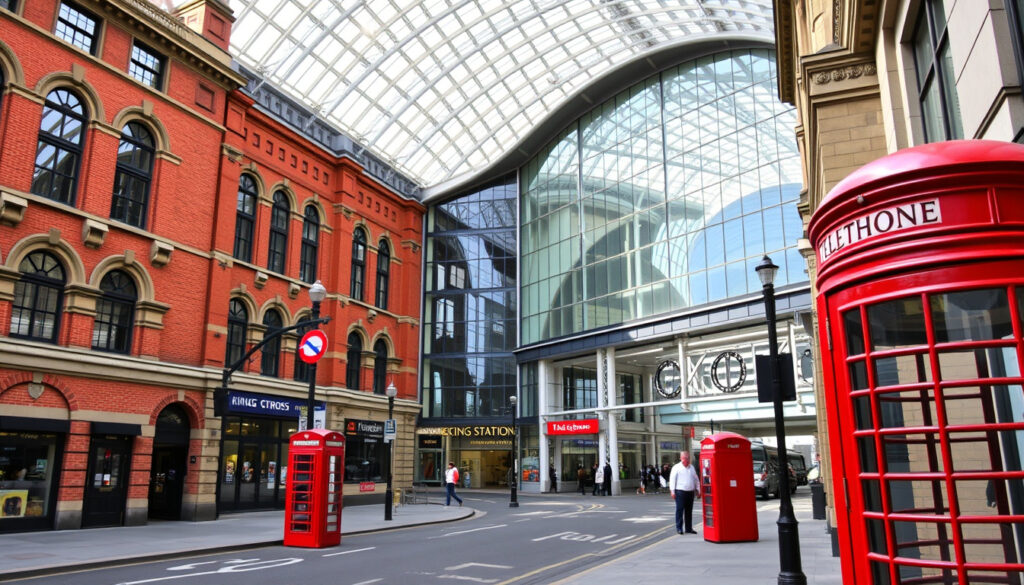
Kings Cross Guide: History, Safety, and Attractions in London
There’s a good chance you’ve seen the photo—or queued up for it yourself: the luggage trolley half-embedded in a brick wall, a scarf fluttering as if caught by some invisible train. That’s Platform 9 3/4, and it’s only a small part of why this corner of north London has become one of the city’s most visited and most debated districts since the early 2000s, when the area began a dramatic shift turning former railway land into a cultural and commercial district (Urban Land Institute)—and this guide untangles the facts behind the fame, the notoriety, and the headlines, giving you a practical read on what King’s Cross is actually like today.
Distance from central London: 1.5 miles (2.4 km) north of Charing Cross ·
Boroughs: Camden and Islington ·
Main station: London King’s Cross ·
Notorious past: Red-light district and crime hub in the 20th century ·
Regeneration: Major redevelopment since 2000 ·
Harry Potter connection: Platform 9 3/4 at King’s Cross station
Quick snapshot
- King’s Cross station serves the northeast of England and Scotland (Urban Land Institute)
- Platform 9 3/4 is a themed installation on the station’s main concourse (European Rail)
- Precise current crime statistics are not published in top sources; some third-party sites suggest higher-than-average crime (CrimeSafe UK)
- Future development plans beyond 2025 are not confirmed in the source material (CrimeSafe UK)
- The area has evolved from a rail and industrial district to a major regeneration zone (Urban Land Institute)
- The station’s original facade was revealed during redevelopment in 2016 (PRX/The World)
- King’s Cross remains an actively monitored local policing area (Metropolitan Police)
- The district continues as a model case for station-led regeneration (Urban Land Institute)
Six facts, one pattern: this is a district where transport heritage, urban renewal, and pop culture collide. The table below pulls the key data points into a single frame.
| Label | Value |
|---|---|
| Location | 1.5 miles north of Charing Cross, in Camden and Islington boroughs |
| Historical Name Origin | Monument to King George IV (1830) |
| Famous For | King’s Cross station, Platform 9 3/4, major regeneration |
| Notoriety | 20th-century red-light district and crime hotspot |
| Regeneration Period | 2000s to present |
| Key Attractions | Granary Square, Coal Drops Yard, Camley Street Natural Park |
The implication: the fame and the fear are both rooted in the same place—a station that has been through a century of change and emerged as a symbol of urban reinvention.
Why is Kings Cross so famous?
Walk into King’s Cross station and you’ll find a busy travel hub used by millions. But the fame goes beyond the commuters. For many visitors, the first stop is the Platform 9 3/4 installation, a photo spot that has turned a fictional train platform into a real-world pilgrimage site (Historic UK). The station also holds a key position in British transport history: it is the main terminus for services to the northeast of England and Scotland (Urban Land Institute).
What is Kings Cross known for?
- Major transport hub with King’s Cross station and St Pancras International (Historic UK)
- Home of Platform 9 3/4, drawing Harry Potter fans year-round (Historic UK)
- A traffic-free oasis in the heart of London, according to the official area guide (King’s Cross official guide)
- Evolution from a run-down district to a cultural and commercial hotspot (Urban Land Institute)
Why this matters: the fame is not a single thing—it’s a stack of different claims layered onto one small stretch of London. For the visitor, the result is an area that feels both like a functional station and a stage set.
Why is it called Kings Cross?
The name has nothing to do with a royal visit or a royal residence. It comes from a monument to King George IV that was built in 1830 at a crossroads where several major roads met. The statue was never popular, and it was pulled down a few years later, but the name stuck (Historic UK). Before that, the area was called Battle Bridge, a name that referred to a bridge over the River Fleet.
The catch: the origin story is a reminder that London place names are often accidents of history that outlive the objects they describe.
Is Kings Cross a nice part of London?
Today, the answer is more nuanced than a simple yes or no. The transformation has been dramatic: former railway wasteland has been replaced by a mix of modern apartments, offices, and green spaces (Urban Land Institute). The official area guide describes it as a “traffic-free oasis” and a place for canalside dining and independent boutiques (King’s Cross official guide).
Is it safe to walk around Kings Cross at night?
- Daytime safety is high, with the area being a major commuter hub and a busy shopping district
- Nighttime caution is advised in some residential streets and quieter back routes
- Police resources are actively dedicated to the area: the British Transport Police runs a dedicated London King’s Cross team, and the Metropolitan Police maintains a local policing page for the district
- Historically, King’s Cross had a reputation for crime—a 2012 report named it London’s worst Tube station for crime with 194 reported offences the previous year (Evening Standard)—but the area has changed significantly since then
The pattern: the daytime experience is a well-managed, family-friendly space; the evening experience depends on where you are, with the main streets feeling safe while quieter residential pockets require standard city caution.
What is the famous street in Kings Cross?
There isn’t one single “famous street,” but several key routes define the area. Euston Road runs along the southern edge, connecting King’s Cross station to St Pancras International and further west. Pentonville Road and King’s Cross Road branch north and east. For visitors, the real draw is the area around Granary Square and the Regent’s Canal towpath—a walking route that connects the district’s key sights and offers a quieter, more scenic way to explore (Urban Land Institute).
What this means: the “famous street” is less a single thoroughfare and more a district of linked spaces, best explored on foot.
Why is Kings Cross notorious?
The notoriety is real, but it’s also a story that’s mostly in the past tense. Throughout the mid-20th century, the area carried a reputation as a red-light district and a crime hotspot. That reputation was so strong that a 2012 report in the Evening Standard named King’s Cross the worst Tube station for crime in London at the time, with 194 reported offences in the previous year (Evening Standard). Since then, the tide has turned. Major redevelopment that began in the 2000s has transformed the physical landscape and, with it, the area’s safety profile (Urban Land Institute).
Some caution is still warranted in specific spots. The Metropolitan Police maintains an active local policing presence in the district (Metropolitan Police), and the British Transport Police operates a dedicated King’s Cross team (British Transport Police). But the era when King’s Cross was a byword for danger is behind it.
The trade-off: the area’s violent past is now a talking point, not a lived reality—yet the memory still shapes visitor expectations and, sometimes, travel decisions.
Crime data for the area is not consistently published in a single public source. The Metropolitan Police maintains a local area page for Camden that includes King’s Cross (Metropolitan Police), and crime summary sites like CrimeSafe UK describe the area as having higher-than-average crime compared to London overall, though these are third-party aggregations and should be treated with caution.
Timeline: the making of modern King’s Cross
A quick walk through the key dates that shaped the district:
- 1830 – Monument to King George IV erected, giving the area its name (Historic UK)
- 1852 – King’s Cross station opens (Urban Land Institute)
- 1868 – St Pancras station opens (Network Rail)
- Mid-20th century – Area declines into a red-light district with high crime (Evening Standard)
- 2001 – First Harry Potter film features Platform 9 3/4, boosting tourism (Historic UK)
- 2000s – King’s Cross Central regeneration project begins (Urban Land Institute)
- 2016 – Station redevelopment reveals the original facade for the first time in 150 years (PRX/The World)
- 2018 – Coal Drops Yard shopping district opens (King’s Cross official guide)
The implication: the regeneration is not just about new buildings—it’s about changing the meaning of a place that had been written off.
Confirmed vs. unclear: what we actually know
Confirmed facts
- Kings Cross is a district in the London boroughs of Camden and Islington (Wikipedia)
- King’s Cross station has 11 platforms (Network Rail)
- Platform 9 3/4 is a tourist attraction within the station (European Rail)
- The name derives from a monument to King George IV (Historic UK)
What’s unclear
- Exact current crime rates are not publicly detailed in top sources
- Future development plans beyond 2025 are not confirmed
- The station’s redevelopment timeline includes some disputed details, such as when the Platform 9 3/4 photo spot was moved (European Rail)
The catch: even with strong reporting, some specifics remain fuzzy—which is why independent, skeptical reading of the sources is valuable.
“King’s Cross is a district in the London boroughs of Camden and Islington, on either side of Euston Road.”
“A traffic-free oasis in the heart of London.”
— King’s Cross official guide
“A core hub for travel, dining and memorable experiences. It’s the home of platform 9 3/4 for Harry Potter’s Hogwarts!”
— Network Rail, official station description
Pros and cons of visiting King’s Cross
Weighing up whether it’s worth your time? Here’s the honest breakdown.
Upsides
- Direct rail connections to the northeast and Scotland make it a practical base (Urban Land Institute)
- Family-friendly attractions, especially the Harry Potter photo spot (Historic UK)
- Excellent transport links: multiple Underground lines, national rail, and international services from St Pancras
- A traffic-free, walkable core around Granary Square
Downsides
- Crowds at Platform 9 3/4 can be intense, with queues forming for photos
- Some residential streets feel quieter and less polished, requiring standard city awareness at night
- The area is more commercial than it is historic—some visitors expect a preserved old London look and find modern developments instead
The trade-off: you get a clean, efficient, well-connected district—but the raw, edgy character that some travellers seek has largely been smoothed away by the redevelopment.
Visit Platform 9 3/4 early in the morning to avoid long queues.
For most visitors, the choice is simple: if you want a convenient, family-friendly base with strong transport links and a side of Harry Potter magic, King’s Cross delivers. If you’re after a charming, quintessentially old-London streetscape, you’ll find it in nearby Bloomsbury or Islington instead. For the traveller weighing the visit, the conclusion is straightforward: King’s Cross is no longer the dangerous, decaying district of its reputation, but it’s also not a preserved historical village—it’s a modern, functional, and well-managed part of London, best enjoyed for what it is now.
metengage.co.uk, londonist.com, crimesafe.co.uk, ukcrimestats.com
Frequently asked questions
Where is Kings Cross located?
Kings Cross is a district in north London, roughly 1.5 miles (2.4 km) north of Charing Cross. It sits across the London boroughs of Camden and Islington, with the station as its anchor point.
How do I get to King’s Cross station?
King’s Cross station is served by multiple Underground lines—including the Victoria, Piccadilly, and Hammersmith & City lines—as well as national rail services and, via the adjacent St Pancras International, Eurostar services to continental Europe.
What are the best restaurants in Kings Cross?
The area around Granary Square and Coal Drops Yard is the main dining hub, offering everything from casual street food to sit-down restaurants. The Regent’s Canal towpath also has a string of cafes and bars with waterside seating.
Is Kings Cross safe during the day?
Yes. Daytime is safe and busy, with heavy foot traffic around the stations and shopping areas. Police presence is visible, and the official area is well-maintained and family-friendly.
What shopping is available in Kings Cross?
Coal Drops Yard is the main shopping destination, featuring independent boutiques, flagship stores, and a mix of established brands. Granary Square adds more retail and dining options.
What is the history of King’s Cross station?
King’s Cross station opened in 1852 as the London terminus for the Great Northern Railway. It was redeveloped in the 2010s, with a major project that revealed the original facade for the first time in 150 years (PRX/The World).
What is the best time to visit Kings Cross?
Weekday mornings and late afternoons are the busiest due to commuters. Mid-morning and early afternoon are quieter and better for exploring. The area around Granary Square is most pleasant in dry weather.
Are there any parks or green spaces in Kings Cross?
Yes. Camley Street Natural Park is a small urban nature reserve near the canal, and the Regent’s Canal towpath offers a green walking route. Granary Square also has open seating areas and fountains.
For the first-time visitor, the morning decision is straightforward: plan for Platform 9 3/4 early, grab a coffee by the canal, and wander through Granary Square—before the crowds build and the day turns into a chase for space.
More related posts
 Roy Keane: Player, Pundit, and the Man Behind the Myth
 Adrian Grenier: Why He Stopped Acting, Wife, Net Worth & More
 Birthday Wishes for Sister – Heartfelt, Funny and Short Messages
 Flea RHCP: His Nickname, Friendship with Kiedis & Near Quit
 Leon Kennedy Age, Love Life, and Popularity Explained
 Wu-Tang Clan: Respect, Religion, Downfall, and Legacy
 Tom Liberatore: Age, Concussions, Pub Ownership, and Career
 Boba Fett: Good or Bad? Origins and Reputation Explained
