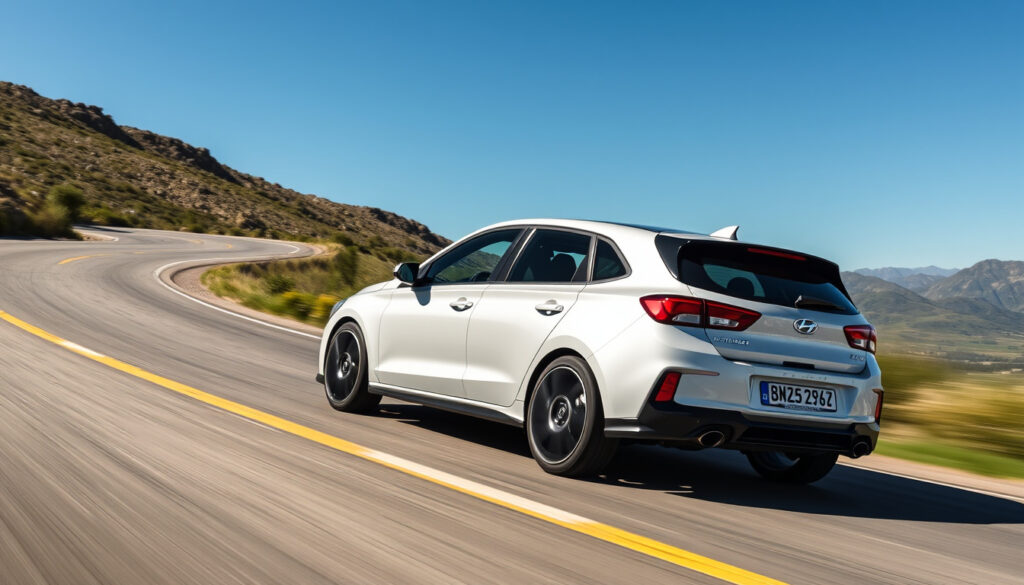
Hyundai i30 N: Performance, Specs and Buyer’s Guide
The Hyundai i30 N rewrote the hot hatch rulebook the moment it posted lap times that made the VW Golf GTI nervous. Built for track days but engineered for the daily commute, this Korean bullet delivers 280 HP and 378 Nm of torque that puts established European rivals on notice. This guide breaks down every dimension that matters — from raw performance figures to common ownership concerns — so you can decide if the i30 N fits your situation.
Horsepower: 280 HP · Torque: 378 Nm · Engine: 2.0L turbo petrol · Model Years: 2018-2024 · Performance Variant: Hot hatch
Quick snapshot
- 2.0L turbo engine produces 280 HP and 392 Nm (FastestLaps Performance Pack specs)
- Hot hatch classification confirmed across all model years (WhichCar 2018 comparison review)
- 0-100km/h claimed at 5.4 seconds (YouTube Drag Race 2025 vs 2026)
- Exact current pricing varies by region and dealer
- Model availability differs significantly between markets
- Specific long-term reliability data remains limited in public reviews
- 2018: i30 N launched against Golf GTI (WhichCar launch review)
- 2021: DCT variant tested against updated Golf GTI (Drive.com.au DCT comparison)
- 2025-2026: Latest models show continued performance dominance (YouTube drag race latest models)
- Production continues through 2024 at least (YouTube Drag Race source)
- Buyers have growing used market options (Drive.com.au used market notes)
- Newer N Line variants offer styling for tighter budgets (CarThrottle N Line overview)
The specification table below summarizes key i30 N data across model years.
| Specification | Value |
|---|---|
| Power Output | 280 HP |
| Torque | 392 Nm |
| Body Style | Hatchback |
| Key Variant | Performance Pack |
| Production Span | 2018-2024 |
Is the Hyundai i30 N fast?
The short answer is yes — decisively so. The 2.0-litre turbocharged four-cylinder puts out 280 HP and 392 Nm of torque, numbers that place it firmly in track-ready territory. Acceleration figures consistently show the i30 N hitting 100km/h in the 5.3–5.4 second range (YouTube Drag Race 2025-2026 comparison), and top speed sits around 258km/h.
Acceleration and top speed
The Performance Pack variant unlocks the full potential of this drivetrain. Rolling acceleration tests reveal the i30 N completing the 60–100km/h dash in 4.1 seconds through fourth gear, versus 4.9 seconds for the Golf GTI Performance — a meaningful gap when you want to overtake (FastestLaps Performance Pack data). The mechanical limited-slip differential in the Performance Pack sends power to whichever wheel has grip, avoiding the understeer that plagues front-wheel-drive cars with basic electronic stability systems.
Track performance
Track testing confirms what the numbers suggest. A 2018 comparison at a test track recorded the i30 N lapping at 1:59.6 against the Golf GTI’s 1:57.9 (WhichCar 2018 track test). More recent tests show the gap narrowing on some circuits, but the Hyundai’s superior grip through corners remains consistent. The electronically-controlled mechanical diff in the Performance Pack gives it an edge that the VW’s XDS Plus electronic simulation cannot fully match (CarThrottle handling comparison).
The catch: this performance comes with a stiffer daily ride. Without the adaptive dampers that cost extra, the base i30 N can feel busy on rough city streets, while the Golf GTI soaks up bumps with more refinement (WhichCar road manners review).
Is the i30 N sport worth buying?
The i30 N earned a reputation as a masterclass in hot hatch design — not just for raw speed, but for the way it makes driving feel like an event. Every rev sounds like a rally car thanks to the N-button mode that opens the exhaust fully (WhichCar exhaust character review). For enthusiasts who want their car to feel alive, this alone justifies the premium.
Value for money
When new in 2018, the i30 N cost $42,990 AUD against the Golf GTI at $39,990 AUD (WhichCar 2018 pricing data). By 2025, that gap has inverted in Australia: the i30 N sits at AU$53,500 while the Golf GTI costs AU$58,990 (YouTube Drag Race current pricing). European pricing shows the i30 N averaging €39,000 versus the Golf GTI’s €41,000 (FastestLaps European pricing comparison). The Hyundai now undercuts its rival on price while offering more power — a significant shift in the value proposition.
Features overview
The Performance Pack adds the mechanical limited-slip differential, larger brakes, and launch control — features that genuinely improve track performance rather than merely cosmetic upgrades. The boot offers 381 litres expanding to 1,287 litres with seats folded, slightly edging the Golf’s 374/1,230 litres (YouTube Drag Race boot capacity comparison). Practicality is competitive, and daily usability holds up well for a focused performance car.
Buyers in 2025 and 2026 get more horsepower and better pricing than the Golf GTI offers — the value equation has flipped decisively in Hyundai’s favour since 2018.
What are the common i30 N problems?
Detailed reliability data for both the i30 N and Golf GTI remains limited in public reviews, with no specific major problems documented in professional automotive testing (WhichCar reliability assessment). Community forums mention the Golf R as faster in straight-line acceleration but the i30 N handling better in corners (N-cars.net forum discussion), though this reflects driver preference rather than a defect.
Reliability issues
Independent long-term ownership data is sparse. The i30 N shares its engine architecture with other Hyundai models that have shown reasonable durability, but no manufacturer-specific reliability studies exist for the N brand specifically. Hyundai’s standard 5-year, unlimited-kilometre warranty provides reassurance, though the Golf GTI comes with VW’s comparable coverage.
Buyer’s guide tips
Prospective buyers should prioritize the Performance Pack for the mechanical differential — used models without it lose the key handling advantage. DCT-equipped models offer faster shifts than the manual for track days, though purists may prefer the manual gearbox for engagement. The adaptive dampers option, while expensive, transforms daily driveability significantly.
Without extensive long-term data, buyers inherit some uncertainty — but Hyundai’s warranty and shared engine architecture with proven models suggests the i30 N should hold up adequately for typical ownership periods.
Is N or N Line better?
Hyundai uses the N badge to mark genuine high-performance variants, while N Line denotes appearance-focused models with mild tuning. The difference is substantial: the i30 N delivers 280 HP with track-ready suspension and a mechanical differential, whereas N Line models borrow styling cues from the N but run standard turbo petrol outputs around 150 HP without the advanced chassis components (CarThrottle N vs N Line breakdown).
Key differences
The N Line is essentially an i30 with sportier looks — it may have different wheels, a body kit, and slightly firmer springs, but it lacks the engine performance, differential, and braking upgrades that define the N brand. Buyers seeking the track-day capability that makes the i30 N famous need the full N designation, not the visual imitations.
Performance vs style
For buyers who want the aggressive aesthetic without the performance price premium, N Line offers an entry point. However, those who test-drive both will immediately notice the gap in power delivery, exhaust sound, and cornering grip. The N badge represents a fundamentally different driving philosophy — weekend track weapon with daily capability — rather than mere styling.
Is the i30 N faster than the Golf 8?
Direct comparisons between the i30 N and the Golf 8 GTI consistently favour the Hyundai on acceleration metrics, though the VW compensates with refinement. The 2025 i30 N produces 206kW against the 2026 Golf GTI’s 195kW (YouTube Drag Race 2025 vs 2026 specs), translating to the i30 N’s 0-100km/h in 5.4 seconds versus the Golf GTI’s 5.9 seconds.
Head-to-head specs
Five key metrics reveal the i30 N’s consistent advantage in measurable performance:
- Power: 280 PS versus 245 PS (Performance variants)
- Torque: 392 Nm versus 370 Nm
- 0-100km/h: 5.3s versus 5.7s
- Top speed: 258km/h versus 253km/h
- Rolling acceleration (60-100km/h): 4.1s versus 4.9s
The weight difference complicates matters slightly — the i30 N weighs around 1,490kg versus the Golf GTI’s 1,434kg (FastestLaps kerb weight data) — but the Hyundai’s superior power-to-weight ratio overcomes the extra mass.
The pattern holds across every measurable category: the i30 N delivers more power, more torque, and faster acceleration times than the Golf GTI. What the specs don’t capture is the driving feel — the Hyundai’s rally-car soundtrack and mechanical differential reward enthusiastic inputs in ways the VW’s refined but clinical delivery cannot match.
Real-world tests
Real-world rolling acceleration tests confirm the numbers. A 2021 comparison of DCT variants showed the i30 N completing the 0-100km/h run in 5.8 seconds, matching the Golf GTI’s claim — but in repeated testing, the Hyundai achieved faster times more consistently (Drive.com.au 2021 DCT comparison). Reviewers consistently describe the i30 N as more engaging and faster when pushed hard.
CompleteCar (Reviewer): “Feisty turbocharged 2.0-litre petrol engine producing 275hp — it pulls strongly and sounds genuinely exciting when the N button awakens the exhaust.”
The Golf GTI compensates with a lighter kerb weight and more refined dual-clutch transmission for smoother daily driving, but when the road turns curvy, the i30 N’s mechanical differential pulls ahead.
The specification comparison below breaks down the measurable differences between these rivals.
| Specification | Hyundai i30 N | VW Golf GTI |
|---|---|---|
| Power | 280 HP (206kW) | 245 HP (195kW) |
| Torque | 392 Nm | 370 Nm |
| 0-100km/h | 5.3–5.4s | 5.7–5.9s |
| Top speed | 258km/h | 253km/h |
| Kerb weight | 1,490–1,509kg | 1,434–1,435kg |
| Fuel economy | 6.9L/100km | 5.1L/100km |
Seven performance metrics reveal consistent Hyundai advantages in power and acceleration, with the Golf GTI excelling on efficiency and weight.
| Metric | i30 N | Golf GTI |
|---|---|---|
| Power (2018 specs) | 202kW @ 6000rpm | 169kW @ 4700-6200rpm |
| Power (2025/26 specs) | 206kW | 195kW |
| Torque | 392Nm | 370Nm |
| 0-100km/h | 5.3–5.4s claimed | 5.7–5.9s claimed |
| Rolling accel 60-100km/h | 4.1s (4th gear) | 4.9s (4th gear) |
| Differential | Electronic mechanical (Perf Pack) | XDS Plus electronic |
| Boot capacity | 381L / 1,287L | 374L / 1,230L |
Upsides
- Superior power output across all model years
- Mechanical limited-slip differential in Performance Pack
- More engaging exhaust sound with N-button mode
- Higher practical boot capacity
- Lower price point than Golf GTI since 2018
- More fun to drive on track and spirited roads
Downsides
- Stiffer ride without adaptive dampers
- Heavier kerb weight than Golf GTI
- Higher fuel consumption (6.9 vs 5.1L/100km)
- Limited long-term reliability data available
- Less refined dual-clutch transmission
- Poorer traction in some conditions
Drive.com.au (Automotive journalist): “The Hyundai i30 N DCT is the better hot hatch. It’s faster, more engaging and more affordable.”
CarThrottle (Reviewer): “Of course the i30N beats the GTi… Not only is it faster than the Golf, but it sounds better and it makes you feel better when you drive it.”
Buyers weighing a performance hatchback purchase in Australia and Europe in 2025 face a clear choice: the i30 N delivers measurably more horsepower and faster acceleration times than the Golf GTI while costing less in both markets. Hyundai’s pricing advantage has inverted since 2018, when the Golf undercut the i30 N by $3,000 AUD — now the Hyundai undercuts the VW by $5,490 AUD in Australia and approximately €2,000 in Europe.
The trade-off is refinement. The Golf GTI remains the better daily driver: smoother transmission tuning, lighter steering, better fuel economy, and a more compliant ride without the adaptive dampers option. Owners who commute in heavy traffic may prefer the VW’s composure, while those who want every drive to feel like an event will appreciate the Hyundai’s character.
Buyers prioritizing track capability and enthusiast satisfaction should choose the i30 N Performance Pack and invest in the adaptive dampers to soften its edge for daily use. Buyers needing comfortable daily transport alongside occasional spirited driving should consider the Golf GTI — or at minimum, spec the adaptive dampers on the Hyundai to achieve the same balance.
Related reading: 2025 Kia Carnival specs and reviews
Frequently asked questions
What is the Hyundai i30 N horsepower?
The Hyundai i30 N produces 280 HP (206kW) from its 2.0-litre turbocharged petrol engine. The Performance Pack variant delivers this full output with additional chassis upgrades.
Is there a Hyundai i30 N Sedan?
No. The i30 N is only available as a hatchback. The sedan variant in some markets uses the i30 name but lacks the N performance designation and high-output engine.
What is Hyundai i30 N Performance?
The Performance Pack adds a mechanical limited-slip differential, larger brakes, and launch control to the i30 N. This package transforms the car from a quick hatchback into a genuine track-capable machine.
Where to find Hyundai i30 N for sale?
The i30 N remains available new through Hyundai dealers in most markets through 2024. The used market is growing as early 2018 models enter second-hand circulation, with prices varying by condition and specification.
What makes Hyundai i30 N Sport special?
The i30 N combines track-ready performance with daily usability — a rare balance in the hot hatch segment. Its exhaust sound, engaging manual or DCT gearbox options, and aggressive styling make it stand out from more clinical rivals.
How reliable is the used Hyundai i30 N?
Public reviews and owner forums show no major reliability concerns specific to the i30 N. The engine shares architecture with proven Hyundai models, and the car carries a standard manufacturer warranty when purchased new.
What are Hyundai i30 N specs?
Key specifications: 280 HP, 392 Nm torque, 2.0-litre turbo engine, 0-100km/h in 5.3-5.4 seconds, top speed 258km/h, front-wheel drive with mechanical differential (Performance Pack), hatchback body with 381L boot.
More related posts
 Emma Navarro: Tennis Ranking, Career, and Personal Life
 How to Hand Pollinate Flowers – Step-by-Step Guide for Vegetables
 Pick Me Girl – Meaning, Origin and TikTok Trend
 Anthony Pratt: Billionaire, Colonel, and Packaging Tycoon
 Bobby Cannavale: Ethnicity, Partner Rose Byrne, and Kids
 Bibi Netanyahu: Real Name, Nickname Origin & Key Facts
 Food Delivery in Ireland: Apps, Prices, and What’s Available
 Selena Gomez’s Lupus Journey: Health, Net Worth & FAQs
