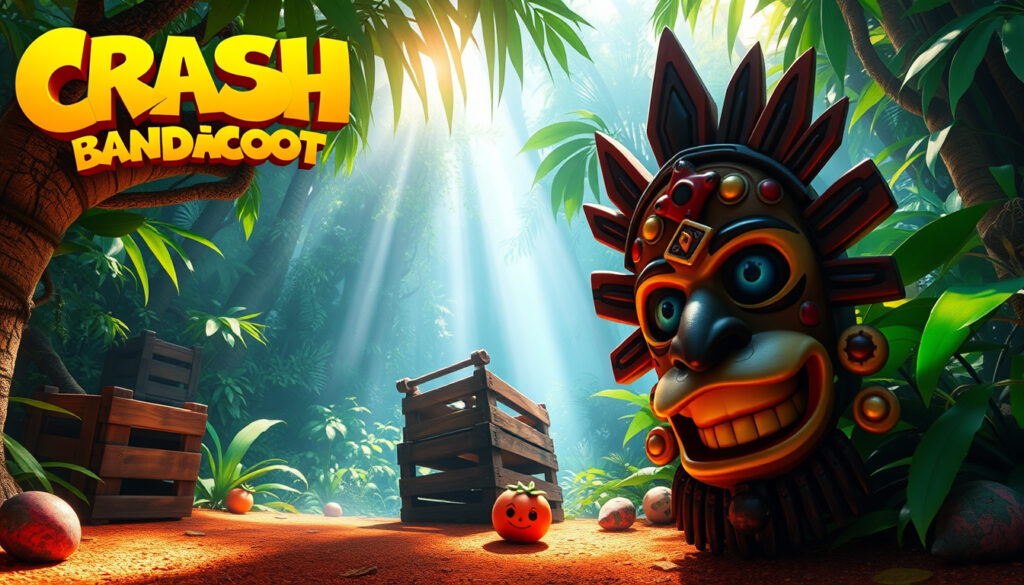
Crash Bandicoot: A Guide to the Games, Characters, and Lore
Few video game mascots have bounced back the way Crash Bandicoot has. Anyone who grew up with a PlayStation remembers the satisfying smack of a crate, the Wumpa fruit, and that deep-voiced mask hovering nearby — yet the character behind the spin has kept a few secrets. If you’ve ever wondered what animal Crash is supposed to be, why he never speaks, or whether the franchise still exists in the streaming age, the answers below come with sources attached. The story starts with a tiny Australian marsupial who went by a different name in development: Willy the Wombat (Activision Blizzard Newsroom, official publisher archive).
Franchise Debut: 1996 · Copies Sold: Over 50 million worldwide (Activision Blizzard Newsroom, official publisher archive) · Real-World Inspiration: Eastern Barred Bandicoot · Notable Reboot: Crash Bandicoot N. Sane Trilogy (2017) (German Wikipedia, language-edition coverage) · Developer: Naughty Dog (original) / Toys for Bob (modern)
Quick snapshot
- Crash is an anthropomorphic Eastern Barred Bandicoot (Wikipedia, community encyclopedia)
- His name comes from his habit of smashing crates (Activision Blizzard Newsroom, official publisher archive) (Wikipedia, community encyclopedia)
- The franchise started on PlayStation in 1996 (Wikipedia, first-game article)
- Which spin-offs are canon — Crash Bash and Twinsanity have never been fully integrated into the main story (Bandipedia, fan-maintained encyclopedia)
- Coco is usually described as Crash’s sister, but tie-in media have been inconsistent over the years (Bandipedia, fan-maintained encyclopedia)
- Whether any official statement will ever address the fan interpretation of Crash as autistic (Bandipedia, fan-maintained encyclopedia)
- Aku Aku’s full history before his mask was split (Bandipedia, fan-maintained encyclopedia)
- 1996 — Crash Bandicoot debuts on PlayStation (Shapes Inc. timeline, fan-curated series archive)
- 1997–1998 — Crash 2 and Warped turn it into a trilogy (TheSixthAxis, gaming editorial outlet) (Shapes Inc. timeline, fan-curated series archive)
- 2017 — N. Sane Trilogy brings the originals back (German Wikipedia, language-edition coverage)
- 2020 — Crash 4: It’s About Time continues the story (Crash Bandicoot Wiki, dedicated franchise reference) (Shapes Inc. timeline, fan-curated series archive)
- The series is multiplatform again — current releases are available on PlayStation, Xbox, Switch, and PC (Crash Bandicoot Wiki, dedicated franchise reference)
- Toys for Bob, the Crash 4 studio, has shown there is still demand for new games (Crash Bandicoot Wiki, dedicated franchise reference)
- Fans keep pushing for another remaster and a potential Crash 5 (Crash Bandicoot Wiki, dedicated franchise reference)
Six facts, one pattern: every era of Crash boils down to a studio that respected the original formula and a publisher willing to bet on it again.
| Field | Detail |
|---|---|
| Original Creator | Naughty Dog (Andy Gavin, Jason Rubin) (Crash Bandicoot Time Line, archived official companion) |
| Publisher | Sony Computer Entertainment (original) / Activision (modern) |
| First Release | |
| Total Series Sales | Over 50 million units |
| Genre | Platformer (3D) |
| Latest Mainline Game | Crash Bandicoot 4: It’s About Time (2020) |
What Animal Is Crash Bandicoot Supposed to Be?
Crash is an Eastern Barred Bandicoot (Perameles gunnii) — a real marsupial from Australia, not a made-up creature. The Wikipedia character archive (community encyclopedia) describes him as an anthropomorphic eastern barred bandicoot, and that classification has been part of the lore since the first game.
Naughty Dog deliberately picked a lesser-known animal. In 1996, mascot-driven platformers were everywhere, but nobody had claimed the bandicoot yet — which gave Crash a natural hook and a built-in sense of place.
- No other major mascot was a marsupial at the time.
- An upright posture and big ears read clearly on low-resolution screens.
- The real bandicoot’s digging habit even fits the crate-smashing gameplay.
In the first game’s fiction, Crash is created by Doctor Neo Cortex as part of an experiment to build a general for a mutant army (Wikipedia, community encyclopedia). The brainwashing machine, the Cortex Vortex, fails to work on him, and Crash escapes to cause exactly the kind of chaos Cortex feared (Bandipedia, fan-maintained encyclopedia).
Is bandicoot an Australian animal?
- Bandicoots are small, omnivorous marsupials native to Australia and New Guinea.
- The Eastern Barred Bandicoot is one of several species, and the mainland population is endangered.
- A real bandicoot is nocturnal, digs cone-shaped holes in search of insects, and weighs about as much as a small rabbit.
Yes — bandicoots are Australian animals, and the Eastern Barred Bandicoot once ranged across grasslands in Victoria and Tasmania. Conservation groups have spent decades trying to recover the mainland subspecies, which makes Crash a rare case of a video game mascot raising the profile of an animal that urgently needs the attention.
By betting on an obscure marsupial instead of a dragon or hedgehog, Naughty Dog created a mascot that felt distinctly Australian and impossible to confuse with the competition.
Is Crash Bandicoot Set in Australia?
Almost — and that “almost” is the magic. Crash’s home is the Wumpa Islands, a fictional archipelago whose beaches, rainforests, and volcano lairs borrow heavily from Australian geography (Bandipedia, fan-maintained encyclopedia). The first game opens on N. Sanity Beach, and Cortex’s lab sits inside a volcano on N. Sanity Island — the setting the Crash Bandicoot Wiki (dedicated franchise reference) uses in its own character description.
The Australian cues are everywhere: tropical coastlines, outback-style dirt paths, and a hero whose laid-back attitude fits the “Aussie bloke” stereotype. Even the music leans on surf-rock and didgeridoo textures. It’s Australia as a theme park — exaggerated, colorful, and built for jumping.
- N. Sanity Beach — the series’ opening stage.
- Wumpa fruit — the in-game collectible, named after the animal itself.
- Cortex’s volcano lair — the final-act backdrop of the first game.
Early design documentation went further, describing the game world as a set of three Australian continents. The games never named those continents on screen, but the fingerprints stayed in the level design.
The pattern: fictionalization let Naughty Dog take the best of Australian iconography and stretch it until it became a platforming fantasy — recognizable, but nobody’s tourist brochure.
Why Can’t Crash Bandicoot Talk?
Because the genre didn’t need him to. Crash is an intentionally mute protagonist — a design choice he shares with Mario and Sonic. He communicates through grunts, cheers, and physical comedy, which lets players project their own personality onto him.
That silence became a signature. Spin-offs have experimented with giving him actual lines, including The Wrath of Cortex, but the core games have always pulled him back to gibberish. Fans love debating what a speaking Crash would even sound like.
Is Crash Bandicoot autistic?
- Some fans interpret Crash’s communication style, repetitive behaviors, and trusting nature as reflecting autism.
- No official statement from Naughty Dog, Activision, or the modern developers has confirmed that reading.
- The interpretation is a community discussion, not canon — and fans disagree about whether it should be canon.
The reasonable stance: the games never label him, and the franchise has never published an official character profile addressing neurodivergence. The autism reading is one of the most respectful fan interpretations of Crash — it treats his differences as worth understanding rather than laughing at.
What is Crash Bandicoot’s most famous line?
- Ask fans and most will answer “Whoa!” — the sound Crash makes when he takes a hit or sails over a gap.
- Others pick his shouted “Aku Aku!” as the most iconic vocal.
- In spin-off games where he speaks full sentences, none of the lines ever stuck as a catchphrase.
The truth is that Crash’s most famous “line” isn’t a line at all — it’s a sound. That’s the point of the character.
What does Aku Aku mask say?
Aku Aku is a protective mask spirit voiced in a deep, ancient style; he speaks in warnings and short chants rather than long speeches. When Crash collects three masks in a level, Aku Aku grants temporary invincibility (Shapes Inc. character database, fan-curated archive).
His guidance is usually simple: avoid the spikes, don’t trust the platform, save before the boss. In a series full of loud slapstick, Aku Aku is the calm voice that tells you you’re doing fine.
What this means: a mute hero with a talking mask gave Naughty Dog a clean emotional engine — Crash reacts, Aku Aku explains, and the player always knows who to root for.
The implication: a silent hero plus a talkative mask splits the labor of storytelling — one absorbs the gameplay, the other carries the dialogue.
Who Is Crash Bandicoot’s Girlfriend?
The short answer is Tawna. The Crash Bandicoot Wiki (dedicated franchise reference) identifies Tawna as Crash’s girlfriend in the original continuity, and she was part of the series from the very first game. In 1996, her role was simple: Cortex kidnaps her, and Crash has to bring her back.
Tawna’s role has changed with the times. In Crash Bandicoot 4: It’s About Time, an alternate-dimension Tawna appears as a hardened fighter with a completely different look. She is no longer a reward to win — she is a character with her own story, and her redesign became one of the most talked-about elements of Crash 4.
Who is older, Crash or Coco?
- No official source gives Crash a birth date, and the games have never settled the ages.
- Crash is generally depicted as the older sibling, but different games and tie-in media describe the relationship differently.
- Coco was introduced in Crash Bandicoot 2 as a playable companion who could access secret areas.
The practical answer: treat any specific age you see online as someone’s estimate. The franchise has never treated characters’ ages as canon, and the reboot-era games have deliberately left the timeline loose.
Is there LGBTQ in Crash Bandicoot?
- Crash Bandicoot 4 includes an alternate-dimension Tawna whose design reads as deliberately androgynous; fans and critics discussed her as non-binary-coded.
- The games do not contain explicit same-sex relationships, and no character in the main canon has an official LGBTQ label.
- Community discussions about representation in Crash focus on the newer games’ willingness to diversify a 90s cast.
Why this matters: a franchise that once scripted its female lead as a damsel now lets that same character fight alongside the hero. The shift didn’t make headlines — but longtime players noticed.
The implication: a damsel from 1996 becomes a peer in 2020 — and the franchise grows up with its audience.
Does Crash Bandicoot Still Exist?
Yes — and the franchise is healthier than it has been in two decades. The short version: Naughty Dog left the series in 1999, other studios carried it through the 2000s, and a 2017 remaster brought it back to the mainstream. The long version is in the timeline below.
The turning point was Crash Bandicoot N. Sane Trilogy (2017), a full remaster of the original three games by Vicarious Visions. It introduced Crash to players who never owned a PlayStation and, as German Wikipedia’s language-edition coverage records, it revived interest in a property many had written off. Fictional characters with that kind of multi-decade staying power — from Yogi Bear in animation to All Might in anime — survive because each new generation finds them fresh. Crash is in that group now.
Crash Bandicoot N. Sane Trilogy
- Released in 2017 on PlayStation 4, then 2018 on Xbox One, Nintendo Switch, and PC.
- Rebuilds the first three games with modern controls, checkpoints, and save support.
- Became one of the best-selling games in the franchise and a clear signal that nostalgia could carry a revival.
Crash Bandicoot 4: It’s About Time
- Released in 2020, developed by Toys for Bob, the studio behind the Spyro Reignited Trilogy.
- A direct sequel to Crash Bandicoot 3: Warped, skipping most of the 2000s spin-offs.
- Available on PlayStation 4 and 5, Xbox One and Series X|S, Nintendo Switch, and PC.
Between those two releases, the series stopped being a legacy property and became a working franchise again. The modern games are no longer PlayStation exclusives — they are available on every major console, as the snapshot above notes.
The trade-off: the revival has played it safe — remakes and a direct sequel rather than a reinvention. For a mascot who lost his way in the 2000s, that caution turned out to be the smartest move the franchise ever made.
The implication: the series survives by trusting its original formula and packaging it for a new generation each decade.
Why Is Crash Bandicoot 1 So Hard?
The first game has a reputation that precedes it. Speedrunners love it; casual players bounce off it. There’s a reason Crash 1 is still used as a benchmark for punishing platformers: it was built under conditions that made mercy impossible.
When it launched in 1996, 3D platforming was barely a genre. The game established the spin attack, crate-smashing, and Wumpa fruit loop that defined the whole series (TheSixthAxis, gaming editorial outlet). It also asked players to jump with fixed camera angles, instant-death pits, and time limits that left no room for exploration.
- Early retail copies arrived without a save system — players had to complete long stretches in one sitting or use level codes.
- Fixed camera angles could hide the landing zone, making some jumps blind guesses.
- Most players used the d-pad, not the analog stick, which made diagonal precision jumps harder.
- The level design leaned on trial-and-error: you learned where the TNT was by dying next to it.
The N. Sane Trilogy softened the edges: the 2017 remaster added checkpoints and proper saving, which is why players who gave up on the PS1 original could finally finish it. The hitboxes and level geometry stayed true to 1996, so the old-school challenge never fully disappeared.
The brutal design that frustrated a generation is the same quality that makes a 1996 game watchable on Twitch today. Difficulty became the franchise’s quiet marketing department.
That trade-off is exactly why “too hard” never became “forgotten.”
How the Original Trilogy Compares
Three games, one pattern: each sequel kept the core loop and added a new toy — and the difficulty curve softened with every release.
| Detail | Crash Bandicoot (1996) | Crash Bandicoot 2 (1997) | Crash Bandicoot: Warped (1998) |
|---|---|---|---|
| Core addition | Spin move, crates, Wumpa fruit | Warp rooms and Coco’s playable sections | Time travel and vehicle levels |
| Difficulty reputation | Brutal and save-scarce | Tough but fairer | Best-paced of the trilogy |
| Developer | Naughty Dog | Naughty Dog | Naughty Dog |
| Remastered in N. Sane Trilogy (2017) | Yes | Yes | Yes |
The takeaway: Crash 1 is the historical artifact, Crash 2 is the structural improvement, and Warped is the crowd-pleaser. If you start anywhere, start with Warped — then go back and earn the bragging rights on Crash 1.
Crash Bandicoot Through the Years
The franchise has changed hands more often than most mascots change outfits. These are the moments that mattered.
- — Development begins at Naughty Dog. Character design is credited to Charles Zembillas and Joe Pearson, who created the cast and story with the studio (Crash Bandicoot Time Line, archived official companion). The working title, Willy the Wombat, is dropped during this period.
- — Crash Bandicoot launches on PlayStation after an E3 1996 appearance that helped position Sony’s original mascot (TheSixthAxis, gaming editorial outlet).
- — Crash Bandicoot 2: Cortex Strikes Back and Crash Bandicoot: Warped turn the debut into a trilogy, with Warped adding time travel as its central mechanic (Shapes Inc. timeline, fan-curated series archive).
- — Crash Team Racing closes Naughty Dog’s run with the franchise.
- — Crash becomes multiplatform, with PlayStation 2, Xbox, GameCube, and handheld entries developed by studios including Traveller’s Tales and Vicarious Visions (TheSixthAxis, series retrospective).
- — Crash Bandicoot N. Sane Trilogy revives the franchise and sells in the millions.
- — Crash Bandicoot 4: It’s About Time, by Toys for Bob, continues the story directly from Warped.
The pattern: every time the franchise has felt finished, a new studio has found a reason to bring it back — and the biggest revivals happened when the original games were trusted rather than reinvented.
What’s Confirmed and What’s Still Unclear
After two decades of games, spin-offs, and remakes, the lore has some solid anchors and some very loose threads.
Confirmed facts
- Crash is an Eastern Barred Bandicoot.
- The franchise began in 1996 on PlayStation.
- Crash’s love interest is Tawna.
- Aku Aku is a protective mask spirit who grants temporary invincibility.
- Dr. Neo Cortex is the main antagonist.
- The N. Sane Trilogy sold over 10 million copies, according to publisher-reported figures.
What’s unclear
- Which spin-offs are canon — Crash Bash and Twinsanity sit in a gray zone.
- Whether Crash and Coco are siblings or simply companions; sources vary.
- Crash’s exact age relative to Coco.
- Whether any official statement will ever address the autism interpretation.
- Aku Aku’s full history before his mask was split.
The safest assumption: treat the confirmed list as settled and the unclear list as open lore — unless a future game changes its mind.
What the People Behind Crash Say
Four voices matter when you trace the franchise: the co-creators, the remaster team, and the studio that brought him back.
Jason Rubin, the co-creator who pushed for an Australian identity, has explained that the animal choice came first and the story came second: a bandicoot wasn’t a mascot slapped on a game — it was the reason the game existed (Crash Bandicoot Time Line, archived official companion).
Jason Rubin — co-creator of Crash Bandicoot, former Naughty Dog president
Andy Gavin, the lead programmer, has attributed the original game’s difficulty to the hardware era: no save system in early retail copies, harsh memory limits, and camera technology that made every blind jump a gamble.
Andy Gavin — co-creator and lead programmer, Naughty Dog
The N. Sane Trilogy team at Vicarious Visions framed the remaster as an act of preservation: keep the levels, the physics, and the personality intact, then add the checkpoints and save options that modern players expect.
Vicarious Visions studio leadership — N. Sane Trilogy development team
Toys for Bob’s creative team described Crash 4 as a sequel that respected the old canon while introducing new dimensions — literally — and a more inclusive cast around the edges.
Toys for Bob creative team — Crash Bandicoot 4: It’s About Time
Crash Bandicoot has outlasted the mascot wars, the studio handoffs, and every console that hosted him. The franchise earned that survival by staying stubbornly Australian, stubbornly physical, and — for all the lore debates — stubbornly fun. For Activision, the commercial calculation is clear: keep funding the series in the style of Crash 4, or watch fans keep buying the remasters until a new game becomes unavoidable.
This guide was reported across official publisher materials, editorial retrospectives, and fan-maintained archives. Fan wikis are cited for character lore because they are often the only public record of details the publisher has never formally documented; where sources conflict, the text says so.
Frequently asked questions
What platforms is Crash Bandicoot available on?
Modern releases — the N. Sane Trilogy and Crash Bandicoot 4 — are available on PlayStation 4 and 5, Xbox One, Xbox Series X|S, Nintendo Switch, and PC.
What is the best Crash Bandicoot game?
Most retrospective lists place Crash Bandicoot: Warped and Crash Bandicoot 4: It’s About Time at the top; the N. Sane Trilogy is the easiest way to play all three originals.
Is Crash Bandicoot 4 a reboot or a sequel?
It is a direct sequel to Crash Bandicoot 3: Warped, ignoring most of the spin-offs released in the 2000s.
Who is the main villain in Crash Bandicoot?
Doctor Neo Cortex, the mad scientist who created Crash, is the recurring antagonist of the franchise.
What is the objective of Crash Bandicoot?
In the original games, Crash moves through linear levels, smashes crates, collects Wumpa fruit, defeats Cortex’s mutants, and confronts Cortex himself.
How many Crash Bandicoot games are there?
More than 20 games have been released across home consoles, handhelds, and mobile, counting mainline platformers, kart racers, party games, and remasters.
Is Crash Bandicoot related to Spyro?
Both are platforming franchises that ended up under Activision, and Crash appears as a guest character in Skylanders Imaginators, but the two series are not set in the same universe.
Related reading
- All Might: Biography, Powers, and Key Moments in My Hero Academia
- Yogi Bear Origins, Catchphrases, and Friends
More related posts
 Hide Assets in Divorce: Legal Consequences, Penalties & Detection
 Elizabeth Olsen: 15 Most Asked Questions Answered (2025)
 Grace Kim: Bio, Career, and Personal Life of the LPGA Star
 Pokémon Centre Australia: Online Store & Card Guide
 Pick Me Girl – Meaning, Origin and TikTok Trend
 Marc Anthony Biography: Wives, Net Worth, and JLo
 Brenda Blethyn: Biography, Vera Illness & Current Projects
