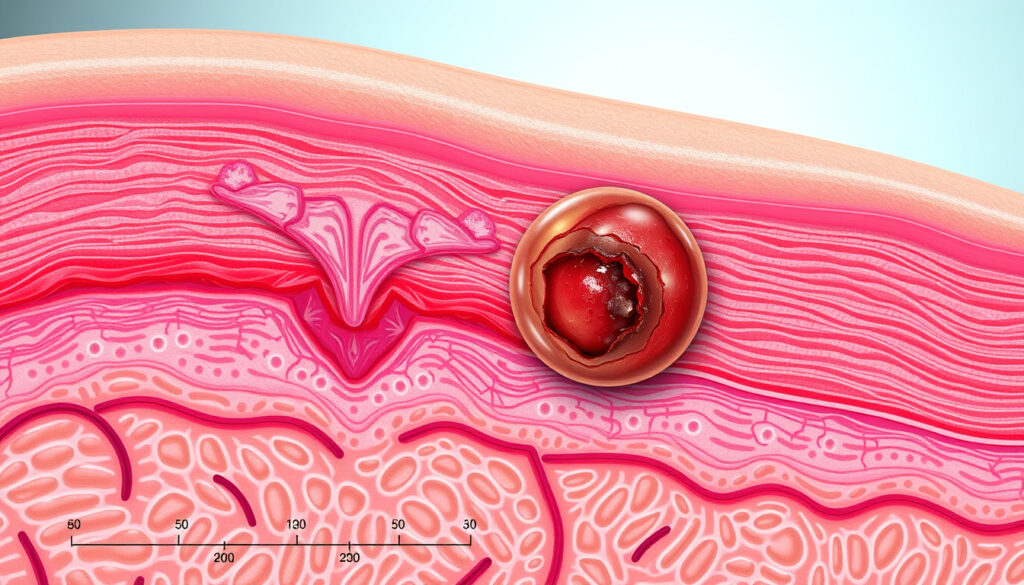
Squamous Cell Carcinoma: Symptoms, Prognosis & Stages
You notice a spot that just won’t go away — maybe it’s rough, maybe it bleeds when you scratch it. That kind of persistence is exactly what makes squamous cell carcinoma (SCC) worth understanding, because when caught early this common skin cancer is highly treatable, but left unchecked it can become dangerous.
Second most common skin cancer: SCC accounts for about 20% of all skin cancers · Annual U.S. cases: Over 1 million new cases diagnosed each year · Common locations: Sun-exposed areas: head, neck, ears, lips, hands · Localized survival rate: 5-year survival exceeds 95% when caught early
Six facts that frame the disease — the first shows how common it is, the last why you should care.
| Fact | Details |
|---|---|
| Type | Keratinocyte carcinoma (nonmelanoma skin cancer) |
| Incidence in U.S. | Over 1 million cases annually |
| Common body sites | Head, neck, ears, lips, hands, arms |
| 5-year survival (localized) | >95% |
| Metastasis rate | Approximately 2–5% |
| Primary cause | Ultraviolet (UV) radiation from sun or tanning beds |
Quick snapshot
- SCC is caused by UV damage to DNA in squamous cells (Mayo Clinic)
- Early detection and treatment dramatically improve prognosis (Moffitt Cancer Center)
- Mohs surgery offers the highest cure rate for high-risk tumors (Skin Cancer Foundation)
- Exact genetic mutations driving individual cases are not fully understood (American Academy of Dermatology)
- Why some SCCs metastasize while others do not remains under investigation (American Academy of Dermatology)
- Optimal follow-up intervals for high-risk patients are not standardized (American Academy of Dermatology)
- The role of diet and nutrition in modifying SCC risk is not well established (American Academy of Dermatology)
Not applicable — SCC develops slowly over months to years; no acute timeline signal
- Greater awareness of early warning signs can reduce advanced diagnoses
- Ongoing research into immunotherapy for high-risk SCC is expanding options
What is the prognosis for squamous cell carcinoma?
Most people diagnosed with SCC have an excellent outlook — provided the cancer is caught before it spreads. The American Academy of Dermatology (AAD) states that SCC in situ is highly treatable because the cancer cells remain in the top skin layer. When the disease is detected at a localized stage, the five-year survival rate exceeds 95%, according to the Moffitt Cancer Center — some estimates put it at 99 percent.
A patient whose SCC has spread to lymph nodes faces a different future: the five-year survival rate drops to less than 50 percent. The gap between those two numbers — 99% vs below 50% — is the strongest argument for early detection.
Localized squamous cell carcinoma survival rate
- Stage 0 and stage I SCCs have survival rates above 95% (Moffitt Cancer Center)
- Stage II includes high-risk features (size >2 cm, depth >2 mm, perineural invasion) but still no nodal spread
- Regular follow-up after treatment is essential to catch recurrence early
Prognosis for metastatic disease
- Once SCC reaches lymph nodes (stage III), the five-year survival drops significantly
- Distant metastasis (stage IV) carries a poor prognosis, though newer immunotherapies are improving outcomes
The trade-off: The earlier the stage at diagnosis, the simpler and more effective the treatment. Delaying evaluation of a suspicious spot can turn a curable lesion into a life-threatening one.
Is squamous cell carcinoma a serious cancer?
Yes — though most SCCs are not life-threatening, the disease can become invasive and disfiguring if left untreated. The Skin Cancer Foundation notes that SCC can grow deep into the skin and spread to other parts of the body. About 2–5% of cases metastasize, and when that happens, the stakes rise sharply.
High-risk features make the difference: tumors larger than 2 cm, deeper than 2 mm, located on the ear or lip, or showing perineural invasion are much more likely to recur or spread. A small spot on the cheek is not the same as a large nodule on the ear.
When SCC becomes dangerous
- Metastasis is rare but can be life-threatening — the five-year survival for metastatic SCC is under 50% (Moffitt Cancer Center)
- Aggressive subtypes (desmoplastic, acantholytic) are more likely to invade nerves and blood vessels
Red flags that indicate aggressive behavior
- Tumor size >2 cm
- Depth >2 mm (measured after biopsy)
- Location on ear, lip, or in a scar
- Rapid growth or bleeding
- Numbness or tingling (nerve involvement)
The pattern: SCC is almost never an emergency — until it is. The key is knowing which features raise the risk and acting before they appear.
What are the symptoms of squamous cell skin cancer?
SCC can show up in several forms, but the common thread is persistence: a spot, sore, or growth that does not heal or resolve on its own. The American Cancer Society lists rough or scaly red patches, raised growths, and open sores as typical signs. The Mayo Clinic adds that SCC may appear as a firm, red nodule or a flat sore with a crusted surface.
Early warning signs of squamous cell carcinoma
- A rough or scaly patch that may crust or bleed
- A firm, dome-shaped growth, sometimes with a central depression
- A sore that repeatedly heals and reopens
- A wart-like lesion that grows or changes shape
Common visual characteristics
- Often located on sun-exposed areas: face, ears, lips, scalp, hands, forearms (Skin Cancer Foundation)
- Color ranges from pink or red to brown or darker shades in people with darker skin
- May be tender to the touch
What this means: If you have a spot that has been there for more than a few weeks and is not healing, it deserves a professional look — even if it is painless.
What stage of cancer is squamous cell carcinoma?
Like most cancers, SCC is assigned a stage from 0 to IV based on how far it has spread. Staging guides both treatment and prognosis. The Moffitt Cancer Center explains the system clearly: stage 0 means the cancer is still confined to the top layer of skin (epidermis); stage I means it has invaded deeper layers but not lymph nodes; stage II includes high-risk features without nodal spread; stage III involves regional lymph nodes; stage IV means distant metastasis.
Staging system for cutaneous SCC
- Stage 0 (in situ): Cells look abnormal but have not penetrated below the epidermis
- Stage I: Tumor ≤2 cm, no high-risk features, no nodal spread
- Stage II: Tumor >2 cm or with ≥2 high-risk features, still node-negative
- Stage III: Spread to regional lymph nodes
- Stage IV: Distant metastasis (e.g., lungs, liver, bone)
TNM classification and clinical significance
- T (tumor) describes size and extent of invasion
- N (nodes) indicates lymph node involvement
- M (metastasis) records whether the cancer has spread beyond the region
The implication: Most SCCs are diagnosed at stage 0 or I, which is why overall survival is so high. Patients should ask their dermatologist for the exact stage after biopsy — it shapes everything from the need for imaging to follow-up frequency.
What is the most common spot for squamous cell carcinoma?
The Skin Cancer Foundation reports that SCC most often appears on skin that gets the most sun: the face, lips, ears, scalp, shoulders, neck, backs of the hands, and forearms. This is because cumulative UV exposure drives the DNA damage that starts the cancer.
Sun-exposed areas most at risk
- Head and neck (especially the nose, forehead, and ears) — the most common region
- Lips (lower lip more than upper) — a frequent site in outdoors workers
- Arms and hands — constant sun exposure over a lifetime
- Scalp in balding men
Less common locations
- Genitalia and perianal area (often linked to HPV)
- Lower legs in women
- Inside the mouth (oral SCC) — a different entity with higher risk
- Chronic wounds, scars, or areas of inflammation (like burn scars)
Why this matters: A person who works indoors may still develop SCC on the face from incidental sun exposure during commutes and errands. Sunscreen on the face and hands every day — not just at the beach — is a simple preventive step.
What’s confirmed and what’s still unclear
Confirmed facts
- SCC is caused by UV damage to DNA in squamous cells (Mayo Clinic)
- Early detection and treatment dramatically improve prognosis (Moffitt Cancer Center)
- Mohs surgery offers the highest cure rate for high-risk tumors (Skin Cancer Foundation)
- SCC in situ is highly treatable (American Academy of Dermatology)
What’s unclear
- Exact genetic mutations driving individual cases are not fully understood
- Why some SCCs metastasize while others do not remains an area of active investigation
- Optimal follow-up intervals for patients with high-risk SCC are not standardized
- The role of diet and nutrition in modifying SCC risk or progression is not well established
Until researchers pin down the biology of metastasis, the safest approach for patients is aggressive monitoring. A second opinion with a dermatologist who specializes in skin cancer can make a real difference when the pathology report shows high-risk features.
Expert perspectives on squamous cell carcinoma
Squamous cell carcinoma of the skin is a type of cancer that starts as a growth of cells on the skin.
— Mayo Clinic (source)
Squamous cell carcinoma (SCC) of the skin is the second most common form of skin cancer.
— Skin Cancer Foundation (source)
SCC can appear as a firm, red nodule or a flat, scaly patch that may bleed.
— American Academy of Dermatology (source)
Each of these authorities reinforces the same central message: SCC is common, visible, and treatable — but only if you know what to look for and act quickly.
Summary
The gap between a 99% survival rate for early SCC and a sub-50% survival after metastasis is not a statistic — it is a warning. For anyone with a persistent spot on sun-exposed skin, the choice is clear: get it checked now, or risk a far more aggressive treatment later. Dermatologists see these cases every week; a five-minute exam could change the trajectory of your health.
Related reading: Marfan Syndrome Symptoms – Recognize Signs Early
medicalnewstoday.com, barederm.com, premiersurgicalnetwork.com
Frequently asked questions
Can squamous cell carcinoma be cured?
Yes — when detected early, SCC is highly curable. Surgical removal, Mohs surgery, or other treatments have success rates above 95% for localized disease. Even advanced cases can often be managed with radiation or immunotherapy.
How is squamous cell carcinoma diagnosed?
A dermatologist will examine the suspicious area and usually perform a skin biopsy (shave, punch, or excision). The tissue is sent to a pathologist to confirm the presence of SCC and determine its stage and risk features.
What is the difference between squamous cell carcinoma and basal cell carcinoma?
SCC arises from squamous cells (upper epidermis), while basal cell carcinoma (BCC) arises from basal cells deeper in the epidermis. SCC is more likely to spread than BCC, but BCC is more common. Both are linked to UV exposure.
Is squamous cell carcinoma contagious?
No — SCC is a form of cancer caused by DNA damage in the patient’s own cells. It cannot be passed to another person through touch, air, or any other means.
Does squamous cell carcinoma always require surgery?
Most SCCs are treated surgically (excision or Mohs surgery). For very early lesions, options like cryotherapy (freezing), topical chemotherapy (5-FU cream), or photodynamic therapy may be appropriate. Advanced cases may need radiation or systemic therapy.
How often should I get a skin check after SCC treatment?
Your dermatologist will recommend a schedule based on the risk of your original tumor. Typically, patients with a history of SCC should have a full-body skin exam every 6 to 12 months — more often if high-risk features were present.
Can squamous cell carcinoma come back after removal?
Yes — recurrence is possible, especially if the margins were not clear or if the tumor had high-risk features. Regular follow-up and self-examination are crucial to catch any recurrence early.
More related posts
 Brian Johnson: AC/DC Singer vs Bryan Johnson Longevity
 Dustin Martin’s Retirement, Net Worth & Father’s Deportation
 Cricket Live Score: Ball-by-Ball Updates & Best Sites 2026
 Bonnie Blue: Bali Deportation and Record Claim Facts
 SCO vs REN: Latest Head-to-Head, Live Score & Stats (2026)
 Jane Lynch: Biography, Family, Career, and FAQs (2024)
 Chris Hemsworth: Wives, Height, Net Worth, Father & Health
 Robbie Graham-Kuntz: Age, Height, and Relationship Status
