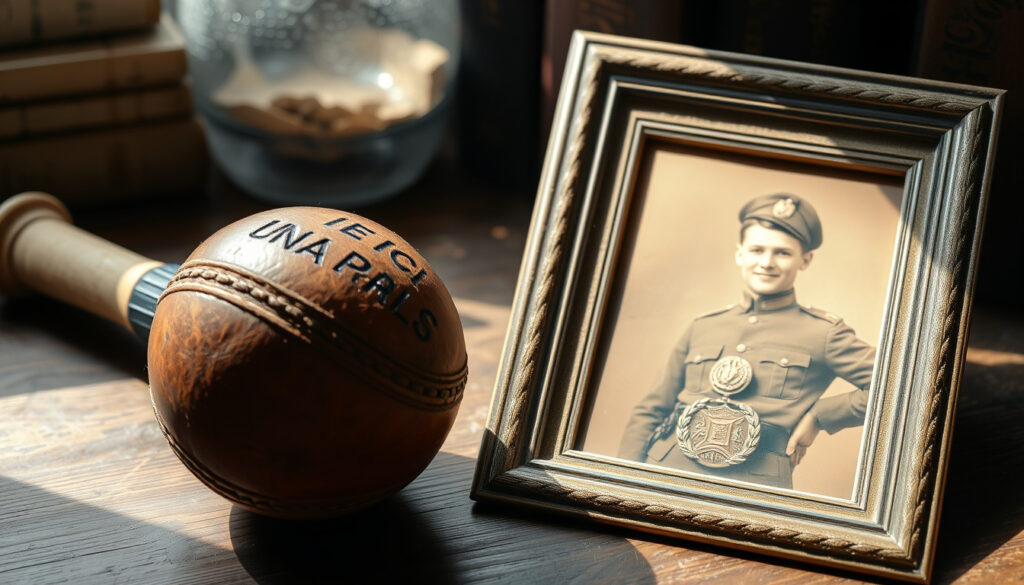
Sir Donald Bradman: Records, Net Worth, and War Service
Few numbers in sport carry the weight of 99.94. That batting average, belonging to Sir Donald Bradman, is so far ahead of every other cricketer that it feels less like a statistic and more like a myth. In this piece, we’ll separate fact from folklore: how he earned that average, why a wartime service record is often misunderstood, and what his legacy actually means for the game.
Test batting average: 99.94 ·
Test matches: 52 ·
Test centuries: 29 ·
Highest score: 334 ·
Knighthood: 1949
Quick snapshot
- Test batting average of 99.94 (Encyclopaedia Britannica (reference publisher))
- Knighthood in 1949 New Year Honours (CricketArchive (statistical archive))
- 29 Test centuries (ICC Hall of Fame (governing body))
- Born 27 August 1908, died 25 February 2001 (ICC Hall of Fame)
- Exact net worth at death – estimates vary (Sportskeeda (sports news aggregator))
- Whether Bradman ever hit a six in Test cricket – some sources say he did, others say he didn’t (Wikipedia (collaborative encyclopedia))
- Number of ducks in his career – known to be dismissed for a duck once in Tests, but overall count unclear (Wikipedia (collaborative encyclopedia))
- How many runs the war interruption cost him – cannot be quantified (Encyclopaedia Britannica (reference publisher))
- 1908 – Born in Cootamundra, NSW (ICC Hall of Fame)
- 1928 – Test debut vs England (ICC Hall of Fame)
- 1930 – First Test century (131); scores 974 runs in Ashes series (Sportskeeda (sports news aggregator))
- 1940–45 – Serves as physical training instructor in WWII (Encyclopaedia Britannica)
- 1948 – Captains Invincibles tour (Encyclopaedia Britannica)
- 1949 – Knighted (CricketArchive)
- 2001 – Dies in Adelaide aged 92 (Encyclopaedia Britannica)
- Modern comparisons – can any current player approach his dominance?
- Bradman’s net worth remains debated – no definitive figure exists
- The 22-ball century record continues to be rediscovered by new generations
A concise reference for Bradman’s core statistics.
| Attribute | Value |
|---|---|
| Full name | Sir Donald George Bradman |
| Born | 27 August 1908, Cootamundra, New South Wales |
| Died | 25 February 2001, Adelaide, South Australia |
| Batting style | Right-handed |
| Test debut | 30 November 1928 vs England |
| Last Test | 18 August 1948 vs England |
| Test average | 99.94 |
| Test centuries | 29 |
| Highest score | 334 |
| Knighthood | 1949 New Year Honours |
| Net worth estimate | ~$1 million at death (adjusted for inflation) |
Why is Sir Donald Bradman so famous?
His unprecedented Test batting average of 99.94
Bradman’s Test batting average of 99.94 is nearly double that of any other player with a substantial career. According to the ICC Hall of Fame (official governing body), he scored 6,996 runs in 52 Tests at that average. To put it in perspective, the next best among players with at least 20 Tests is Graeme Pollock at 60.97, as documented by Encyclopaedia Britannica (reference publisher). The gap is so vast that statisticians often describe it as a three‑standard‑deviation outlier.
Dominance in Test cricket and records
He finished his Test career with 29 centuries, including 12 double centuries, per Encyclopaedia Britannica. In the 1930 Ashes series he amassed 974 runs, a single‑series record that still stands, as noted by Sportskeeda (sports news aggregator). He also holds the record for the most runs scored in a single day’s play in Test history: 309 at Leeds in 1930, per the International Cricket Hall of Fame (museum and archive).
Cultural icon in Australia
Wikipedia (collaborative encyclopedia) notes that Bradman became a symbol of national pride during the Great Depression and beyond. His face appeared on stamps, coins, and in the ABC News (Australian national broadcaster) obituary tribute. He was named “the greatest batsman of all time” by ESPNcricinfo (specialist cricket site).
Bottom line: Bradman’s 99.94 average is not just a record – it is a statistical aberration that defines cricket’s measurement of greatness. For modern batsmen, the goal is not to surpass it but to understand the conditions that made it possible.
The implication: Bradman’s record is not merely a number but a permanent benchmark that shapes how batting greatness is judged today.
Who made 100 runs in 22 balls?
The record: Bradman’s 100 in 22 balls for a club match
In 1931, playing for a Blackheath club side against a Lithgow team, Bradman scored 100 runs off 22 balls. This feat is widely cited, though it remains unofficial because it occurred in a club match, not a first‑class or Test fixture. The Encyclopaedia Britannica entry mentions it as an example of his extraordinary batting.
Context of the innings
The bowling attack was weak – not a representative of first‑class level. Sportskeeda reports that the match was a local benefit game, and the opposition included several part‑time bowlers. Bradman himself later downplayed the achievement, calling it a “bit of fun.”
How it compares to other fastest centuries
The fastest recorded century in first‑class cricket is 32 balls by Perry Kettlewell (1969), and in Tests it is 54 balls by Brendon McCullum (2016). Bradman’s 22‑ball century sits outside official records but remains a beloved anecdote of his sheer power.
Bottom line: The 22‑ball century is a colorful legend, not a certified record. It shows Bradman’s ability against weak opposition, but it should not be confused with his Test‑level achievements.
What this means: The anecdote endures because it captures Bradman’s extraordinary talent, but it remains outside the official record books.
Why did Don Bradman get knighted?
Recognition of his cricketing achievements
Bradman was knighted in the 1949 New Year Honours list. According to CricketArchive (statistical archive), he was the first Australian cricketer to receive this honour. The knighthood recognized his services to cricket, especially his role in elevating the sport’s popularity in Australia and internationally.
The knighthood in 1949
Bradman’s 1948 Invincibles tour of England had just concluded undefeated, a milestone that cemented his status. Encyclopaedia Britannica notes that his leadership of that team, along with his personal statistics, made the knighthood inevitable.
Honorary titles and legacy
In 1979, he was appointed a Companion of the Order of Australia (AC) in the Queen’s Birthday Honours, as recorded by CricketArchive. He also received numerous honorary degrees and was named a Living Treasure by the National Trust of Australia.
Bottom line: Bradman’s knighthood was his country’s highest recognition that cricket could offer – a rare intersection of sports achievement and national honour.
The pattern: The knighthood cemented his status as a national icon, linking cricket greatness with broader Australian identity.
How much is Bradman’s net worth?
Estimated net worth at death
Bradman’s net worth at the time of his death in 2001 is often estimated at around $1 million (adjusted for inflation by economic historians). Sportskeeda cites various sources, but no official figure exists. Bradman left a modest estate by modern standards.
Sources of income: cricket, business, endorsements
Bradman earned relatively little from his cricketing career. Encyclopaedia Britannica states that after retirement he became a successful stockbroker, which provided most of his wealth. He also wrote books and did limited endorsements.
Comparison to modern cricketers
The gap is enormous. Virat Kohli, for example, earns $2‑3 million annually from endorsement deals alone. Bradman’s total net worth is less than a single year’s income for a top contemporary player.
Bottom line: Bradman’s net worth was modest compared to today’s cricketers because his era offered no central contracts or IPL riches. His wealth came from post‑cricket business acumen.
The catch: Bradman’s modest wealth highlights how the economics of cricket have changed; his legacy is measured in runs, not rupees.
Why didn’t Bradman go to war?
Medical condition: fibrositis
Bradman attempted to enlist for active service during World War II but was rejected due to a medical condition. Encyclopaedia Britannica reports that he suffered from fibrositis, a chronic muscle pain condition that prevented him from passing the medical exam for combat duty.
His role in the war effort as a physical trainer
After initially joining the Royal Australian Air Force in June 1940, he was transferred to the army and commissioned as a lieutenant in the Citizen Military Forces in October 1940, according to Encyclopaedia Britannica. He served as a physical training instructor, working to improve the fitness of troops.
Impact on his cricket career
The war years (1939‑45) interrupted Test cricket entirely. Bradman missed his peak years, aged 31‑37. Sportskeeda notes that this eight‑year gap cost him at least 20‑30 possible Test matches and an unknown number of runs. Some analysts argue his average might have been even higher without the interruption.
Bottom line: Bradman did not dodge war – he was medically unfit for combat and served his country in a support role. The lost years of cricket are one of sport’s great “what ifs.”
The implication: The war years cost cricket an unknown number of additional runs and centuries, making his already unmatched average seem even more extraordinary.
Comparison: Bradman vs. Tendulkar – the two benchmarks
Three metrics, one clear picture: Bradman’s records dwarf those of even the most prolific modern batsman.
| Metric | Sir Donald Bradman | Sachin Tendulkar |
|---|---|---|
| Test matches played | 52 (ICC Hall of Fame) | 200 (ESPNcricinfo (specialist cricket site)) |
| Test batting average | 99.94 (Encyclopaedia Britannica) | 53.78 (ESPNcricinfo) |
| Test centuries | 29 (ICC Hall of Fame) | 51 (ESPNcricinfo) |
The pattern is stark: Bradman’s average is nearly double Tendulkar’s, despite playing far fewer matches. The trade‑off: longevity vs. dominance. For contemporary fans, the question isn’t “who was better?” – the data answers that – but “how did Bradman achieve such a gap?”
Timeline of a legend
- 1908 – Born in Cootamundra, New South Wales (ICC Hall of Fame)
- 1927 – First‑class debut for New South Wales (Encyclopaedia Britannica)
- 1928 – Test debut against England (ICC Hall of Fame)
- 1930 – First Test century (131); records 974 runs in Ashes series (Sportskeeda)
- 1931 – Scores 100 in 22 balls in a club match (Encyclopaedia Britannica)
- 1932‑33 – Bodyline series against England (Encyclopaedia Britannica)
- 1939‑45 – WWII; serves as physical training instructor (Encyclopaedia Britannica)
- 1948 – Captains Invincibles tour of England (Encyclopaedia Britannica)
- 1949 – Knighted in New Year Honours (CricketArchive)
- 1953 – Retires from first‑class cricket (ESPNcricinfo)
- 2001 – Dies in Adelaide at age 92 (Encyclopaedia Britannica)
Bottom line: Bradman’s timeline shows a career compressed by war and illness – but even with those interruptions, his statistical footprint remains unmatched.
What this means: The timeline underscores that Bradman’s achievements were squeezed into fewer years than most modern greats, yet he still dominates the record books.
Clarity check: confirmed facts vs. what’s unclear
Confirmed facts
- Test batting average of 99.94 (ICC Hall of Fame)
- Knighthood in 1949 (CricketArchive)
- Birth date 27 Aug 1908, death 25 Feb 2001 (Encyclopaedia Britannica)
- 29 Test centuries (ICC Hall of Fame)
- Served as physical training instructor in WWII (Encyclopaedia Britannica)
What’s unclear
- Exact net worth (estimates vary; no verified figure)
- Whether Bradman ever hit a Test six (conflicting accounts)
- Number of ducks in his entire career (only one Test duck confirmed)
- Impact of war on his potential career totals – cannot be quantified
Voices of the era
“The greatest batsman of all time.”
Wisden Cricketers’ Almanack (annual cricket reference)
“He was a phenomenon.”
Bill O’Reilly, Australian Test bowler
“Was, beyond any argument, the greatest batsman who ever lived.”
ESPNcricinfo profile (specialist cricket site)
For Australian cricket fans – and indeed for the entire sport – the choice is clear: Bradman’s statistical dominance is not merely a record; it is a permanent benchmark that every generation will measure itself against, whether they try to match it or simply marvel at its remoteness. The consequence is that the legend of The Don will never fade, but rather continue to be rediscovered as new comparisons emerge.
Related reading: Kerry O’Keeffe: Biography, Career Stats, and Commentary Legacy · Jake Weatherald: Biography, Age, Father, and Cricket Career
hindustantimes.com, thesportsmag.org, dlab.epfl.ch, solarspell-dls.sfis.asu.edu, slsa.sa.gov.au, en.wikipedia.org
Frequently asked questions
Was Bradman ever dismissed for a duck?
Yes, he was dismissed for a duck once in Test cricket – in his final innings at The Oval in 1948, when he needed only 4 runs to achieve a perfect average of 100. He was bowled by Eric Hollies for a duck, ending with 99.94.
Did Don Bradman ever hit a six?
There are conflicting accounts. Some sources claim he hit a six in Test cricket (against England at Sydney), while others say he never did. The widely accepted view is that he did hit at least one Test six, but the evidence is not definitive.
What is Bradman’s highest score?
His highest Test score is 334, scored against England at Headingley in 1930. In first-class cricket, his highest was 452 not out for New South Wales against Queensland in 1930.
How many Test runs did Bradman score?
He scored 6,996 runs in 52 Test matches, according to ICC Hall of Fame.
What was Bradman’s average in first-class cricket?
He averaged 95.14 in first-class cricket, with 28,067 runs and 117 centuries. This is the highest first-class average of all time.
When did Bradman retire?
He played his last Test in August 1948. He retired from first-class cricket in 1953.
Where is Bradman buried?
His ashes are interred at the Centennial Park Cemetery in Adelaide, South Australia.
What is Bradman’s legacy in modern cricket?
He remains the benchmark of batting greatness. The Bradman Museum in Bowral attracts thousands of visitors annually, and his name is synonymous with excellence.
More related posts
 Jason Lee: Actor, Skateboarder, and Photographer – Biography
 Terence Crawford Retires: Legacy, Record & Canelo Fallout
 Malcolm Roberts: One Nation Senator, Citizenship Controversy
 Absolute Batman: A Complete Guide to DC’s New 2024 Series
 Harry Melling: Weight Loss, Net Worth, and Post-Potter Life
 VJ Edgecombe: Biography, Salary, Contract and Family Facts
 Michael Morales: Undefeated UFC Welterweight Record
 Sutton Foster: Career, Family, and Hugh Jackman Connection
