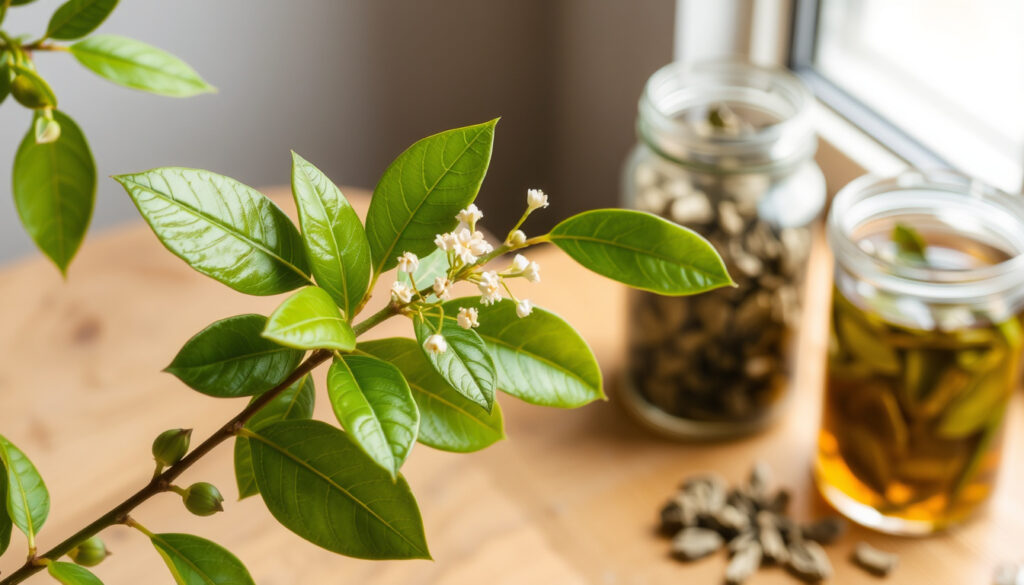
Lemon Myrtle: Uses, Benefits, and How to Grow
Few herbs deliver the instant sensory hit of lemon myrtle. Its leaves pack a citral concentration that rivals lemon itself — and that’s just the beginning. This Australian native has quietly moved from rainforest understory to kitchens and labs, where it’s earning a reputation as both a culinary standout and a scientifically studied antimicrobial agent.
Botanical name: Backhousia citriodora ·
Family: Myrtaceae ·
Key chemical compound: Citral (90–98%) ·
Antimicrobial activity: Effective against Staphylococcus aureus, Escherichia coli, Pseudomonas aeruginosa ·
Native region: Queensland, Australia
Quick snapshot
- Botanical classification: Myrtaceae family (PMC review in the International Journal of Molecular Sciences)
- Citral content: 90–98% of essential oil (Journal of Agricultural and Food Chemistry)
- Antimicrobial activity confirmed by peer-reviewed studies (PMC review)
- Exact lifespan under home garden conditions — anecdotal reports of 50+ years, but no controlled studies (Bunnings Australia gardening guide)
- Precise nutritional profile — limited published data on vitamins and minerals (Southern Monitor)
- No significant timeline events reported for lemon myrtle cultivation — crop cycle is steady, harvest year-round in warm climates (Warndu native food guide)
- Further research into food preservation applications and clinical trials for antimicrobial use (PMC review)
- Expansion of commercial cultivation outside Australia, especially in subtropical regions (Bunnings Australia)
Here is a quick reference of lemon myrtle’s key identifiers.
| Scientific name | Backhousia citriodora |
| Common names | Lemon myrtle, lemon scented myrtle, lemon ironwood |
| Native to | Queensland, Australia |
| Height (wild) | Up to 20 m |
| Height (cultivated) | 3–8 m |
| Key chemical | Citral (90–98%) |
| Antimicrobial spectrum | Staphylococcus aureus, E. coli, Pseudomonas aeruginosa |
What is the lemon myrtle used for?
Lemon myrtle leaves and powder find their way into everything from teas and baked goods to sauces, dressings, and ice cream. The leaves are intensely aromatic, which is why they’re often used in small quantities to brighten a dish. Coast Pulse notes the herb’s versatility in both sweet and savory cooking. According to Bunnings Australia, the leaves can be crushed for cooking oil, brewed into tea, or used with grilled meats and vegetables.
What does a lemon myrtle taste like?
Its flavor is described as a tangy lemon with subtle eucalyptus undertones — sharper than lemongrass but more rounded than lemon zest. The Southern Monitor guide notes that the intensity means a little goes a long way, especially in baking.
Can you eat lemon myrtle?
Yes, all parts of the plant are edible, though the leaves are the most commonly used part. Fresh leaves can be stuffed into fish or poultry before baking, while ground leaves (powder) work in shortbread biscuits, sauces, desserts, and even liqueur, according to the Southern Monitor.
Lemon myrtle’s intense flavor fades with prolonged cooking. Home cooks should add the leaves toward the end of preparation to retain that bright citrus punch. As Southern Monitor advises, timing matters.
What this means: for anyone swapping lemon myrtle into a recipe, treat it as a finishing herb rather than a simmering staple. The payoff is a cleaner, more vibrant citrus note.
Where is the best place to plant a lemon myrtle tree?
Lemon myrtle thrives in a warm, sheltered position with full sun to partial shade. Bunnings Australia recommends well-drained, fertile soil and regular watering while the plant establishes. The Warndu growing guide adds that it’s suitable for subtropical or warm climates and prefers full sun for best leaf production.
How big does lemon myrtle grow?
In the wild, it can reach up to 20 m, but in gardens it typically stays between 3–8 m. Regular pruning after flowering helps maintain a manageable shape, per Bunnings Australia.
Does lemon myrtle grow in pots?
Yes, it can be grown in large pots with adequate drainage. A container at least 40–50 cm in diameter is recommended, using a quality potting mix. The Warndu guide notes that potted plants may need more frequent watering and a light feed during the growing season.
What is the lifespan of a lemon myrtle tree?
Under optimal conditions, anecdotal reports suggest a lifespan of 50 years or more. No controlled studies exist, but the Bunnings Australia guide implies that with proper care, a home garden tree can be a long-term feature.
How to plant lemon myrtle — step by step
- Choose a location: Full sun to partial shade, sheltered from strong winds. Bunnings Australia recommends a warm, sheltered spot.
- Prepare the soil: Well-drained, fertile soil. Mix in organic matter if needed. Warndu suggests testing drainage — the plant hates wet feet.
- Plant the tree: Dig a hole twice the width of the pot, place the tree at the same depth it was in the container, and backfill. Water in well.
- Water regularly: Keep soil moist during the first year. Established trees are moderately drought-tolerant, but Bunnings Australia advises regular watering in dry spells.
- Prune after flowering: Light pruning maintains shape and encourages bushier growth. Bunnings Australia notes this is best done after flowering.
- Fertilise: Apply a native plant fertilizer in spring and autumn. Warndu recommends a low-phosphorus feed.
Lemon myrtle is a rainforest tree — it’s not frost-hardy. Gardeners in temperate climates should grow it in a large pot that can be moved indoors during winter, or in a sheltered microclimate. Bunnings Australia warns that cold damage can stunt growth significantly.
The pattern: lemon myrtle rewards patience and warmth. A well-sited, well-watered tree will outlast many garden perennials, but neglect in the first year is the fastest way to lose it.
What are the health benefits of lemon myrtle?
The most compelling evidence for lemon myrtle lies in its antimicrobial activity. A 2021 review in the International Journal of Molecular Sciences highlights the oil’s efficacy against Staphylococcus aureus, Escherichia coli, and Pseudomonas aeruginosa, positioning it as a potential natural food preservative and surface disinfectant. A 2003 study in the Journal of Agricultural and Food Chemistry confirmed both antibacterial and antifungal activity. Research from Griffith University also found that methanolic extracts showed inhibitory bioactivity against a panel of bacteria, supporting traditional Australian Aboriginal antiseptic use.
The main active compound is citral, comprising 90–98% of the essential oil. In traditional medicine, lemon myrtle has been used for respiratory and digestive issues, though clinical evidence for these uses remains limited. The Southern Monitor notes that the plant is generally well-tolerated, but no large-scale human trials exist outside of in vitro studies.
For food manufacturers and home cooks, lemon myrtle offers a natural antimicrobial edge that synthetic preservatives can’t match in terms of clean label appeal. But for anyone expecting a medicinal cure-all, the evidence is still in the lab, not the clinic. The PMC review makes clear: the antimicrobial data is strong, but human health claims need more research.
Why this matters: the gap between lab-tested antimicrobial activity and proven human health benefits is wide. Consumers should enjoy lemon myrtle for its flavor and aroma, but not mistake it for a medicine.
How to make lemon myrtle tea?
Making lemon myrtle tea is straightforward. Use fresh or dried leaves: steep 1–2 teaspoons of crushed leaves or a small handful of fresh leaves in hot water (not boiling) for 5–10 minutes. The Bunnings Australia guide suggests a shorter steep for a lighter flavor. The result is a bright, citrusy infusion with a hint of eucalyptus.
How to use lemon myrtle powder?
Lemon myrtle powder is simply ground dried leaves. It can be added directly to hot water for an instant tea, or blended with other teas for a custom mix. The Warndu guide recommends starting with a quarter teaspoon per cup and adjusting to taste. The powder is also a convenient way to add lemon myrtle flavor to baked goods, smoothies, and dressings without the texture of whole leaves.
Step-by-step: lemon myrtle tea
- Gather leaves: Pick a few fresh leaves or measure 1–2 tsp of dried leaves. Bunnings Australia recommends using fresh leaves from your own tree for the best flavor.
- Crush or tear: Bruise the leaves to release the oils. This intensifies the aroma.
- Heat water: Bring water to 90°C (just off the boil). Boiling water can make the tea bitter.
- Steep: Pour water over the leaves and steep for 5–10 minutes. Southern Monitor suggests a shorter steep for a milder brew.
- Strain and serve: Remove leaves or strain the powder. Add honey or lemon if desired, though the tea is already intensely citrusy.
- Store leftovers: Keep dried leaves or powder in an airtight container away from light. Warndu advises storing in a cool, dark place.
The takeaway: lemon myrtle tea is a caffeine-free alternative to traditional herbal teas, with a unique flavor profile that stands out. A small investment in leaves or powder pays off in versatility.
Where to buy lemon myrtle?
Lemon myrtle products are widely available online from Australian native food suppliers. Dried leaves, powder, and essential oil are the most common forms. Some Australian supermarkets such as Bunnings Australia (which also sells the plant) stock lemon myrtle products. Warndu and other specialist native food retailers offer organic options. For international buyers, online marketplaces like Amazon and specialty stores often carry it, but always check for Australian origin to ensure quality.
The bottom line: availability is better than ever, but quality varies. Stick with reputable Australian suppliers for the highest citral content and freshest product.
Confirmed facts vs. what’s unclear
Confirmed facts
- Botanical classification: Myrtaceae family (PMC review)
- Citral content: 90–98% of essential oil (Journal of Agricultural and Food Chemistry)
- Antimicrobial activity against S. aureus, E. coli, P. aeruginosa (Journal of Agricultural and Food Chemistry)
- Edible leaves used in cooking and tea (Bunnings Australia)
What’s unclear
- Exact lifespan in home gardens — anecdotal reports only (Bunnings Australia)
- Precise nutritional profile — limited published data (Southern Monitor)
- Clinical evidence for respiratory/digestive health benefits — traditional use only (PMC review)
- Optimal growing conditions outside subtropical Australia — limited testing (Warndu)
- Optimal harvest timing for essential oil yield — not well documented
What experts say
“Lemon myrtle oil’s antimicrobial activity is unrivalled among Australian native plants.”
— Ian Southwell, author of the PMC review on Backhousia citriodora (International Journal of Molecular Sciences)
“Backhousia citriodora is a flowering tree in the Myrtaceae family, native to Queensland, Australia.”
— Wikipedia (Wikipedia — Backhousia citriodora)
The evidence is clear: lemon myrtle is a legitimate antimicrobial powerhouse with a place in the kitchen, but its health claims are still in the lab. For Australian growers and home cooks, the tree offers a low-maintenance, high-yield herb that can transform a dish or a cup of tea. For anyone else, the challenge is sourcing quality product and understanding that this is a flavor enhancer, not a substitute for medicine. The bottom line: Australian growers and home cooks will get the most out of lemon myrtle by treating it as a finishing herb and sourcing quality product — otherwise, its unique citrus punch will be lost.
sciencedirect.com, research-repository.griffith.edu.au, leafyheaven.com, bunnings.com.au, bindy.com.au
Frequently asked questions
Is lemon myrtle safe for pets?
There is very little published data on lemon myrtle toxicity in pets. The essential oil contains high levels of citral, which can be irritating to dogs and cats in concentrated form. It’s best to avoid giving pets lemon myrtle tea or leaves, and to keep essential oil out of reach. Consult a veterinarian for specific concerns.
Can lemon myrtle be used in savory dishes?
Absolutely. It works well with grilled meats, fish, vegetables, and in marinades and dressings. Bunnings Australia suggests using it with chicken and seafood. The leaves can also be stuffed into poultry before roasting.
How to store lemon myrtle leaves?
Fresh leaves can be refrigerated in a sealed bag for up to a week. For longer storage, dry them in a cool, dark place and store in an airtight container away from light. The Warndu guide recommends drying at low temperature to preserve flavor.
What is the difference between lemon myrtle and lemongrass?
Lemon myrtle (Backhousia citriodora) is a tree with leaves, while lemongrass (Cymbopogon citratus) is a grass. Lemon myrtle has a stronger, more complex citrus flavor with eucalyptus notes, and its citral content can be double that of lemongrass. Southern Monitor notes that lemon myrtle is more potent, so use less.
Does lemon myrtle contain caffeine?
No, lemon myrtle is naturally caffeine-free. It’s a popular herbal tea base for that reason.
Can lemon myrtle help with colds?
Traditional use suggests it may help with respiratory issues, but no clinical studies confirm this. The antimicrobial activity of the oil is well-documented, but that doesn’t directly translate to cold relief. The PMC review notes that more research is needed.
How to propagate lemon myrtle?
Propagation can be done from seeds or cuttings. Seeds should be soaked overnight and sown about 1 cm deep, according to the Warndu guide. Cuttings from semi-hardwood stems taken in spring or early summer have a higher success rate. Keep the medium moist and warm.
Are there any drug interactions with lemon myrtle?
No documented drug interactions are known, but because lemon myrtle contains high levels of citral, which can affect liver enzymes in theory, anyone taking medications should consult a healthcare professional before using concentrated extracts or essential oil.
More related posts
 Felicia Djamirze: A Miss Australia’s Fall and Redemption
 Qatar Airlines Review: Service, Policies & vs Emirates
 Hottest 100 Date 2026 – Expected Schedule and Voting Guide
 CommBank Car Loan – Rates from 5.99%, Features & Reviews
 Kim So-Hyun’s Journey: From Child Actress to Leading Lady
 Martin Luther King Jr.: Biography, Speeches & Legacy
 Pad Thai Recipe – Authentic Thai Noodles Made Easy
 Kiernan Shipka: Facts About Her Age, Ethnicity, and Religion
