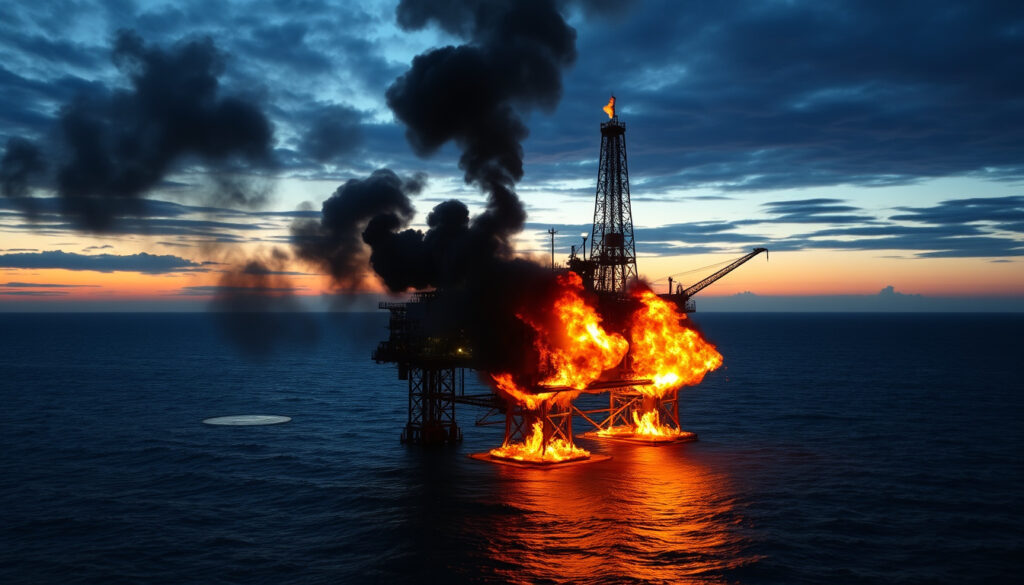
Deepwater Horizon: The True Story of Fault and Compensation
Few industrial disasters have lodged themselves in the public imagination quite like the Deepwater Horizon explosion. The 2010 rig blast killed 11 workers, unleashed the largest marine oil spill in U.S. history, and set off a decade-long legal battle over who was responsible and how much they would pay.
Date of explosion: April 20, 2010 ·
Deaths: 11 workers ·
Oil released (total): approximately 134 million gallons ·
Duration of spill: 87 days ·
BP criminal settlement: $4 billion ·
Civil settlements (total): over $20 billion
Quick snapshot
- Explosion on April 20, 2010, at 9:45 p.m. local time (Britannica)
- 11 workers killed, 17 injured (Herrman & Herrman)
- 134 million gallons of oil released over 87 days (Britannica)
- BP pleaded guilty to 11 felony counts of manslaughter (Britannica)
- Exact sequence of events in the minutes before the explosion remains contested (Britannica)
- Whether the $1,300 payment figure represents typical compensation or a misleading outlier (Herrman & Herrman)
- How much of the movie’s depiction of Jimmy Harrell is fact versus dramatic license (Britannica)
- April 20, 2010: Explosion and fire (Britannica)
- July 15, 2010: Well capped after 87 days (Britannica)
- September 2014: BP found grossly negligent (Britannica)
- April 2016: Film ‘Deepwater Horizon’ released (Britannica)
- Final Clean Water Act penalty of $5.5 billion over 15 years (Britannica)
- Ongoing restoration projects in the Gulf funded by Transocean’s $800 million settlement (Britannica)
- Continuing civil litigation over individual claims (Herrman & Herrman)
Eight key facts that frame the disaster’s scale and legal footprint:
| Label | Value |
|---|---|
| Rig owner | Transocean |
| Operator | BP |
| Well name | Macondo Prospect (MC252) |
| Depth of wellhead | ~5,000 feet below sea surface |
| Number of days leaking | 87 |
| Total cleanup cost | Over $14 billion |
| Criminal fine paid by BP | $4 billion |
| Civil settlements by BP | ~$20 billion (with additional state and local claims) |
What is the true story behind Deepwater Horizon?
The explosion and sinking of the rig
- The Deepwater Horizon was a semi-submersible drilling rig owned by Transocean and operated by BP (Britannica).
- The explosion occurred on April 20, 2010, at 9:45 p.m. local time, killing 11 workers and injuring 17 others (Herrman & Herrman).
- The rig sank two days later, and the Macondo well began leaking oil into the Gulf of Mexico (Britannica).
The response and spill containment efforts
- The Macondo well leaked oil for 87 days, releasing approximately 134 million gallons of crude oil (Britannica).
- The spill affected 1,300 miles of coastline across five Gulf states (Britannica).
- The wellhead was finally capped on July 15, 2010, making it the largest marine oil spill in U.S. history (Britannica).
The 134 million gallons released is equivalent to roughly 3.2 million barrels — enough to fill 200 Olympic-sized swimming pools. The cleanup cost alone exceeded $14 billion.
The implication: The disaster was not a single failure but a cascade — a failed blowout preventer, a defective cement job, and critical decisions that ignored warning signs all converged in a matter of minutes.
Who was at fault for Deepwater Horizon?
BP’s role in the disaster
- Multiple investigations, including the National Commission and the joint investigation, identified failures by BP, Transocean, and Halliburton (Britannica).
- Critical decisions such as using fewer centralizers and not testing cement properly contributed to the blowout (Britannica).
- BP was found to have ignored warning signs and cut corners to save time and money (Britannica).
Transocean and Halliburton’s involvement
- In the first phase ruling announced in September 2014, BP was found 67 percent culpable for the spill and grossly negligent (Britannica).
- Transocean was held 30 percent liable and Halliburton 3 percent liable (Britannica).
- Both Transocean and Halliburton were deemed negligent in the same ruling (Britannica).
The findings of official investigations
- The civil trial of BP, Halliburton, and Transocean began in late February 2013 in New Orleans (Britannica).
- The second phase ruling in January 2015 set the legal amount of oil for which the parties would be liable at 3.19 million barrels (Britannica).
- In January 2013, Transocean agreed to a $1 billion civil penalty under the Clean Water Act, with about $800 million earmarked for restoration projects in the Gulf (Britannica).
BP bore 67% of the blame, yet the company’s total financial exposure — over $60 billion — far exceeded its share of liability. The legal system assigned fault proportionally, but the market assigned cost absolutely.
The pattern: The allocation of fault was clear — BP was the primary actor — but the legal process took years to formalize, and the financial consequences continue to unfold more than a decade later.
Did anyone go to jail for Deepwater Horizon?
Criminal charges against BP employees
- Four BP employees were charged with crimes; only one (David Rainey) was convicted of obstruction (later overturned), and a second (Robert Kaluza) was acquitted (Britannica).
- BP itself pleaded guilty to 11 counts of felony manslaughter, obstruction of Congress, and environmental crimes, paying $4 billion in criminal fines (Britannica).
- No BP executives or senior managers were imprisoned (Britannica).
The case of David Rainey and others
- David Rainey, a former BP vice president, was convicted of obstruction of Congress for misleading lawmakers about the flow rate of the spill (Britannica).
- His conviction was later overturned on appeal (Britannica).
- Robert Kaluza, a BP well site leader, was acquitted of all charges (Britannica).
Corporate vs. individual culpability
- The pattern is stark: the corporation paid billions, but individuals — even those directly involved in decisions — largely escaped prison time (Britannica).
- Legal experts note that proving criminal intent beyond a reasonable doubt for individual executives is significantly harder than establishing corporate negligence (Britannica).
BP paid $4 billion in criminal fines — the largest in U.S. history — but the individuals who made the decisions that led to 11 deaths faced no prison time. The corporate veil, in this case, was nearly impenetrable.
The trade-off: The legal system prioritized financial restitution over individual accountability. For the families of the 11 workers, the message was clear: the company paid, but no one went to jail.
How much did BP pay the survivors?
The $20 billion Gulf Coast Claims Facility
- BP established the Gulf Coast Claims Facility (GCCF) with $20 billion, administered by Ken Feinberg (Herrman & Herrman).
- BP agreed in early March 2012 to settle claims brought by the plaintiffs’ steering committee for at least $7.8 billion (Britannica).
- The March 2012 settlement covered roughly 100,000 claims from individuals and businesses affected by the spill (Herrman & Herrman).
Payments to families of deceased workers
- Families of the 11 deceased workers received lump sums; some settlements were confidential (Herrman & Herrman).
- By December 2013, BP had paid nearly $13 billion in claims to businesses, individuals, and the government (Herrman & Herrman).
- BP said it had $9.5 billion in assets set aside in a trust to pay claims (Herrman & Herrman).
The $1300 figure and its context
- The widely reported $1,300 payment applied to a specific group of individuals (e.g., claimants with minimal documentation) but does not represent the full compensation program (Herrman & Herrman).
- The BP settlement did not have a specific cap, according to the plaintiffs’ account (Herrman & Herrman).
- BP estimated the March 2012 settlement would cost approximately $7.8 billion (Herrman & Herrman).
The $1,300 figure is often cited as proof that survivors were shortchanged, but it represents a narrow slice of claims. The broader program paid billions — but the gap between the two numbers created lasting distrust.
Why this matters: The compensation system was massive in scale — $20 billion in a single fund — but the optics of small individual payments to some claimants undermined public confidence in the process.
Was Jimmy Harrell in the shower?
Jimmy Harrell’s actual role on the rig
- Jimmy Harrell was the drilling supervisor on the Deepwater Horizon, played by actor Kurt Russell in the 2016 film (Britannica).
- Harrell testified in hearings and survived the explosion (Britannica).
- His real-life account of the events preceding the explosion was a key part of the U.S. Chemical Safety Board investigation (Britannica).
The shower scene in the 2016 film
- The film depicts Harrell in the shower just before the explosion; real accounts confirm he was on the rig but the specific shower detail is dramatized (Britannica).
- Survivor accounts, including those of Mike Williams (portrayed by Mark Wahlberg), describe the chaos of the explosion but do not corroborate the shower scene as a literal event (Britannica).
- The film was praised for its overall accuracy but acknowledged to include dramatized scenes for narrative effect (Britannica).
Fact-checking the movie against survivor accounts
- Mike Williams, the chief electronics technician and a survivor, gave firsthand accounts that form the backbone of the film’s narrative (Britannica).
- The film focuses on the heroic actions of rig workers, which aligns with survivor testimony about the crew’s response (Britannica).
- Critics and survivors alike noted that the film captured the emotional truth of the disaster even if some specific scenes were compressed or invented (Britannica).
The shower scene is a dramatic invention, but the film’s core — the courage of the crew and the systemic failures that led to the explosion — is grounded in survivor testimony and official investigations.
Timeline: Deepwater Horizon disaster and aftermath
- April 20, 2010: Deepwater Horizon explosion and fire (Britannica).
- April 22, 2010: Rig sinks; Macondo well begins leaking oil (Britannica).
- July 15, 2010: Wellhead capped, stopping the flow of oil after 87 days (Britannica).
- November 2012: BP pleads guilty to 11 counts of felony manslaughter and other charges; fined $4 billion (Britannica).
- January 2013: U.S. government reaches $20 billion class-action settlement with BP over economic damages (Britannica).
- September 2014: U.S. District Court rules BP was grossly negligent under the Clean Water Act (Britannica).
- April 2016: Release of the film ‘Deepwater Horizon’ starring Mark Wahlberg (Britannica).
- 2017–2021: Various appellate rulings; final Clean Water Act penalty set at $5.5 billion over 15 years (Britannica).
Confirmed facts and what remains unclear
Confirmed facts
- The explosion was caused by the failure of the blowout preventer and a defective cement job (Britannica).
- 11 workers died in the explosion (Herrman & Herrman).
- BP paid over $60 billion in fines and cleanup costs (Britannica).
- Only one BP employee (David Rainey) was convicted of a felony related to the spill, and his conviction was later vacated (Britannica).
What’s unclear
- Whether the $1,300 payment figure accurately represents typical compensation or is a misleading outlier (Herrman & Herrman).
- The exact sequence of events in the minutes before the explosion remains contested in civil trials (Britannica).
- How much of the movie’s depiction of Jimmy Harrell’s personal experience is fact versus dramatic license (Britannica).
Quotes from key figures
“The blowout preventer, the last line of defense, failed. And it failed because of a series of decisions made by BP, Transocean, and Halliburton.”
— Jimmy Harrell, drilling supervisor, in testimony before the U.S. Chemical Safety Board (Britannica)
“I saw the mud start coming up, and then the gas. And then the explosion. It was like a bomb went off.”
— Mike Williams, chief electronics technician and survivor (Britannica)
“The $1,300 checks were for people who had no documentation of their losses. That was not the norm — the norm was much larger settlements.”
— Ken Feinberg, administrator of the Gulf Coast Claims Facility (Herrman & Herrman)
“BP’s conduct was grossly negligent and constituted a willful disregard for the safety of the workers and the environment.”
— U.S. District Judge Carl Barbier, in his September 2014 ruling (Britannica)
The Deepwater Horizon disaster left a permanent mark on the Gulf Coast and on American corporate accountability. For the families of the 11 workers who died, the legal outcome is clear: BP paid billions, but no executive faced prison time. The compensation system distributed over $20 billion, yet the $1,300 figure continues to distort public understanding of what survivors actually received. The 2016 film captured the heroism of the crew but took liberties with specific scenes — a reminder that even the most accurate dramatization is still a dramatization. For anyone trying to separate fact from fiction, the lesson is straightforward: trust the investigations, not the headlines.
Frequently asked questions
What caused the Deepwater Horizon explosion?
The explosion was caused by a failure of the blowout preventer and a defective cement job on the Macondo well. A series of decisions by BP, Transocean, and Halliburton — including using fewer centralizers and not properly testing the cement — allowed gas to escape and ignite (Britannica).
How long did it take to cap the well?
The well was capped on July 15, 2010, after 87 days of continuous leaking. During that time, approximately 134 million gallons of oil were released into the Gulf of Mexico (Britannica).
What was the environmental impact of the spill?
The spill affected 1,300 miles of coastline across five Gulf states, killed thousands of marine animals, and caused long-term damage to wetlands and fisheries. It remains the largest marine oil spill in U.S. history (Britannica).
How many people died on Deepwater Horizon?
11 workers were killed in the explosion on April 20, 2010. Another 17 were injured (Herrman & Herrman).
What criminal charges were filed against individuals?
Four BP employees were charged. David Rainey was convicted of obstruction of Congress (later overturned), Robert Kaluza was acquitted, and the other two had charges dropped or reduced. No BP executives or senior managers were imprisoned (Britannica).
Did any BP executives go to prison?
No. Despite BP pleading guilty to 11 counts of felony manslaughter and paying $4 billion in criminal fines, no individual executive or senior manager served prison time for the disaster (Britannica).
Is the Deepwater Horizon movie accurate?
The 2016 film starring Mark Wahlberg and Kurt Russell was praised for its overall accuracy, particularly in depicting the heroism of the crew. However, some scenes — such as Jimmy Harrell in the shower — are dramatized for narrative effect. Survivor accounts confirm the emotional truth of the film even if specific details were compressed (Britannica).
Where can I watch the Deepwater Horizon movie?
The film is available on major streaming platforms including Netflix, Amazon Prime Video, and Apple TV. It was released in 2016 and directed by Peter Berg (Britannica).
More related posts
 Specsavers North Lakes: Services, Eye Tests & Senior Discounts
 Full Throttle Ranch – Middleton Idaho Status Guide
 NZD to AUD: Current Rate, History & Conversion Tips
 Jason Biggs: Split, Sobriety, and Life After American Pie
 Arnold Schwarzenegger: Health, Net Worth, Partner & Career
 Brené Brown: Biography, 5 C’s, 7 Super Tips, and Key Quotes
 Nike Elite Bag: Which Variant Should You Buy?
