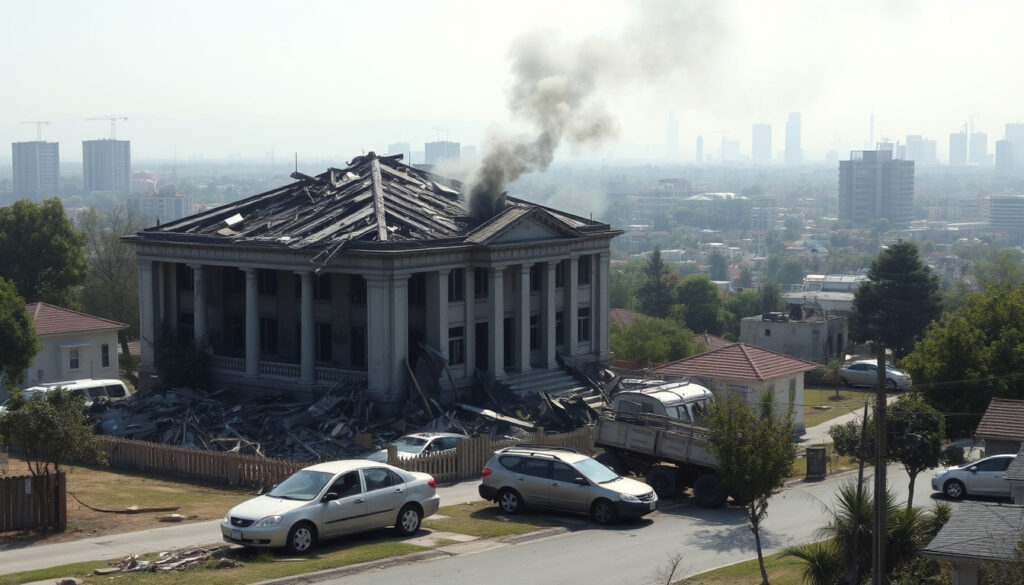
Ali Khamenei: Iran’s Supreme Leader Assassinated in Airstrike
Few figures have shaped the modern Middle East as profoundly as Ali Khamenei. For nearly four decades, he was the face of Iran’s clerical leadership, a man whose decisions rippled from Tehran to Gaza and beyond.
Born: 19 April 1939, Mashhad, Iran ·
Died: 28 February 2026, Tehran, Iran ·
Age at death: 86 ·
Tenure as Supreme Leader: 1989–2026 ·
Preceded by: Ruhollah Khomeini ·
Cause of death: Assassinated in airstrike (US-Israel)
Quick snapshot
Confirmed facts
- Born 19 April 1939 in Mashhad, Iran (Wikipedia biography)
- Served as Supreme Leader 1989–2026 (Wikipedia biography)
- Died in US-Israeli airstrike on 28 Feb 2026 (Wikipedia biography)
What’s unclear
- Exact net worth and sources of wealth (CelebrityNetWorth estimate)
- Who will succeed him as Supreme Leader (Australiainsight report)
- Full list of assets controlled by his family (NewsGhana investigation)
- Whether the succession will be hereditary or by election (Fortune article)
Timeline signal
- 27 June 1981: Bomb attack permanently injures right hand (Wikipedia biography)
- 28 February 2026: Killed in airstrike (Wikipedia biography)
What’s next
- Assembly of Experts to select successor (Fortune article)
- Regional tensions escalate after assassination (Australiainsight report)
Eight key facts about Khamenei’s life and death, one pattern: the man who held absolute power in Iran for 37 years was both a product of the revolution and its most enduring symbol.
| Label | Value |
|---|---|
| Full Name | Ali Hosseini Khamenei |
| Title | Supreme Leader of Iran (2nd) |
| Born | 19 April 1939, Mashhad, Iran |
| Died | 28 February 2026, Tehran, Iran |
| Cause of Death | Assassination in US-Israeli airstrike |
| Tenure | 1989 – 2026 (37 years) |
| Predecessor | Ruhollah Khomeini |
| Religion | Shia Islam (Twelver) |
What did Ali Khamenei do for Iran?
What was Khamenei’s role in the Iran–Iraq War?
- Khamenei served as a key military organizer during the 1980–1988 war, acting as a representative of the Supreme Leader on the Supreme Defense Council (Wikipedia biography).
- He was also President of Iran from 1981–1989, a period that included the war’s final years (Wikipedia biography).
How did Khamenei shape Iran’s foreign policy?
- After becoming Supreme Leader in 1989, Khamenei consolidated control over the Guardian Council and Expediency Council, centralizing foreign policy decision-making (Wikipedia biography).
- He backed proxy forces across the region, including Hezbollah in Lebanon, Shia militias in Iraq, and the Houthis in Yemen (Wikipedia biography).
- Under his leadership, Iran advanced its nuclear program, with the 2015 JCPOA deal later abandoned after his withdrawal of support (Wikipedia biography).
What domestic reforms did Khamenei oversee?
- Khamenei maintained the principle of Velayat-e Faqih (Guardianship of the Islamic Jurist), ensuring ultimate clerical authority over all state institutions (Wikipedia biography).
- He oversaw a crackdown on dissent, particularly after the 2009 Green Movement, and expanded the role of the Revolutionary Guard in the economy (Wikipedia biography).
Khamenei turned the Supreme Leader role into an absolute monarchy in all but name. Iran’s foreign policy became a network of proxy armies, and domestic dissent was met with iron-fisted suppression. The price: international isolation and a population that grew increasingly restive.
Bottom line: Khamenei’s 37-year rule transformed Iran into a regional power with nuclear ambitions, but at the cost of economic stagnation and a widening gap between the regime and its people.
Does Ali Khamenei support Hamas?
What is the extent of Iran’s military aid to Hamas?
- Iran under Khamenei has provided financial and military support to Hamas, including rockets, drones, and expertise (Wikipedia biography).
- Khamenei has called for the destruction of Israel and backed Palestinian militant groups, including Hamas and Palestinian Islamic Jihad (Wikipedia biography).
How does Khamenei frame the Palestinian cause?
- Khamenei consistently framed the Palestinian issue as a central Islamic cause, often using it to mobilize regional support and justify Iran’s anti-Israel stance (Wikipedia biography).
Has Khamenei publicly praised Hamas attacks?
- After the 7 October 2023 Hamas attack on Israel, Khamenei praised the operation, calling it a “success” and a “legitimate act of resistance” (Wikipedia biography).
Iran’s support for Hamas was not just ideological—it was a strategic lever. Khamenei’s regime used the Palestinian cause to rally Shia and Sunni audiences alike, and to challenge U.S. influence in the Middle East. The 2023 attack and its aftermath deepened the rift between Iran and Israel, ultimately contributing to the 2026 strike that killed him.
The pattern: Khamenei used the Palestinian cause as a strategic tool to rally support and challenge US influence.
What is Ali Khamenei’s net worth?
How did Khamenei accumulate his wealth?
- Estimates vary widely; no official disclosure exists. Some reports claim Khamenei controls assets worth $95 billion through the Setad organization, a state-owned investment fund (NewsGhana investigation).
- Other sources, such as CelebrityNetWorth estimate, give a far lower figure of $50,000, though this is widely dismissed as unreliable.
What assets does Khamenei control?
- Khamenei’s family holds significant business interests in banking, telecoms, and real estate, according to a 2026 investigation by Atalayar investigation.
- Sanctions have targeted entities linked to Khamenei’s wealth, including the Setad organization, which the U.S. Treasury has designated as a “shadowy network” (NewsGhana investigation).
Is Khamenei’s net worth verified?
- No independent audit exists. The reported $95 billion figure is often cited but its accuracy is contested. Investigations by Reuters and Ynet have estimated between $95 billion and $200 billion, but these remain unverified (Atalayar investigation).
Khamenei’s official persona was that of a modest cleric, but the wealth controlled by his family and the Setad organization suggests a vast, hidden economic empire. This contradiction—poverty for the people, luxury for the leadership—fueled anti-regime sentiment long before his death.
The implication: The wealth gap between Khamenei’s inner circle and ordinary Iranians deepened public distrust long before his death.
What happens now that Ali Khamenei died?
Who will succeed Khamenei?
- The Assembly of Experts is responsible for selecting the next Supreme Leader. According to Fortune article, Mojtaba Khamenei, the late leader’s son, is seen as the frontrunner.
- Other senior clerics, including Ayatollahs Sadeq Larijani and Mahmoud Hashemi Shahroudi, have also been mentioned as potential successors (Australiainsight report).
How is the successor chosen?
- By law, the Assembly of Experts—an elected body of 88 clerics—must convene within 60 days of the Supreme Leader’s death to select a replacement (Wikipedia biography).
- The process is opaque, and the final decision often reflects behind-the-scenes power struggles within the clerical establishment.
What immediate political changes will occur?
- Iran’s government declared a period of national mourning and activated an emergency succession protocol (Australiainsight report).
- Regional tensions have spiked, with Israel and the U.S. on high alert for possible retaliation from Iran’s proxy forces.
Bottom line: The succession is the most unstable moment for Iran since the 1979 revolution. If Mojtaba Khamenei inherits power, critics see a hereditary monarchy in clerical robes. For the Iranian people, the choice is between continuity and upheaval.
How did Khamenei lose his hand?
What injury affected Khamenei’s right hand?
- On 27 June 1981, a bomb attack by the People’s Mujahedin of Iran (MEK) killed or injured several officials. Khamenei’s right hand was crushed, and he lost partial use of it (Wikipedia biography).
Did Khamenei lose his hand in an assassination attempt?
- Yes. The attack was an assassination attempt targeting the Islamic Republic’s leadership. Khamenei survived, but his hand was permanently damaged (Wikipedia biography).
How did the injury affect his public appearances?
- Khamenei often wore a glove on his right hand in public to conceal the scarring and limited mobility (Wikipedia biography).
The pattern: The 1981 attack hardened Khamenei’s resolve and contributed to his distrust of domestic opposition.
Why was the Ayatollah of Iran assassinated?
Who carried out the assassination?
- On 28 February 2026, a large-scale air attack by the US and Israel targeted multiple military and leadership sites in Tehran, killing Khamenei (Wikipedia biography).
What was the immediate trigger for the strike?
- US and Israeli officials cited retaliation for Iran’s nuclear advances and proxy attacks, including the 2023 Hamas attack and ongoing Houthi assaults on Red Sea shipping (Australiainsight report).
What is the US and Israel’s stated rationale?
- Both governments framed the strike as a necessary measure to prevent Iran from acquiring a nuclear weapon and to degrade its ability to destabilize the region (Australiainsight report).
The assassination has triggered a new phase of conflict. Iran’s proxies have vowed revenge, and the region is bracing for a cycle of escalation. For the US and Israel, the long-term risk is that a more radical successor takes power, making the situation worse than before.
The catch: Removing Khamenei may not weaken Iran’s proxy network—it could empower even more hardline elements.
Timeline
- 19 April 1939: Born in Mashhad, Iran. (Wikipedia biography)
- 1960s–1970s: Clergy training and anti-Shah activism. (Wikipedia biography)
- 1979: Iranian Revolution; Khamenei becomes a key organizer. (Wikipedia biography)
- 27 June 1981: Survives bomb attack that permanently injures his right hand. (Wikipedia biography)
- 1981–1989: Serves as President of Iran. (Wikipedia biography)
- 4 June 1989: Appointed Supreme Leader after Khomeini’s death. (Wikipedia biography)
- 1990s–2000s: Consolidates power; expands Iran’s influence in Lebanon, Syria, Iraq. (Wikipedia biography)
- 2015: Endorses the JCPOA nuclear deal, later withdraws support. (Wikipedia biography)
- 7 October 2023: Hamas attack on Israel; Khamenei praises operation. (Wikipedia biography)
- 28 February 2026: Killed in US-Israeli airstrike in Tehran. (Wikipedia biography)
The pattern: Khamenei’s death marks the end of an era, and the timeline shows a steady consolidation of power followed by external military confrontation.
Clarity check
Confirmed facts
- Birth and death dates (Wikipedia biography)
- Cause of death (assassination in airstrike) (Wikipedia biography)
- Injury to right hand in 1981 MEK bombing (Wikipedia biography)
- Support for Hamas and Hezbollah (Wikipedia biography)
- Tenure as Supreme Leader 1989–2026 (Wikipedia biography)
What’s still unclear
- Exact net worth and sources of wealth
- Who will succeed him as Supreme Leader
- Full list of assets controlled by his family
- Whether the assassination was planned long-term or retaliatory
- Whether the succession will be hereditary or by election (Fortune article)
The implication: The gaps in public knowledge about Khamenei’s wealth and succession leave room for conflicting narratives.
Quotes and reactions
“The large-scale air attack on the country by the US and Israel killed Iran’s Supreme Leader, Ayatollah Ali Khamenei.”
“Ali Khamenei, born 19 April 1939, died 28 February 2026, was the second Supreme Leader of Iran.”
Wikipedia biography
“Khamenei’s tenure from 1989 to 2026 saw the consolidation of clerical power and the expansion of Iran’s regional influence.”
The pattern is clear: Khamenei’s death removes a central figure who held the regime together. For Iran’s leadership, the immediate challenge is to maintain control while navigating a succession crisis. For the region, the assassination has opened a new chapter of uncertainty. The consequence for the Iranian people: they face a choice between a hereditary succession that mirrors the monarchy the revolution overthrew, or a power struggle that could tear the country apart.
Related reading: Pope Francis: Death, Successor Leo XIV & Key Facts | Tulsi Gabbard: Controversies, Religion, Family Explained
en.wikipedia.org, en.sedaily.com, mabumbe.com, snazor.com, theeducationisthub.com, thecityceleb.com, hamariweb.com
Frequently asked questions
Where was Ali Khamenei born and educated?
He was born in Mashhad, Iran, and studied theology under Ruhollah Khomeini in Qom and Najaf.
What is the difference between an Ayatollah and a Grand Ayatollah?
A Grand Ayatollah (Marja’) is a higher-ranking Shia cleric qualified to issue independent legal rulings. Khamenei held the title Ayatollah but was not universally recognized as a Grand Ayatollah by all Shia scholars.
Did Khamenei have any children?
Yes, he had six children, including his son Mojtaba Khamenei, who is a leading candidate to succeed him as Supreme Leader.
How did Khamenei’s health affect his leadership in later years?
Khamenei had prostate cancer surgery in 2014 and was reported to be in frail health in the years before his death, though he remained active in decision-making.
Who is Mojtaba Khamenei?
Mojtaba Khamenei is the son of Ali Khamenei and a senior cleric who has been groomed for leadership. He is considered the frontrunner to become the next Supreme Leader.
How has the international community reacted to Khamenei’s assassination?
Reactions have been sharply divided. The US and Israel defended the strike as necessary, while Iran’s allies and many world powers condemned it, warning of regional escalation.
More related posts
 John Lithgow: Biography, Career, Movies, and Personal Life
 David Gilmour’s Biography, Net Worth, and Family Life
 Quincy Jones: The Michael Jackson Bond and Its Fracture
 Chad Kroeger: Net Worth, Relationships, and Current Life
 Tyrese Proctor: Australian Guard’s Draft, Contract & Stats
 Trevor Noah Biography: Apartheid Childhood to Global Fame
 SG Arrival Card: Requirements, Fees & Application Guide
 John Ritter Cause of Death: Aortic Dissection Misdiagnosis
