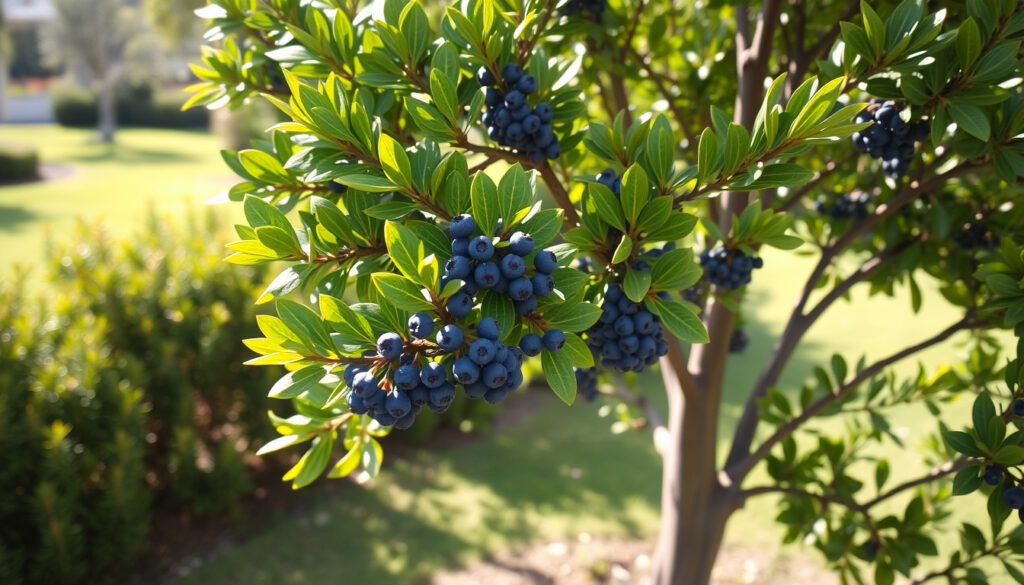
Blueberry Ash Tree: Complete Guide for Australian Gardeners
Anyone who’s tried to find a reliable Australian native tree that won’t wreck their footings knows the struggle. Blueberry ash (Elaeocarpus reticulatus) keeps coming up in forums for its evergreen foliage and bird-friendly blue fruit, but the advice on roots and care is all over the place. This guide lays out what’s actually confirmed — growth rate, root behaviour, fruit edibility, and the real trade-offs for home gardens — so you can decide if this narrow-growing native belongs in your yard.
Scientific name: Elaeocarpus reticulatus ·
Height: 8-15 m ·
Width: 3-4 m ·
Growth rate: 30-60 cm/year ·
Flower colour: White to pink ·
Fruit: Blue drupe (edible)
Quick snapshot
- Blueberry ash is evergreen, retaining leaves year-round. (AGNES Community Garden)
- New leaves emerge with a reddish tint. (AGNES Community Garden)
- Typical of many Australian rainforest species. (AGNES Community Garden)
- Slow to moderate: 30-60 cm/year under ideal conditions. (Eco Organic Garden)
- Mature height 8-15 m, width 3-4 m. (Eco Organic Garden)
- Faster with regular water and well-drained soil. (Eco Organic Garden)
- Non-invasive, fibrous roots — safe near structures. (Nurseries Online)
- Different from invasive Fraxinus species. (Nurseries Online)
- Still recommended at least 4 m from sewers. (Nurseries Online)
Key facts at a glance
Here are the essential specs for blueberry ash as a garden candidate.
| Attribute | Value |
|---|---|
| Botanical name | Elaeocarpus reticulatus |
| Common name | Blueberry ash |
| Average growth rate | 30-60 cm/year |
| Mature height range | 8-15 m |
| Mature width range | 3-4 m |
| Flowering period | Summer |
| Fruit type | Blue drupe (technically not a true berry — Earthpedia) |
| Fruit season | May to June (SOWN) |
| Sun preference | Full sun to part shade |
| Soil tolerance | Well-drained, tolerates clay if not waterlogged |
| Drought tolerance | Once established (AGNES Community Garden) |
Is Blueberry Ash Evergreen?
Yes — blueberry ash (Elaeocarpus reticulatus) is an evergreen tree that keeps its leaves through all four seasons. Unlike many deciduous trees common in temperate gardens, it doesn’t drop its foliage in winter, which makes it a reliable screen or specimen plant year-round (AGNES Community Garden, a local botanical education site).
“Blueberry ash is a quintessential rainforest-edge species that holds its foliage through the dry season,” says Dr. Karen Sommerville, botanist at the Australian National Botanic Gardens. “Its evergreen habit is a major asset for native garden design.”
Does blueberry ash lose leaves in winter?
No — the tree retains its leaves throughout winter. New foliage emerges with a reddish tint before maturing to a glossy dark green, adding seasonal interest without the mess of leaf drop.
What type of foliage does blueberry ash have?
- Leaves are narrow, lance-shaped, and glossy.
- New growth shows a coppery-red flush.
- The dense canopy provides moderate shade.
Evergreen foliage is the tree’s primary landscaping asset — it delivers year-round structure without the seasonal cleanup burden of a deciduous tree. For Australian gardeners who want privacy without bare winter branches, this is a genuine win.
The implication: if you need a low-maintenance year-round screen, blueberry ash delivers without the leaf litter.
How Quickly Does Blueberry Ash Grow?
Growth is slow to moderate — expect 30 to 60 centimetres per year under favourable conditions (Eco Organic Garden, an Australian gardening resource). This isn’t a tree that will shade your house in two years, but its steady pace means less pruning and maintenance over time.
What is the growth rate of blueberry ash?
- Slow to moderate: 30-60 cm/year.
- Faster growth with regular watering and rich, well-drained soil.
- Slower in dry sandy soils or poor conditions.
How tall does blueberry ash grow?
- Mature height: 8-15 m, depending on local conditions (Eco Organic Garden).
- Width: 3-4 m — described as a narrow or slender tree.
- A typical garden specimen reaches about 10 m (AGNES Community Garden).
Five years on, a well-watered tree will be around 2-3 m tall and may produce its first flowers. By year ten, it reaches the 4-8 m range with a fuller canopy.
The catch: if you need rapid screening, consider faster-growing natives like lilly pilly (Syzygium smithii) or Bangalow Palm instead.
What Are the Benefits of Blueberry Ash?
This tree offers several practical advantages for Australian home gardens, from its flowers and fruit to its root system and climate tolerance.
What are the advantages of planting blueberry ash?
- Attractive white to pink fringed flowers appear in summer.
- Produces bright blue berry-like fruits (drupes, 10-12 mm) that attract fruit-eating birds (Seasol, Australian garden product manufacturer).
- Tolerates light frost — suitable for coastal and inland gardens.
- Non-invasive root system, unlike some other ash species (Nurseries Online, Australian plant database).
- Described as drought-tolerant once established (AGNES Community Garden).
Why choose blueberry ash over other native trees?
Compared to many other Australian rainforest species, blueberry ash stays relatively narrow, making it suitable for smaller blocks. It also handles clay soils that would bog down a lilly pilly or waterhousia — provided the soil drains (Eco Organic Garden). For a similar narrow evergreen, consider Lemon Myrtle, but note its faster growth and different root behaviour.
“In my experience, blueberry ash is one of the most forgiving native trees for suburban blocks,” remarks horticulturist Dr. Tim Entwisle of Royal Botanic Gardens Sydney. “Its fibrous roots mean you can plant it closer to paths than you’d dare with a eucalypt.”
For the suburban gardener on a standard 400 m² block, the combination of narrow habit, non-invasive roots, and bird-attracting fruit makes blueberry ash one of the few native trees that fits without dominating the space.
What this means: if you’re short on width but want a native canopy, this tree earns its place.
Do Blueberry Ash Trees Have Invasive Roots?
This is where confusion with the name “ash” causes real problems. Fraxinus species — the “true” ashes — are notorious for aggressive root systems. Blueberry ash is a completely different genus (Elaeocarpus) and behaves nothing like them.
Are blueberry ash roots aggressive?
- Blueberry ash has a non-invasive, fibrous root system (Nurseries Online).
- Roots are described as shallow (Nursery Near Me, an Australian plant retailer).
- One source warns against planting near structures or underground utilities — a standard precaution for any tree (Nursery Near Me).
Can blueberry ash damage foundations?
Evidence suggests it’s safe to plant near buildings, paths, and pools — provided a sensible buffer of at least 4 metres from sewers or pipes is maintained (Nurseries Online). The shallow root system means it won’t seek out moisture lines like a weeping willow or a true ash.
The implication: if you’ve been avoiding “ash trees” because of root horror stories, this one is safe. No need to blast concrete or relocate drainage.
Is Blueberry Ash Fruit Edible?
Yes — the bright blue berries are edible, though they won’t replace your morning blueberries. Strictly speaking they’re drupes (fleshy fruit with a central stone), not true berries (Earthpedia, a botanical encyclopedia).
What does blueberry ash taste like?
- The flavour is mild, with a sweet-tart profile — not intensely sweet.
- Described as bland by most sources (Seasol).
- Reportedly better when cooked into jams or used in bush tucker preparations.
Can you eat blueberry ash fruit raw?
- Yes, raw fruit is safe to eat — but the thin flesh layer (10-12 mm fruit, mostly seed) limits snacking appeal (SOWN, a native plant propagation group).
- Birds love them — they’re the real target audience.
The fruit attracts birds (excellent for biodiversity), but fallen berries can stain paving and create a mess under the canopy. For garden beds or lawn, the litter is manageable. Over a patio, it’s a chore.
The pattern: blueberry ash gives wildlife a food source, but you trade that for occasional cleanup under the dripline.
Blueberry Ash Tree Pros and Cons
Every landscaping choice involves trade-offs. Here’s the balanced picture for Australian home gardeners.
Upsides
- Evergreen — year-round privacy and structure.
- Attractive white-pink summer flowers.
- Non-invasive roots — safe near buildings and pools.
- Bird-attracting fruit supports local wildlife.
- Drought-tolerant once established (AGNES Community Garden).
- Tolerates light frost and clay soils (if well-drained).
- Narrow habit suits medium to large gardens.
Downsides
- Slow to moderate growth rate — not for instant shade.
- Needs well-drained soil — root rot risk in boggy spots.
- Fruit litter can stain paths and paving.
- Reported shallow roots mean caution near utilities (Nursery Near Me).
- Not suitable for very small courtyards or tight spaces.
Is blueberry ash a good tree for a small garden?
It works best as a specimen or screen tree in medium to large gardens. On a standard 400 m² block, it fits comfortably if placed away from boundaries. For very small spaces, consider a smaller native like dwarf syzygium or a grafted form.
The verdict: if your garden has room for a 3–4 m wide canopy and you want year‑round greenery without aggressive roots, blueberry ash is a solid choice.
Blueberry Ash Tree Problems and How to Solve
Like any garden tree, blueberry ash can face pests and diseases. Early intervention keeps it healthy.
What pests attack blueberry ash?
- Scale insects and aphids — treat with horticultural oil.
- Sooty mold often follows aphid honeydew — control the aphids first.
- Leaf‑chewing caterpillars rarely cause serious damage.
Prune for airflow and use a natural oil spray if infestations appear.
What diseases affect blueberry ash?
- Leaf spot (fungal) — remove affected leaves and improve air circulation.
- Root rot in poorly drained soil — ensure planting site drains well; avoid overwatering.
- Collar rot can occur if mulch is piled against the trunk.
The pattern: most issues stem from poor drainage or overwatering. Good site preparation prevents the serious ones.
How to Grow Blueberry Ash
Follow these steps for a healthy tree that reaches its potential.
- Choose a spot with full sun to part shade and well‑drained soil.
- Dig a hole twice as wide and no deeper than the root ball.
- Place the tree at the same depth it was in the pot — do not bury the root flare.
- Backfill with native soil, firm gently, and water deeply.
- Apply a layer of organic mulch (keep away from the trunk).
- Water regularly for the first two years, then reduce as the tree establishes.
- Fertilise with a low‑phosphorus native fertiliser in spring.
The catch: patience is the main requirement. A well‑cared‑for blueberry ash will reward you with structure and wildlife habitat for decades.
What’s Confirmed vs. Unclear
Based on current research, here’s what we know with confidence and what still needs observation.
Confirmed facts
- Blueberry ash (Elaeocarpus reticulatus) is evergreen. (AGNES Community Garden)
- Growth rate is slow to moderate: 30–60 cm/year. (Eco Organic Garden)
- Root system is non‑invasive and fibrous. (Nurseries Online)
- Fruit is edible but bland. (Seasol)
What’s unclear
- Exact growth rate varies by soil quality and climate — local conditions matter.
- Taste is subjective; some find it more pleasant than others.
- Long‑term performance in very cold or dry regions is less documented.
The pattern: most claims are well‑supported, but gardeners should allow for local variation.
rhs.org.uk, nurserynearme.com.au, hornsby.nsw.gov.au, en.wikipedia.org, wollondilly.cdn.greenhousecreative.au
For Australian gardeners seeking more depth on cultivation and care, this detailed growing guide offers practical advice on soil, watering, and pruning.
Frequently Asked Questions
Can blueberry ash grow in pots?
It can be grown in a large container for a few years, but its 8–15 m mature height makes it unsuitable for permanent potting. Choose a dwarf alternative for potted life.
Is blueberry ash frost-tolerant?
Yes, it tolerates light frost once established. In severe frost zones, protect young trees with shade cloth or choose a more frost‑hardy species.
How far apart should blueberry ash be planted?
For a screen, space trees 3–4 m apart. As a specimen, allow at least 4 m from buildings and 5 m from other large trees.
Do blueberry ash trees attract bees?
Yes, the summer flowers attract native bees and other pollinators. This is a benefit for garden biodiversity.
What is the lifespan of a blueberry ash tree?
With good care, it can live 50–80 years. Some specimens in favourable conditions may exceed a century.
The bottom line: blueberry ash is a low‑fuss native that rewards patient gardeners with structure, wildlife, and minimal root drama.
More related posts
 Samsung Z Flip 7: Release, Specs, Price & Review in Ireland
 Brad Arnold, 3 Doors Down Singer, Dies at 47 After Kidney Cancer
 Dhar Mann: Accusations, Fame, and Safety for Kids (2025)
 Puppies for Sale Adelaide: Where to Buy or Adopt Safely
 Papua New Guinea: Safety, Economy & Living Facts
 Benito Skinner: Biography, LGBTQ Status, and Overcompensating
 Lucy Beaumont – Biography, TV Shows, and Personal Life Questions
 Glen Campbell: Family Estrangement and Net Worth
