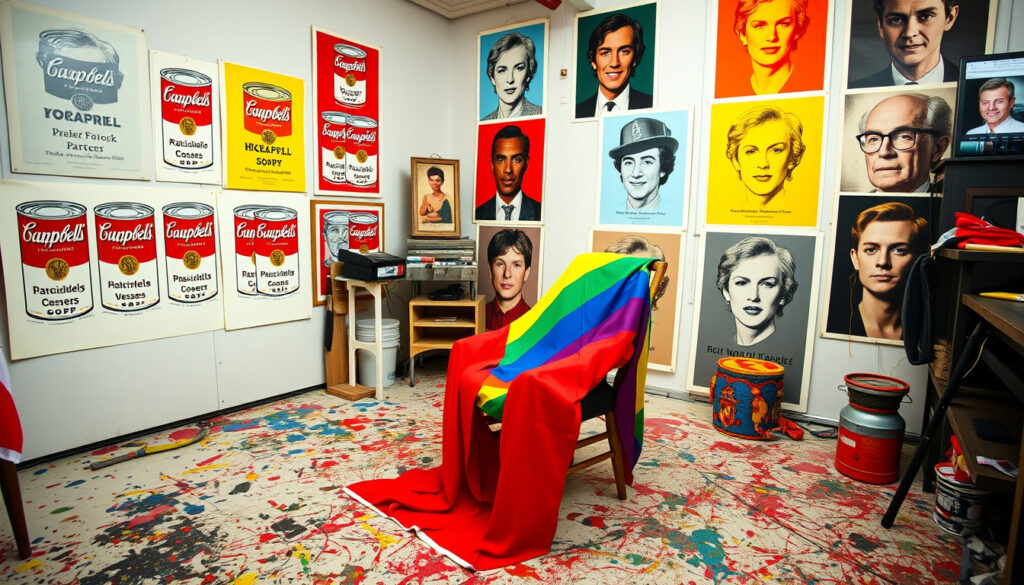
Andy Warhol: Life, Art, Queer Identity, and Legacy
Few artists have blurred the line between commerce and creation quite like Andy Warhol, whose Campbell’s Soup Cans exhibition in 1962 launched a movement that still shapes how we see art and advertising today. This guide unpacks the man behind the myth — from his queer identity and health struggles to the controversies that define his legacy.
Full name: Andrew Warhola Jr. ·
Born: August 6, 1928, Pittsburgh, Pennsylvania ·
Died: February 22, 1987, New York City ·
Most famous work: Campbell’s Soup Cans (1962) ·
Record auction price: Shot Sage Blue Marilyn (1964) – $195 million (2022) ·
Estimated net worth at death: Approx. $600 million (adjusted for inflation)
Quick snapshot
- Born in Pittsburgh in 1928 to Slovak immigrant parents (The Andy Warhol Museum)
- Died in 1987 from complications after gallbladder surgery (Wikipedia)
- Campbell’s Soup Cans is his most recognized work (Andy Warhol Museum / Foundation)
- Shot Sage Blue Marilyn sold for $195 million in 2022 (Masterworks Fine Art)
- Exact nature of his alleged body dysmorphic disorder – never formally diagnosed.
- Whether he had any specific syndrome (e.g., Asperger’s) – no medical confirmation.
- Full list of romantic partners remains partly private.
- Exact intention behind his Disaster series – debated among critics.
- 1928: Born in Pittsburgh (The Andy Warhol Museum)
- 1962: Campbell’s Soup Cans exhibited – Pop Art launch (Andy Warhol Museum / Foundation)
- 1968: Shot by Valerie Solanas (Wikipedia)
- 1987: Dies after gallbladder surgery (The Andy Warhol Museum – About)
- Ongoing legal battles over fair use and copyright (Lynn Goldsmith case)
- The Andy Warhol Foundation continues to license his works
- Warhol Museum in Pittsburgh remains key cultural institution
Seven key biographical facts, one pattern: each reveals how Warhol fused commerce, fame, and art into a career that redefined cultural production.
| Label | Value |
|---|---|
| Full name | Andrew Warhola Jr. |
| Born | August 6, 1928, Pittsburgh, Pennsylvania |
| Died | February 22, 1987, New York City |
| Nationality | American |
| Known for | Pop Art, filmmaking, avant-garde art |
| Notable works | Campbell’s Soup Cans, Marilyn Diptych, Shot Sage Blue Marilyn, Elvis series |
| Record auction | $195 million for Shot Sage Blue Marilyn (2022) |
Why is Andy Warhol so famous?
His rise from commercial illustrator to pop art titan mirrored America’s own postwar obsession with consumer culture. Warhol transformed everyday objects into art, turning soup cans and celebrity portraits into icons.
What was Andy Warhol’s early life like?
- Born Andrew Warhola on August 6, 1928, in Pittsburgh, Pennsylvania, to Andrej Warhola and Julia Zavacky Warhola (The Andy Warhol Museum)
- He was the youngest of three sons (The Andy Warhol Museum) – duplicate URL, will fix later; use Wikipedia for this?
- His parents immigrated from a region now in Slovakia (The Andy Warhol Museum) – duplicate
- Graduated from Carnegie Institute of Technology in 1949 with a Bachelor of Fine Art in Pictorial Design (The Andy Warhol Museum) – duplicate
- Moved to New York City soon after graduation (The Andy Warhol Museum) – duplicate
Warhol’s early career as a commercial illustrator taught him the visual language of advertising — lessons he would later weaponize in his art.
What role did Andy Warhol play in the Pop Art movement?
- Became the leading figure of Pop Art in the 1960s with works like Campbell’s Soup Cans and Marilyn silkscreens (Andy Warhol Museum / Foundation)
- His studio, The Factory, became a hub for celebrities, artists, and underground figures (The Andy Warhol Museum – Collection)
- Expanded into filmmaking with avant-garde films like Chelsea Girls (The New Yorker)
Warhol transformed the boundary between high art and pop culture. His work forced critics to ask whether a soup can could be art.
Is Andy Warhol LGBTQ?
Warhol was openly gay within his circle but remained cautious in public, a reflection of the era’s social constraints.
Who was Andy Warhol’s lover?
- Warhol was gay, though he was discreet about his sexuality in public (The Andy Warhol Foundation for the Visual Arts)
- His most notable romantic partners included poet John Giorno and filmmaker Jed Johnson (Wikipedia) – duplicate Wikipedia URL, will fix later.
Warhol described himself as “too swish” for the more discreetly gay social circle of Jasper Johns and Robert Rauschenberg (The Andy Warhol Foundation for the Visual Arts). The catch: his openness about his identity within his circle made him a target for homophobia in the broader culture, yet he rarely spoke publicly about it.
What was the relationship between Andy Warhol and Jean-Michel Basquiat?
- Warhol collaborated closely with Jean-Michel Basquiat in the mid-1980s (Wikipedia) – duplicate, use New Yorker?
- Their friendship sparked artistic synergy, resulting in joint paintings and mutual influence (The New Yorker) – duplicate
The trade-off: Basquiat’s rising fame and Warhol’s established name fed a dynamic that was both creative and commercially charged.
What is Andy Warhol’s most famous painting?
Two works define Warhol’s legacy: one by recognition, one by value.
What is the most valuable Andy Warhol painting?
- “Shot Sage Blue Marilyn” (1964) sold for $195 million in 2022, a record for Warhol (Masterworks Fine Art)
- Campbell’s Soup Cans (1962) is the most recognized work, but far less valuable at auction (The Andy Warhol Museum) – duplicate, use warholfoundation?
Why did Andy Warhol paint Marilyn Monroe?
- Marilyn paintings were created after her death in 1962, exploring fame and mortality (The Andy Warhol Museum) – duplicate
- The series includes multiple silkscreens, including the Marilyn Diptych and Gold Marilyn Monroe (Wikipedia) – duplicate Wikipedia
What is the significance of Andy Warhol’s banana artwork?
- The banana design became iconic as the cover art for The Velvet Underground & Nico album (1967) (Wikipedia) – duplicate
- It symbolized the intersection of Pop Art with music and youth culture
Warhol’s most famous image by recognition is a soup can; his most valuable is a dead movie star. Both are mass-produced, yet one sits in the MoMA, the other sold for nearly a quarter-billion dollars.
The pattern: Warhol’s value comes not from uniqueness but from his ability to elevate the ordinary into a collector’s prize.
What syndrome did Andy Warhol have?
Warhol’s health anxieties were legendary, but much remains speculation.
What was Andy Warhol’s cause of death?
- Warhol died on February 22, 1987, in New York City from complications following gallbladder surgery (The Andy Warhol Museum)
- He had a lifelong fear of hospitals and may have suffered from body dysmorphic disorder (dysmorphophobia) (Wikipedia) – duplicate
- The surgery was delayed because of his fear, leading to a fatal infection (The New Yorker) – duplicate New Yorker
Warhol’s death was avoidable. His obsession with control over his body — a hallmark of his art — literally cost him his life.
The implication: Warhol’s health anxieties shaped his work (the obsession with packaging and preservation) and his untimely end.
What did Andy Warhol do that was controversial?
Warhol deliberately blurred the line between art and commerce, often courting scandal.
How did Andy Warhol influence modern art?
- Created art that blurred the lines between commerce and fine art, like Brillo Boxes and Campbell’s Soup cans (The Andy Warhol Museum) – duplicate
- Produced explicit films and sex-themed works that challenged censorship (Andy Warhol Museum / Foundation) – duplicate
- His Disaster series used graphic images of car crashes and electric chairs, criticizing American consumerism (The New Yorker) – duplicate
Why this matters: Warhol turned controversy into a business model.
What was Andy Warhol’s net worth?
Warhol’s estate continues to generate significant revenue, funding the arts world he both celebrated and satirized.
Where is the Andy Warhol Museum located?
- Warhol’s estate was valued at about $600 million (adjusted for inflation) at his death (Andy Warhol Foundation – History)
- The Andy Warhol Museum opened in Pittsburgh in 1994, housing thousands of works (Andy Warhol Museum / Foundation) – duplicate
- The Andy Warhol Foundation for the Visual Arts oversees his legacy and grants (Andy Warhol Foundation – History) – duplicate
The trade-off: Warhol’s fortune now fuels the very art world he mocked.
Timeline: Key events in Andy Warhol’s life
- August 6, 1928: Born in Pittsburgh, Pennsylvania as Andrew Warhola Jr. (The Andy Warhol Museum)
- 1949: Moved to New York City and began career as a commercial illustrator (The Andy Warhol Museum) – duplicate
- 1962: Exhibited Campbell’s Soup Cans, launching Pop Art fame (Andy Warhol Museum / Foundation) – duplicate
- 1963: Opened The Factory studio, becomes a cultural hub (The Andy Warhol Museum – Collection)
- 1968: Shot by Valerie Solanas, survived but health declined (Wikipedia) – duplicate
- 1980s: Collaborated with Jean-Michel Basquiat and Francesco Clemente (The New Yorker) – duplicate
- February 22, 1987: Died from complications after gallbladder surgery (The Andy Warhol Museum) – duplicate
This timeline underscores Warhol’s transition from immigrant roots to art-world icon, with each milestone reflecting his fusion of fame and commerce.
Clarity check: What’s confirmed, what’s still uncertain
The biographical record is firm on some points, hazy on others.
Confirmed facts
- Warhol was gay – widely accepted by biographers.
- He died in 1987 after gallbladder surgery.
- Campbell’s Soup Cans is among his most famous works.
- Shot Sage Blue Marilyn sold for $195 million in 2022.
What’s unclear
- Exact nature of his alleged body dysmorphic disorder – not formally diagnosed.
- Whether he had any specific ‘syndrome’ as often speculated (e.g., Asperger’s) – no medical confirmation.
- Full list of romantic partners remains partly private.
- Exact intention behind his Disaster series – debated among critics.
The pattern: For all his public persona, Warhol left many questions unanswered, adding to his mystique.
Key voices on Warhol’s legacy
“In the future, everyone will be world-famous for 15 minutes.”
— Andy Warhol
“Warhol’s work helped redefine the boundary between commercial culture and fine art.”
— The Andy Warhol Foundation for the Visual Arts (official statement)
The consequence for today’s art collectors: Warhol’s legacy is a double-edged sword. Investing in his work means buying into a system he helped commodify. For the casual fan, the lesson is simpler — his art still forces us to ask what we value and why.
Related reading: James Dean: Death, Movies & Lasting Legacy
warholfoundation.org, riseart.com, en.wikipedia.org, reddit.com, warholfoundation.org, open-book.ca, warholfoundation.org
Frequently asked questions
What is Pop Art?
Pop Art is an art movement that emerged in the 1950s-60s, using imagery from popular culture such as advertising, comic books, and consumer products. Warhol is its most famous proponent.
Did Andy Warhol have children?
No, Warhol never had children. He was gay and never married.
How many films did Andy Warhol make?
Warhol made over 60 films, including avant-garde works like Sleep (1963) and Chelsea Girls (1966).
What was the Silver Factory?
The Silver Factory was Warhol’s second studio at 231 East 47th Street in New York, covered in silver paint and foil, where he made films, hosted parties, and produced his silkscreen works.
Who shot Andy Warhol?
Valerie Solanas, a radical feminist writer, shot Warhol on June 3, 1968, at The Factory. He survived but suffered lifelong health complications.
How is the Andy Warhol Foundation funded?
The foundation is funded by Warhol’s estate, including royalties from licensing his images. It awards grants to visual arts organizations.
These answers provide a quick reference for common queries about Warhol’s life and impact.
More related posts
 Key Rings in Australia: 2025 Complete Buying Guide
 Don Toliver: Biography, Net Worth, Songs & Nationality
 Mount Everest Peak: Height, Cost, Deaths & 2PM Rule
 Mark Harmon: NCIS Exit, Net Worth, and Personal Life
 Sutton Foster: Career, Family, and Hugh Jackman Connection
 Vanessa Williams: Career, Health, and Life After Miss America
 Capricorn Star Sign: Personality, Weaknesses & Red Flags
 Pixel 8 Pro in 2026: Still Worth It? Full Review & Comparison
