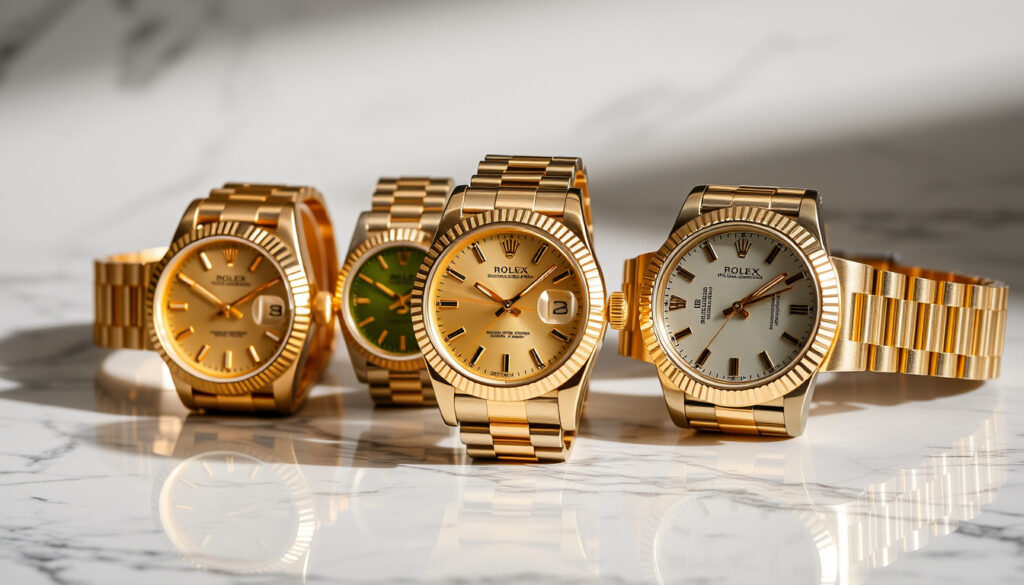
Rolex Day Date – History Models Prices Presidents Watch
Rolex Day-Date: Complete Guide to the President’s Watch (Prices, History, Models 2025)
What Is the Rolex Day-Date?
The Rolex Day-Date stands apart in the world of luxury timepieces as the only watch in Rolex’s current collection to display both the full day of the week and the date in separate windows on the dial. Introduced in 1956, this Oyster Perpetual model became the world’s first wristwatch to offer these dual complications in window format, setting a benchmark for practical elegance that continues to define the line today. Available exclusively in 18k gold or 950 platinum, the Day-Date has cultivated an aura of uncompromising prestige that transcends mere horology.
The watch carries the unofficial but widely recognized nickname “President’s Watch,” a title earned through decades of association with world leaders, heads of industry, and influential figures across the globe. This connection to power and accomplishment has made the Day-Date not simply a timekeeping instrument but a symbol of achievement and status recognized in boardrooms and diplomatic circles alike. The combination of its technical innovation and material exclusivity has ensured its position as one of the most sought-after luxury watches ever produced.
1956
President’s Watch
36mm, 40mm, 41mm
18k Gold, Platinum
Key Features at a Glance
- First wristwatch to display full day of the week and date in separate windows at 12 and 3 o’clock respectively
- Available exclusively in precious metals—no steel versions ever produced
- Signature President bracelet with semi-circular three-piece link design and concealed Crownclasp
- Day display available in 26 or more languages, reflecting its global ambitions from inception
- Modern calibers 3255 and 3235 deliver chronometric precision of +2/-2 seconds per day
- 100-meter water resistance through the Oyster case architecture
- Cyclops lens magnifies the date at 3 o’clock for enhanced readability
Current Model Reference Prices
| Model | Reference | Size | Price Range (2025 est.) |
|---|---|---|---|
| Day-Date 40 | 228238 | 40mm | $45,000–$60,000 |
| Day-Date 36 | 128238 | 36mm | $40,000–$55,000 |
| Day-Date 41 | 228235 | 41mm | $50,000–$70,000 |
When Was the Rolex Day-Date Introduced and Its History?
The Day-Date made its debut at Baselworld in 1956 under reference 6611, marking a significant milestone in horological engineering. The launch required the development of the Caliber 1055 movement, which necessitated a larger case size to accommodate the revolutionary day disc mechanism that would display the full spelling of the weekday rather than abbreviations. Rolex founder Hans Wilsdorf envisioned a watch that would serve as what he called “the ultimate symbol of prestige,” and the Day-Date delivered on this ambition through its combination of technical innovation and material opulence.
The Presidential Connection
The association between the Day-Date and presidential leadership began shortly after its introduction. U.S. President Dwight D. Eisenhower reportedly wore an early Day-Date, and subsequent presidents including Richard Nixon and Ronald Reagan continued this tradition. The moniker “President’s Watch” solidified during these administrations, cementing the watch’s reputation as the preferred timepiece of those who lead nations and shape global policy. Beyond American presidents, the watch found favor with figures including Elvis Presley and Fidel Castro, further establishing its status as an icon of power and influence.
Evolution Through the Decades
The 1960s and 1970s brought significant refinements to the Day-Date line. The introduction of quickset date and quickset day functions in the 1970s enhanced practical usability, allowing wearers to adjust these displays independently without cycling through the full time-setting process. The President bracelet, with its distinctive semi-circular three-piece link design and concealed Crownclasp folding clasp, debuted during this period, becoming so synonymous with the Day-Date that it carries the watch’s nickname.
The introduction of sapphire crystal replaced the acrylic crystals of earlier models, providing superior scratch resistance and clarity. The Oysterquartz models of the 1970s and 1980s, such as reference 19018, represented a brief experiment with quartz technology that has since become collector curiosities, currently trading around $13,150 on the secondary market.
Vintage Day-Date references from the 1960s and 1990s, such as the ref. 1803 and ref. 18238, command significant premiums today. Models featuring the lacquer “Stella” dials in unusual colors remain particularly sought after by collectors, demonstrating how the Day-Date’s history translates directly into market value.
The modern era began with the introduction of the Day-Date 40 in 2015, expanding the case size from the traditional 36mm to accommodate contemporary preferences while maintaining the proportions that define the line. Subsequent additions include the 41mm variant and the ladies’ 28mm option, ensuring the collection addresses diverse wrist sizes and style preferences. Current production centers on the Caliber 3255 for the 40mm and 41mm models, while the 36mm continues to utilize variations of the 3155 and 3156 movements.
How Much Does a Rolex Day-Date Cost?
New Rolex Day-Date models at authorized dealers range substantially based on metal choice, dial configuration, and bezel style. Entry-level configurations in 36mm with yellow gold start around $38,000 to $43,700 at manufacturer’s suggested retail price. The transition to the larger 40mm format with yellow gold brings MSRP to approximately $48,000, while platinum references can command $70,000 or more before customization options enter the equation.
2025-2026 Retail and Secondary Market Prices
| Model Configuration | Reference | Retail (MSRP) | Market Price |
|---|---|---|---|
| Yellow Gold, Fluted Bezel | 228238 | $44,200 | $38,100 |
| Everose Gold, Diamond | 228345 | $67,300 | $56,350 |
| Platinum, Diamond Bezel | 228396TBR | $139,000+ | Varies |
Secondary market pricing frequently falls below retail for current-production models, particularly following the price increases implemented in 2025. This dynamic presents opportunities for buyers seeking pre-owned examples, with 36mm references available from approximately $19,000 to $33,000 depending on condition and configuration. The secondary market undercuts retail by margins that fluctuate based on broader economic conditions and watch market dynamics.
Vintage and discontinued references follow different economics entirely. Early references such as the 1803 from the 1960s trade between $18,000 and $30,000, while rare configurations featuring unique dial treatments or special editions can exceed $300,000. The Oysterquartz references occupy a niche position, with the ref. 19018 currently valued around $13,150—reflecting both its quartz movement and its cult status among collectors.
The secondary market for Day-Date watches operates with significant regional variation. North American and European markets typically show tighter spreads between retail and market price, while Asian markets may exhibit premiums for certain configurations. Consulting multiple sources including Chrono24 and specialized dealers provides the clearest picture of current fair market value.
Rolex Day-Date Models and Features
Available Sizes and Their Characteristics
The Day-Date lineup addresses distinct preferences through its size options. The 36mm configuration represents the traditional proportions that defined the watch for decades, appealing to those who favor a more conservative profile and offering particular relevance for individuals with smaller wrists. This size maintains strong appeal among traditionalists and continues to represent the quintessential Day-Date aesthetic.
The 40mm variant, introduced in 2015, became the modern standard for the collection. This size delivers balanced proportions that accommodate contemporary tastes while preserving the watch’s elegance and legibility. Larger wrists find comfortable fitment without the watch appearing oversized, making this the most versatile option in the lineup.
The 41mm configuration represents the boldest expression of the Day-Date design, targeting wearers who prefer pronounced presence on the wrist. Reference 218239 exemplifies this approach, offering substantial visual impact while maintaining the technical excellence and material quality that characterize the collection. Ladies’ options in 28mm extend the range to those preferring smaller proportions.
The President Bracelet
No discussion of the Day-Date proceeds far without addressing its signature bracelet. The President bracelet features a semi-circular three-piece link design that Rolex initially reserved exclusively for the Day-Date, reinforcing the watch’s position as the brand’s pinnacle offering. The concealed Crownclasp folding clasp maintains clean lines along the wrist, appearing as a seamless extension of the bracelet rather than a separate mechanical element.
While the Datejust shares the President bracelet configuration on its gold models, the Day-Date’s exclusive association with precious metals and its historical pedigree create a distinction that transcends the physical bracelet design. The psychological association between the bracelet and the watch remains powerful in the luxury watch market, where symbolism often matters as much as specification.
Materials and Finishing
Rolex produces the Day-Date exclusively in 18k gold or 950 platinum, with yellow gold, white gold, and Everose gold (Rolex’s proprietary rose gold alloy) representing the precious metal options. Platinum represents the pinnacle of material choice, offering approximately twice the density of gold and a naturally white appearance that develops a distinctive patina over time.
Bezel options include the classic fluted design in precious metals, smooth bezels, diamond-set configurations, pyramid bezels, and sapphire bezels that offer unobstructed views of the dial. Dial treatments span from traditional champagne and silver sunburst finishes to highly decorative lacquers, with over 50 distinct dial variants available across the current collection. Gem-set dials incorporating diamonds and colored stones extend the customization possibilities considerably, with prices rising accordingly.
Modern Movement Technology
The Caliber 3255 powers current Day-Date 40 and Day-Date 41 references, representing Rolex’s latest generation of in-house mechanical movements. This movement incorporates Chronergy escapement geometry, Parachrom hairspring technology for enhanced shock resistance, and Paraflex shock absorbers to protect against mechanical stress. Power reserve extends to 70 hours through the twin-barrel architecture.
Chronometric performance exceeds COSC certification standards, with the Caliber 3255 achieving accuracy of +2/-2 seconds per day—double the official requirement. The movement features automatic winding through the Perpetual rotor, with smooth oscillation visible through caseback variations in precious metal models.
The secondary market for Rolex watches, including the Day-Date, contains counterfeit examples of varying quality. Verification through serial and model numbers engraved between the lugs, rehaut engraving introduced after 2005, and the micro-etched coronet at 6 o’clock provides initial authentication. Professional inspection by authorized dealers or recognized experts remains advisable for significant purchases.
Rolex Day-Date vs Datejust: Key Differences
Understanding the distinction between the Day-Date and the Datejust requires examining several functional and philosophical differences that separate these two iconic Rolex families. While both belong to the Oyster Perpetual collection and share certain design elements, their positioning within the Rolex universe reflects distinct purposes and audiences.
| Aspect | Day-Date | Datejust |
|---|---|---|
| Complications | Day + Date | Date only |
| Materials | 18k Gold, Platinum only | Steel, Gold, Rolesor |
| Entry Price | $38,000+ | $7,000+ (steel) |
| Bracelet | President (gold/platinum) | Jubilee, Oyster, President |
| Target Audience | Leadership, Achievement | Professional, Everyday Luxury |
| Status Symbol | Ultimate prestige | Accessible prestige |
The fundamental distinction lies in the day display. The Day-Date’s full-day indicator at 12 o’clock represents a commitment to complete calendar information that the Datejust deliberately omits. This single feature carries significant implications for both functionality and symbolism. The day display requires additional mechanism complexity and dial real estate, justifying in part the Day-Date’s positioning above the Datejust in Rolex’s hierarchy.
Material exclusivity defines the Day-Date’s market position. Where the Datejust welcomes steel and two-tone configurations that broaden its accessibility, the Day-Date maintains its commitment to precious metals alone. This policy reinforces the watch’s prestige positioning while eliminating the entry point that steel provides for Datejust aspirants.
The Datejust with President bracelet on gold configurations presents the closest visual cousin to the Day-Date, and the confusion between these references creates opportunities for both savings and disappointment depending on buyer awareness. Careful attention to the dial text—specifically the presence or absence of the day indicator—resolves any ambiguity instantly.
Does the Rolex Day-Date Hold Its Value?
The Rolex Day-Date demonstrates exceptional value retention characteristics that distinguish it within the luxury watch market. Pre-owned examples frequently maintain 80 to 100 percent of retail value, a ratio that few other consumer products approach. This performance reflects both the watch’s inherent quality and its sustained demand among collectors and enthusiasts.
Historical appreciation data indicates annual returns of approximately 8 to 12 percent on vintage Day-Date references since 2015, figures that have outpaced broader stock market indices during comparable periods. Platinum references and rare dial configurations—including ice-blue Arabic numerals and the colorful Stella lacquer treatments—have generated the strongest returns, with select examples trading above $100,000 in the collector market.
The distinction between investment potential and practical value retention merits emphasis. New Day-Date purchases at authorized dealers typically trade below retail on the secondary market, reflecting the built-in retail premium. However, discontinued references, rare configurations, and vintage examples operate under different dynamics where scarcity drives premiums above original retail. Purchasing with realistic expectations about the difference between personal enjoyment and financial return serves prospective buyers well.
While the Day-Date’s track record suggests potential for appreciation, watch investment carries risks that differ from traditional financial instruments. Liquidity varies significantly based on reference and condition, and market preferences shift over time. Heirloom quality and personal enjoyment should likely outweigh pure investment calculus when considering a Day-Date purchase.
Rolex’s continued investment in movement technology, materials science, and manufacturing quality supports long-term value retention. The brand’s network of authorized service centers ensures that mechanical servicing remains available for decades-old references, maintaining functionality that contributes to sustained desirability.
Timeline: Key Milestones in Day-Date History
- 1956 — Day-Date introduced at Baselworld as reference 6611 with Caliber 1055 movement
- 1960s — U.S. Presidents begin wearing the Day-Date, establishing the “President’s Watch” nickname
- 1960s–1970s — President bracelet debuts as signature accessory exclusive to the Day-Date
- 1970s — Quickset date and day functions introduced, enhancing practical usability
- 1970s–1980s — Oysterquartz Day-Date models released, including reference 19018
- Late 20th century — Sapphire crystal replaces acrylic across the collection
- 2015 — Day-Date 40 introduced with 40mm case and Caliber 3255 movement
- 2015–present — Size expansion to 41mm, ladies’ 28mm, and new dial configurations
- 2024 — New platinum models expand the high-end offerings
Understanding the Current Market
Established Information
- The Day-Date remains available exclusively in 18k gold and platinum configurations
- Current production utilizes Caliber 3255 (40mm/41mm) and Caliber 3155/3156 (36mm) movements
- Retail pricing for new models ranges from approximately $38,000 to over $139,000 depending on configuration
- The Day-Date’s association with presidential and leadership figures continues to drive its prestige positioning
- Authentication features include serial numbers between lugs, rehaut engraving, and micro-etched coronets
Information That Remains Less Certain
- Specific celebrity and public figure wearing habits in 2025 lack confirmed public documentation
- Pre-owned market prices fluctuate with 10-20% variation annually based on broader economic conditions
- Future model announcements remain subject to Rolex’s undisclosed product planning
- Exact availability at authorized dealers varies by market and changes frequently
The Cultural Significance of the President’s Watch
The Day-Date’s cultural weight extends beyond its technical specifications or market performance. Since its introduction, the watch has occupied a unique position in the intersection of horology, business culture, and political history. Its association with presidential leadership emerged organically rather than through marketing orchestration, reflecting the watch’s genuine appeal to those who lead.
In business contexts, the Day-Date communicates accomplishment without ostentation. Its precious metal construction signals wealth, while its technical excellence—the day display requiring additional mechanical complexity—suggests attention to detail and appreciation for craftsmanship. These qualities resonate in cultures where understated success carries more weight than obvious display.
The watch’s continued relevance despite rapid technological change speaks to the enduring appeal of mechanical timekeeping as a luxury pursuit. While smartphones render wristwatch functionality redundant for practical purposes, objects that carry meaning beyond utility retain their significance. The Day-Date represents one of the clearest expressions of this principle in the contemporary watch market.
“The Day-Date was designed to be the ultimate symbol of prestige and achievement.”
— Rolex corporate materials on the Day-Date collection
Modern wearers span corporate executives, political leaders, and accomplished professionals across industries. The watch’s customization options—spanning metal choices, dial colors, and bezel treatments—allow personalization while maintaining the unmistakable silhouette that defines the line. This combination of recognizable identity and individual expression suits contemporary attitudes toward luxury that value both status and self-expression.
Summary
The Rolex Day-Date occupies a singular position among luxury watches, combining the technical achievement of the first wristwatch to display full day and date with material exclusivity that excludes steel entirely from its offerings. Since 1956, the watch has accumulated cultural significance through its association with leadership, its continued technical evolution through modern Caliber 3255 movements, and its investment-grade value retention that rewards both collectors and those who simply appreciate owning exceptional objects. For those considering a luxury timepiece purchase, the Day-Date represents a proven choice that balances heritage, functionality, and enduring value.
Frequently Asked Questions
How can I authenticate a Rolex Day-Date?
Verify the serial and model numbers engraved between the lugs, check for rehaut engraving introduced after 2005, and examine the micro-etched coronet at 6 o’clock under magnification. The movement should feature smooth oscillation, and President bracelet hallmarks should be present. Professional verification through authorized dealers or recognized experts provides additional certainty.
Does the Rolex Day-Date appreciate in value?
Vintage Day-Date references have demonstrated 8-12% annual appreciation since 2015, with platinum and rare dial configurations commanding the highest returns. However, current-production models often trade below retail on the secondary market. Investment potential varies significantly based on specific reference, condition, and market timing.
What is the difference between Day-Date 36mm and 40mm?
The 36mm represents the traditional proportions and heritage appeal, while the 40mm introduced in 2015 reflects contemporary sizing preferences. Both sizes utilize precious metals exclusively and share the President bracelet, with the larger size accommodating modern tastes for more substantial watches on the wrist.
Why is the Day-Date called the President’s Watch?
The nickname emerged from the watch being worn by multiple U.S. presidents including Eisenhower, Nixon, and Reagan, establishing associations with leadership and power that persist today. This historical connection to political authority cemented the Day-Date’s reputation as the preferred timepiece of those who hold positions of influence.
What materials is the Day-Date made from?
The Day-Date is produced exclusively in 18k yellow gold, 18k white gold, 18k Everose gold (rose gold), and 950 platinum. No steel versions exist, maintaining the watch’s positioning as a precious metal timepiece suitable only for those materials.
How accurate is the Day-Date movement?
Modern Day-Date movements achieve accuracy of +2/-2 seconds per day, exceeding COSC certification standards. The Caliber 3255 and 3155/3156 movements incorporate Parachrom hairsprings and Paraflex shock absorbers for enhanced reliability and chronometric performance.
What languages does the Day-Date day display support?
The day display is available in 26 or more languages, reflecting the watch’s global ambitions and the international audience it serves. Language options typically include major business languages such as English, French, German, Spanish, Arabic, Japanese, and Chinese, among others.
More related posts
 Boba Fett: Good or Bad? Origins and Reputation Explained
 Lil Tay OnlyFans: Bio, Earnings, and Net Worth in 2025
 Harry Hamlin: Age, Net Worth, Wife, and Rumors
 Kelley Mack Cause of Death, Walking Dead Role, and Biography
 2025 Kia Carnival: Price, Specs, Seating & Reviews
 Rami Malek: Relationships, Family, Movies, and FAQs (2025)
 Wu-Tang Clan: Respect, Religion, Downfall, and Legacy
 Octavia Spencer: Biography, Disability, Marriage, and Privacy
