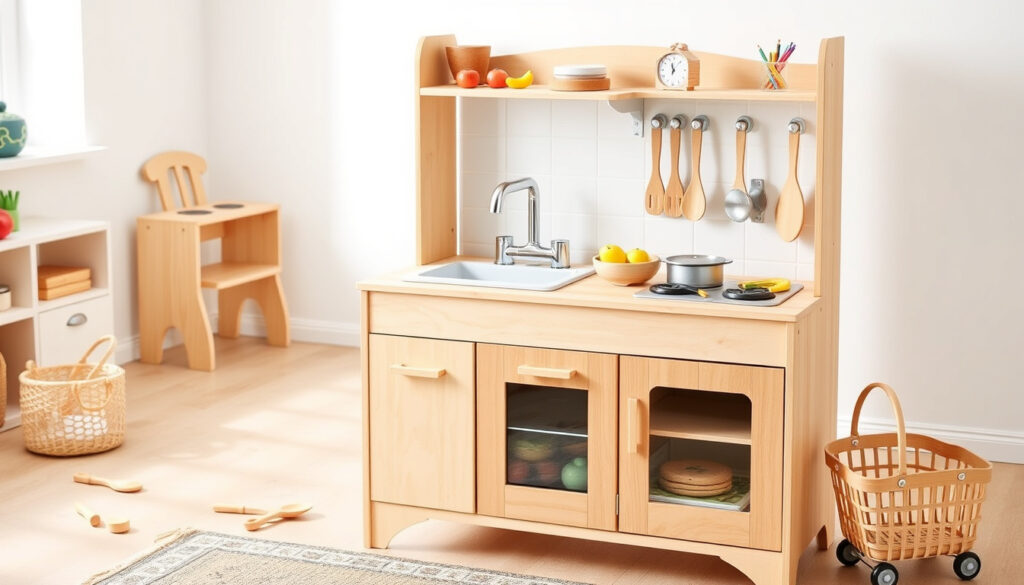
Play Kitchen Age, Cost, and Value: What Parents Should Know
Every parent who has walked past a play kitchen in a shop has asked the same question: will this actually get played with, or will it just gather dust? Australian retailers make the answer complicated by pricing the same toy category from AU $79.95 to AU $299.99 in the top results we reviewed, so this guide sorts those kitchens by age, price, and real-world value to match the right format to your child and floor space.
Lowest price in supplied AU SERP: AU $79.95 at Bunnings (Costway wooden kitchen) ·
Highest price in supplied AU SERP: AU $299.99 on eBay (outdoor play kitchen) ·
Age stated on Amazon AU wooden kitchen: 3 years and up ·
Major retailers in top 5 results: Bunnings, Harvey Norman, Kmart, Amazon AU, eBay AU ·
Formats found on page 1: Full wooden kitchen, sink toy, tabletop set, outdoor kitchen
Quick snapshot
- Bunnings sells the Costway wooden kitchen at AU $79.95 for online order.
- Harvey Norman sells the Cute Stone sink toy with automatic water circulation and colour-changing utensils.
- Kmart sells the Tooky Toy tabletop set for simulated cooking, chopping, and serving.
- Amazon AU lists the New Classic Toys kitchen for ages 3 and up, the same threshold used for Play Kitchen Australia’s Deluxe Wooden Play Kitchen.
- eBay AU outdoor kitchens run roughly AU $139.95–AU $299.99.
- Aldi’s current play kitchen price is not stated in the supplied Australian results.
- IKEA’s Duktig model and its discontinuation status are not confirmed on IKEA’s official page.
- No official Montessori certification appears in any of the five top retailer listings.
- The supplied listings carry no usage-lifespan figure. (Play Kitchen Australia age guide)
- Age guidance suggests a typical play-kitchen window of roughly 1–6 years, with height needs rising at each stage (Play Kitchen Australia age guide).
- Decide between the four formats before comparing price: full wooden, tabletop, sink-only, outdoor.
- Check the child’s interest and your floor space before buying a full-height unit.
- Verify Aldi and current promotions in-store, since the supplied results do not state them.
Seven benchmarks, one pattern: the Australian play kitchen market spans an AU $220 price gap and four distinct formats.
| Benchmark | Value |
|---|---|
| Lowest listed price | AU $79.95 — Bunnings, Costway wooden kitchen |
| Highest listed price | AU $299.99 — eBay outdoor kitchen |
| Age label on Amazon AU listing | 3+ years |
| Retailers represented | Bunnings, Harvey Norman, Kmart, Amazon AU, eBay AU |
| Product formats | Full-size, tabletop, sink-only, outdoor |
| Specialist wooden range | A$154.95–A$179.95 — Play Kitchen Australia (wooden kitchen collection) |
| Outdoor kitchen range | AU $139.95–AU $299.99 — eBay AU |
What age should a child get a play kitchen?
There is no single age tag for all play kitchens in the Australian market. The supplied top results carry one explicit age label — the New Classic Toys wooden kitchen on Amazon AU is designed for ages 3 and up — while a dedicated guide to choosing the perfect play kitchen by age (1-6 years) maps the category across a 1–6 year window, with height and complexity scaling as the child grows.
Is a play kitchen suitable for a 1 year old?
- Simple, stable models can work from around 12 months, according to Play Kitchen Australia’s age guide.
- For 1–2 year olds, the same guide recommends kitchens under 75 cm high, sized to a toddler’s reach.
- For children under 3, the safety advice is explicit: only simple, stable models with adult supervision, because small accessories are a choking risk (Play Kitchen Australia’s safety guide).
- The same retailer’s Deluxe Wooden Play Kitchen page lists a recommended age of 3+ with adult supervision (Play Kitchen Australia product listing).
The rule is not “no kitchen before three.” It is “no small parts and no unsupervised play before three.” A 1-year-old can stir, stack, and open and close cabinets; what a 1-year-old cannot do is manage tiny plastic food safely. That split matters more than the label on the box.
What age is the IKEA play kitchen for?
None of the supplied Australian SERPs includes IKEA’s official product page, so the Duktig’s official age label cannot be confirmed from the inputs we were given.
What can be confirmed is indirect: a roundup of best wooden play kitchens in Australia lists the IKEA Duktig at A$109, and the same guide states wooden play kitchens are generally suitable for children aged 2 to 6. That places the Duktig in the middle of the 1–6 window, not at the toddler end. If you are eyeing a specific IKEA model, check the current listing directly — the supplied results do not confirm whether the Duktig has been discontinued.
When to get rid of a kids’ play kitchen?
- No supplied listing or guide sets a fixed retirement age for a play kitchen.
- Height guidance from Play Kitchen Australia scales the kitchen to the child: under 75 cm for 1–2 years, 80–90 cm for 3–4 years, and 90–105 cm for 5–6 years (Play Kitchen Australia age guide).
- Safety is the hard limit: chipped paint, loose parts, unstable legs, or broken screws mean the kitchen retires immediately, whatever the child’s age.
A play kitchen retires when the child stops using it or the kitchen stops being safe — not on a birthday. The 90–105 cm size recommendation for 5–6 year olds suggests the format is designed to last through the preschool years, which makes the purchase decision about demonstrated interest as much as age.
The implication: the real gates are supervision under 3 and interest above 4 — not a birthday on the calendar.
How much do play kitchens cost?
The price question has an unusually wide answer in Australia. In the supplied top results, the lowest listed price is AU $79.95 for a full wooden Costway kitchen at Bunnings, and the highest is AU $299.99 for an outdoor kitchen on eBay with Buy It Now. Between those extremes, the market splits into clear bands by format.
What price range appears across Australian retailers?
- AU $79.95 — Bunnings, Costway wooden kitchen, online only.
- AU $139.95–AU $149.95 — eBay outdoor kitchens with free delivery.
- AU $299.99 — eBay outdoor kitchen listed with Buy It Now.
- A$154.95–A$179.95 — wooden kitchen collection at Play Kitchen Australia’s wooden kitchen collection, a specialist Australian play kitchen retailer.
- A$169.95 — the same retailer’s Deluxe Wooden Play Kitchen, marked down from A$261.99 (Play Kitchen Australia product listing).
- Under A$55 — CUTE STONE Play Sink, a budget tabletop sink-and-stove unit identified by NestPath’s Australian comparison.
The gap between AU $79.95 and AU $299.99 is not simply a quality gap — it is a format gap. A sink-only toy can cost less than a third of a full outdoor kitchen, and both can be the right buy for different children. The price range only makes sense once the format is set.
How much is the Aldi play kitchen?
The Aldi play kitchen price is not stated in the supplied Australian results, so any figure you have seen online cannot be confirmed here. Aldi rotates stock quickly, and pricing varies by store and season.
Because Aldi’s catalogue does not appear in the top five organic results, treat any community-shared “Aldi price” as a lead, not a price. Check the current catalogue or a local store before building a budget around it.
Are IKEA play kitchens worth the money?
- The IKEA Duktig is listed at A$109 in the wooden play kitchen roundup, alongside the Plum Peppermint Kitchen as a small-space option.
- The same roundup compares the Duktig against a Deluxe Wooden Play Kitchen at A$197 and a KidKraft Uptown Espresso at A$189.95.
- By comparison, NestPath names the Teamson Kids Little Chef Boston Farmhouse wooden kitchen at A$109.99 as the best value for small spaces (NestPath comparison).
Worth is not a standalone number; it is price divided by features, included accessories, and usable years. The Duktig and the Teamson Kids unit sit at nearly the same price, so the decision comes down to what each box includes — and the supplied snippets do not give a full parts breakdown. A kitchen that ships with pots, pans, and utensils changes the effective price, which is why the New Classic Toys set on Amazon AU, with its included play accessories, reads as a stronger value than its bare price suggests.
The pattern: indoor formats cluster at roughly A$55–A$180 and outdoor formats at AU $140–AU $300; format, not quality, explains the AU $220 gap between the cheapest and most expensive listings.
Is a play kitchen worth it?
A play kitchen can look like a big box for a small stake, so the worth question deserves a direct answer: the value is real, but only when the format matches the child. The supplied results show play kitchens priced from AU $79.95 to AU $299.99, and the retailer listings consistently sell a role-play experience rather than a piece of furniture — stoves, sinks, faucets, ovens, “immersive cooking.” That is the pitch. The follow-up question is whether the child will buy it.
How long do kids normally use a play kitchen?
- No supplied listing or guide states an average usage lifespan for a play kitchen.
- Age guidance for Australian parents maps the format across a 1–6 year window, with kitchen height scaling from under 75 cm to 90–105 cm (Play Kitchen Australia age guide).
- A kitchen sized for 5–6 year olds implies the toy is designed to carry a child through the preschool years, not just the toddler phase.
The absence of a lifespan figure is itself a finding: manufacturers and retailers are not claiming the kitchen lasts from 1 to 6. They are claiming it fits a stage. A kitchen that holds attention for two to three years — a common reading of the 1–6 guidance — costs less per year than most one-day outings.
What should a parent consider before buying one?
The cheapest full kitchen in the supplied results is AU $79.95, and the most expensive is AU $299.99. The difference is not quality — it is the format, and how long the child will use it.
- Interest first: pretend cooking is the skill being sold, and a child who has not shown interest in play cooking can ignore both a AU $80 and a AU $300 kitchen.
- Accessories second: bundled sets, like the New Classic Toys kitchen with its play accessories, add value that a bare kitchen price hides.
- Space third: a full-height kitchen needs floor area; a tabletop set or sink toy covers the same skills in a fraction of the space.
- Development fourth: pretend play is widely linked to social, language, and cognitive growth, and the retailer listings lean hard on role-play language — cooking, chopping, serving.
The danger is buying for the child you imagine rather than the child you have. A child who watches you cook and asks to stir is a better candidate than one who ignores the real kitchen entirely. In that sense, the worth question is a watching question: spend a week noticing whether your child plays at cooking before spending money on a kitchen.
The trade-off: a full wooden kitchen buys the most immersive play and costs the most space and money; a sink-only or tabletop unit buys the same imaginative skills for less. Worth is decided by fit, not by price.
What to get instead of a play kitchen?
A full-height play kitchen is the most visible option, but the supplied Australian results show three other formats that answer the same play need in different rooms and budgets. Each alternative trades something — immersion, floor space, or mess — and for many families one of them is the better buy.
Can a tabletop kitchen set replace a full play kitchen?
- Kmart sells the Tooky Toy Kitchen Interactive Pretend Tabletop Fun Play Set, which lets children “simulate cooking, chopping, and serving activities.”
- NestPath names the Teamson Kids Little Chef Boston Farmhouse wooden kitchen as best value for small spaces at A$109.99 (NestPath comparison).
A tabletop set replaces a full kitchen when floor space is the constraint or the child is still young enough to need supervision. The trade-off is physical: there is no oven to open and no lower cabinet to fill, so the role-play is smaller in scale even if the skills are the same.
Is a sink-only toy a good alternative?
- Harvey Norman sells the Cute Stone Pretend Play Kitchen Sink Toy with an “automatic water circulation system, and colour-changing utensils.”
- NestPath identifies a CUTE STONE Play Sink as a budget tabletop sink-and-stove unit priced well under A$55 (NestPath comparison).
Sink-only toys convert the least popular part of the kitchen — washing up — into the main event. Water play holds attention for long stretches, and colour-changing utensils give a small visual reward loop. The supervision rule still applies, but the cleanup is simpler: the toy is built to be wet.
Are outdoor play kitchens worth considering?
- eBay AU lists outdoor play kitchens as a distinct format, with prices around AU $139.95–AU $299.99.
- Outdoor units free up indoor floor space entirely, at the cost of weather exposure and the need to supervise outdoor water or mud play.
- For children who want to serve rather than cook, a kids wooden picnic table with benches is A$68.95 at Play Kitchen Australia’s homepage, with the wider collection running A$69.95–A$136.99 (kids picnic table collection).
An outdoor kitchen makes sense when the child already prefers outdoor play and the household has a covered or semi-covered area. It also changes the mess equation: flour, water, and pretend food are easier to hose away outside. The supplied eBay listings run from AU $139.95 to AU $299.99, which puts outdoor units at the top of the price range — so the worth question depends on how much outdoor play the child actually does.
The catch: every alternative to a full kitchen trades immersion for space, price, or cleanup. The right choice is the format that solves the constraint your home actually has.
Is a play kitchen Montessori?
The short answer: a play kitchen can be Montessori-aligned, but no supplied result is officially certified as one. Montessori-style play favors child-sized, real, purposeful activity, so the philosophy is a filter you apply to a toy — not a stamp a retailer puts on the box.
What makes a toy Montessori-aligned?
None of the five supplied top results mentions official Montessori certification, so treat any “Montessori play kitchen” claim as a marketing description, not a formal endorsement.
- Montessori-aligned toys tend to be child-sized, realistic, and open-ended, with one activity per element.
- Practical-life tasks — pouring, scrubbing, chopping, serving — are the closest match to Montessori sensibilities in a toy kitchen.
- Water-based toys, such as the Harvey Norman sink with its automatic water circulation, support practical-life play in a controlled way.
A toy does not need a certificate to be useful in a Montessori-inspired home. The features that matter are visible in the listings: child scale, real actions, and open-ended use. The Bunnings Costway kitchen is described with solid wood support legs and a splinter-free surface, which addresses the durability a Montessori-minded parent would look for.
Do wooden play kitchens fit Montessori-style play?
- Wood is the material most aligned with Montessori-style aesthetics, and Play Kitchen Australia’s wooden kitchen collection prices that material at A$154.95–A$179.95.
- Wooden play kitchens are generally suitable for children aged 2 to 6, per the same retailer’s roundup (best wooden play kitchens in Australia).
- Wood alone does not make a toy Montessori; the alignment comes from the child being able to use it independently, safely, and meaningfully.
The distinction matters because the market labels many toys “Montessori” without meeting the philosophy’s core test. A wooden kitchen with a few simple accessories and a low counter supports independent, purposeful play. A plastic kitchen with sounds and flashing lights moves in the opposite direction. For parents who want Montessori-style play, the supplied results point the same way: choose wood, choose simple, choose child-height.
The implication: the Montessori question is a materials-and-scale question, and the closest fit in the supplied Australian market is a low wooden kitchen or a supervised water sink.
Which play kitchen is the best?
The best play kitchen in Australia is the one that matches a specific child’s age, space, and interests — and the supplied top results make that easy because each retailer owns a different format. Bunnings leads with a full wooden kitchen at AU $79.95, Harvey Norman with a water-circulation sink, Kmart with a tabletop set, Amazon AU with a 3+ wooden kitchen, and eBay AU with outdoor units.
What formats are available from the top Australian retailers?
- Bunnings — Costway wooden kitchen, AU $79.95, online only.
- Harvey Norman — Cute Stone sink toy with automatic water circulation and colour-changing utensils.
- Kmart — Tooky Toy tabletop set for simulated cooking, chopping, and serving.
- Amazon AU — New Classic Toys wooden kitchen, designed for ages 3 and up.
- eBay AU — outdoor play kitchens from AU $139.95 to AU $299.99.
None of these listings tries to win every category. Bunnings wins on price for a full wooden kitchen, Amazon AU wins on an explicit age fit, Harvey Norman wins on water play, and eBay AU owns the outdoor format. That segmentation is the most useful signal in the supplied results — there is no single “best” listing because there is no single child.
How should a parent choose between a wooden kitchen, tabletop set, and sink toy?
Small space: tabletop. Toddler under 3: simple, supervised sink or tabletop. Preschooler who role-plays: full wooden kitchen at 3+. Outdoor child: outdoor unit. Settle the format first; the brand follows.
After the format is set, the price data does the rest. A full wooden kitchen can be had for AU $79.95 at Bunnings or A$154.95–A$179.95 at a specialist retailer; the difference is in build, size, and included pieces. For small spaces, the Teamson Kids unit at A$109.99 via NestPath and the Kmart Tooky Toy set are the reference points. For water play, the CUTE STONE sink sits under A$55 and the Harvey Norman version adds colour-changing utensils. The selection method is simple: pick the format by space and age, then pick the listing by price and accessories.
The pattern: each of the five top Australian retailers has staked out one format and priced it competitively. The best play kitchen for your child is the format that matches your floor plan and their play style — the brand is almost secondary.
Play kitchen formats compared
Each format solves one problem — space, budget, water play, or outdoor mess — and none solves all four. Pick the trade-off you can live with, then compare prices within that format.
Four formats, one pattern: the smaller the footprint, the lower the entry price, and the closer the play gets to a single focused activity.
| Format | Price in supplied AU results | Age fit | Space | Best for |
|---|---|---|---|---|
| Full wooden kitchen | AU $79.95 (Bunnings); A$154.95–A$179.95 (specialist) | 3+ label on Amazon AU; 2–6 per wooden-kitchen guides | Large | Children who want whole-kitchen role play |
| Tabletop set | A$109.99 (Teamson Kids via NestPath); Kmart Tooky Toy set | Wide; under-3s with supervision | Small | Small spaces and first kitchens |
| Sink-only toy | Under A$55 (CUTE STONE via NestPath); Harvey Norman model with extras | Wide; water play needs supervision | Small | Children drawn to water and practical-life tasks |
| Outdoor kitchen | AU $139.95–AU $299.99 (eBay AU) | No supplied label; depends on model | Outdoor area | Messy play without indoor cleanup |
Why this matters: format, not brand, is the real price driver. Once you lock the format, the price range narrows from AU $220 to a few dozen dollars.
Play kitchen specs at a glance
The cheapest kitchen in the supplied results is a full wooden model, and the most expensive is an outdoor one. Price does not map to size — it maps to format.
Eleven data points, one pattern: the Australian play kitchen market is defined by its extremes, and the band from roughly A$110 to A$180 is where most parents get the best price-per-year outcome.
| Spec | Value |
|---|---|
| Lowest listed price | AU $79.95 — Bunnings, Costway wooden kitchen |
| Highest listed price | AU $299.99 — eBay outdoor kitchen (Buy It Now) |
| Outdoor kitchen range | AU $139.95–AU $299.99 — eBay AU |
| Specialist wooden kitchen range | A$154.95–A$179.95 — Play Kitchen Australia (wooden kitchen collection) |
| Best-value small-space wooden kitchen | A$109.99 — Teamson Kids Little Chef Boston Farmhouse, per NestPath comparison |
| Budget sink unit | Under A$55 — CUTE STONE Play Sink, per NestPath comparison |
| Age label on Amazon AU listing | 3+ years — New Classic Toys wooden kitchen |
| Recommended height, 1–2 years | Under 75 cm (Play Kitchen Australia age guide) |
| Recommended height, 3–4 years | 80–90 cm (Play Kitchen Australia age guide) |
| Recommended height, 5–6 years | 90–105 cm (Play Kitchen Australia age guide) |
| Toy safety standard referenced for Australia/NZ | AS/NZS ISO 8124 (Play Kitchen Australia safety guide) |
What this means: the Teamson Kids, IKEA Duktig, and most of Play Kitchen Australia’s wooden range all sit inside that middle band, which is exactly where a child who actually uses the kitchen repays the spend.
Upsides
- Play kitchens fit an unusually wide age window — roughly 1 to 6, per age guidance for Australian parents (Play Kitchen Australia age guide).
- Four formats mean there is an option for almost any space and budget, from a AU $79.95 full wooden kitchen at Bunnings to a tabletop set at Kmart.
- Wooden models suit Montessori-inspired homes and hold up to daily role-play; the specialist range runs A$154.95–A$179.95 (Play Kitchen Australia wooden kitchen collection).
- Pretend cooking supports social, language, and cognitive development through the role-play the listings keep emphasising — cooking, chopping, serving.
Downsides
- The price spread is wide — AU $79.95 to AU $299.99 in the supplied results — so it is easy to over-spend by comparing the wrong formats.
- Small accessories create choking risks for children under 3, who need simple, stable, supervised models (Play Kitchen Australia safety guide).
- No supplied listing or guide states how long a kitchen holds a child’s attention; durability of interest is the biggest variable.
- Aldi’s price and IKEA’s official listing are unverified in the supplied inputs, so two of the most-cited budget comparisons cannot be confirmed.
- Full-height kitchens need real floor space — the existence of tabletop and sink formats is the market’s own admission of that constraint.
What we can confirm, and what we cannot
- Bunnings sells the Costway Kid Play Kitchen Wooden Kitchen Playset at AU $79.95 online only.
- Harvey Norman sells the Cute Stone Pretend Play Kitchen Sink Toy with automatic water circulation and colour-changing utensils.
- Kmart sells the Tooky Toy Kitchen Interactive Pretend Tabletop Fun Play Set.
- Amazon AU lists the New Classic Toys White Wooden Pretend Play Toy Kitchen for ages 3 and up — the same age threshold used for the Deluxe Wooden Play Kitchen at Play Kitchen Australia.
- eBay AU lists outdoor play kitchens around AU $139.95–AU $299.99.
Those are the verifiable anchors. The less solid territory:
- Aldi’s current play kitchen price — not provided in the supplied inputs.
- IKEA Duktig availability and discontinuation status — not confirmed in the supplied SERPs; the A$109 figure comes from a specialist roundup (wooden-kitchen roundup).
- Official Montessori designation — no supplied top result mentions certification.
- Average usage lifespan — no listing or guide states one.
- Teamson Kids and CUTE STONE prices — sourced from NestPath’s Australian comparison, not from retailer product pages.
Why this matters: the confirmed list is short because the supplied top results are retail product pages, not guides. Price and age are visible; lifespan and certification are not. Shop with that asymmetry in mind.
What the product listings actually say
The most useful information in the supplied Australian results is the feature language each retailer leads with. These four quotes reveal the format differences that price alone hides.
“Stoves, sink, faucet, and oven for immersive cooking experience.”
Bunnings product listing — Costway Kid Play Kitchen Wooden Kitchen Playset
“Automatic water circulation system, and colour-changing utensils.”
Harvey Norman product listing — Cute Stone Pretend Play Kitchen Sink Toy
“Simulate cooking, chopping, and serving activities.”
Kmart product listing — Tooky Toy Kitchen Interactive Pretend Tabletop Fun Play Set
“Designed for anyone aged 3 and up.”
Amazon AU product listing — New Classic Toys White Wooden Pretend Play Toy Kitchen
The Amazon age claim is the only explicit age label in the supplied top five, and it matches the 3+ recommendation on Play Kitchen Australia’s Deluxe Wooden Play Kitchen (Play Kitchen Australia product listing). The quotes also sharpen the value question: Bunnings sells immersion, Harvey Norman sells water play, Kmart sells tabletop practicality, and Amazon sells an age guarantee.
The Australian play kitchen market splits into four formats, and the supplied results price them from AU $79.95 to AU $299.99 — with a full wooden kitchen at the bottom and an outdoor unit at the top. A play kitchen is worth the spend when the format fits the child’s age, the floor plan, and their demonstrated interest in cooking play; the unverified Aldi price and the absent IKEA official listing are reminders to check current catalogues before treating any third-party figure as fact. For Australian parents, the decision is clear: settle the format by space and age first, then compare prices within that format — or risk paying the outdoor-kitchen premium for a child who would have been just as happy at a tabletop sink.
Related reading: Best wooden play kitchens in Australia · Choosing the perfect play kitchen by age (1-6 years)
playkitchen.com.au, playkitchen.com.au, playkitchen.com.au, robud.com.au, ebay.com.au, kindtokidz.com.au, playkitchen.com.au, step2direct.com.au
Frequently asked questions
Are wooden or plastic play kitchens better for toddlers?
For toddlers under 3, the material matters less than the parts: small accessories are a choking risk, so a simple, stable model with adult supervision is the priority (Play Kitchen Australia safety guide). Wooden kitchens are generally suitable from age 2 to 6 and match Montessori-style preferences, which is why the specialist wooden range sits at A$154.95–A$179.95 (wooden-kitchen roundup).
What is the best way to clean a play kitchen?
For wooden kitchens, wipe surfaces with a damp cloth and dry them promptly; avoid soaking the wood. For sink-style toys with automatic water circulation, like the Harvey Norman Cute Stone model, drain and dry the unit after play so water does not sit in the system. Follow the manufacturer’s care instructions for the exact model.
Do play kitchens need assembly?
The supplied listings do not state assembly requirements in their search snippets, so check the full product page before ordering a full-size model. The online-only Costway kitchen at Bunnings is a good example of a listing where that check matters.
What accessories should I buy with a play kitchen?
Check what is included first. The New Classic Toys kitchen on Amazon AU ships with a play set with accessories, so extra purchases can be unnecessary. The Cute Stone sink includes colour-changing utensils, and the Tooky Toy tabletop set is designed for simulated cooking and chopping. Buy accessories only when the child has shown interest in a specific type of play.
Are secondhand play kitchens safe?
A secondhand kitchen can be safe if it still meets the basics: check for chipped paint, loose small parts, unstable legs, and missing screws, and confirm the model fits the child’s age. The Australian/New Zealand toy safety standard referenced in the supplied research is AS/NZS ISO 8124 (Play Kitchen Australia safety guide), a useful benchmark when assessing a used toy.
How do I stop play kitchen parts from getting lost?
Give every accessory a home: a caddy, a nearby shelf, or one of the kitchen’s own cabinets. The Tooky Toy tabletop set and the New Classic Toys kitchen both include multiple pieces, so a designated storage spot is what keeps the set playable. Fewer, better-stored accessories beat a large set that scatters.
More related posts
 Jar Jar Binks: Why He Was Removed, Darth Jar Jar Theory
 Crash Bandicoot: A Guide to the Games, Characters, and Lore
 Pandora Charms Ireland: Where to Buy, Sales and Authenticity Tips
 Alex Albon: Coma Claims, Engagement, and F1 Career
 Rome to Rio: Flights, Time, Distance & Planner Guide
 Aaron Carter Death: Autopsy, Cause, Family, Estate – Timeline
 ADHD Symptoms: Signs, Types, and Age-Specific Guide
 George Pell: Biography, Conviction, Appeal, and Death
