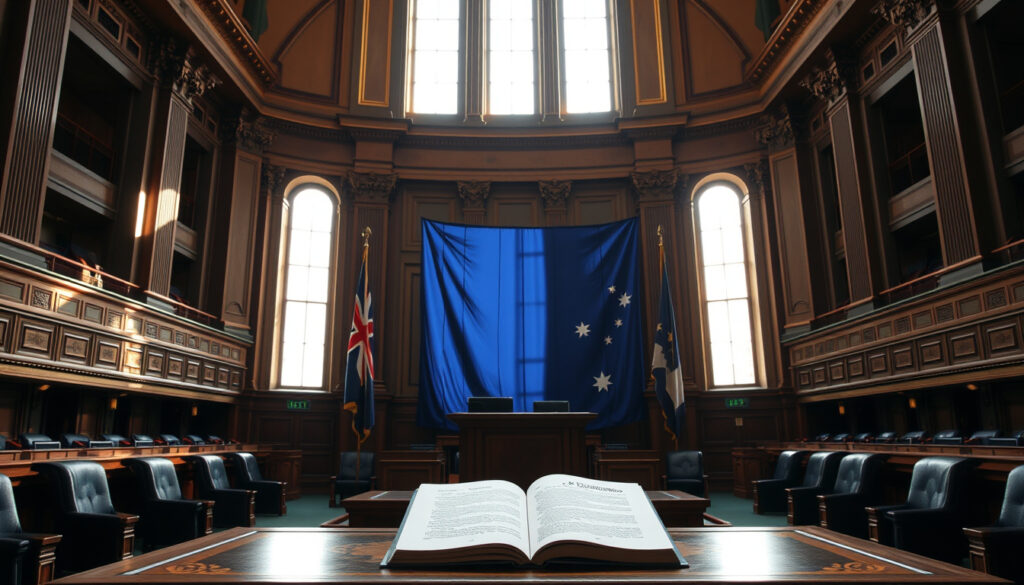
Edmund Barton: First Prime Minister and Federation Leader
There aren’t many leaders who swap the top job for a courtroom, but Edmund Barton did exactly that. He became Australia’s first prime minister when the Commonwealth began on 1 January 1901 (National Museum of Australia), then resigned in 1903 to sit on the High Court.
Born: 18 January 1849, Glebe · Died: 7 January 1920, Sydney · First PM: 1 Jan 1901 – 24 Sep 1903 · Party: Protectionist · High Court: 5 Oct 1903 – 7 Jan 1920
Quick snapshot
- Barton was sworn in as Australia’s first prime minister on 1 January 1901 (National Museum of Australia). (High Court of Australia)
- He helped lead the federation movement and draft the Constitution (National Archives of Australia). (High Court of Australia)
- He served on the High Court from 1903 until his death in 1920 (High Court of Australia).
- Historians still debate how far Barton’s personal views shaped the White Australia policy (Australian Parliament House archive).
- Exactly which delegate wrote specific constitutional clauses is not always clear (First Parliament of Australia).
- Federation began on 1 January 1901; Barton’s ministry was sworn in the same day at Centennial Park (National Museum of Australia).
- He left the prime ministership in September 1903 to join the High Court (High Court of Australia).
- His early High Court rulings are still studied as foundational constitutional law (High Court of Australia).
Six facts capture the shape of a public life split between Parliament House and the High Court.
| Field | Detail |
|---|---|
| Full Name | Sir Edmund Barton |
| Lifespan | 18 January 1849, Glebe – 7 January 1920, Sydney (Parliament of New South Wales) |
| Family | Jane Mason (m. 1877); six children (Australian Parliament House archive) |
| Political Party | Protectionist Party (First Parliament of Australia) |
| Prime Minister Term | 1 January 1901 – 24 September 1903 (National Archives of Australia) |
| High Court Term | 5 October 1903 – 7 January 1920 (Australian Parliament House archive) |
What was Edmund Barton most famous for?
Barton earned his place in Australian history before the Commonwealth even existed.
Early political career
- Called to the Bar in 1871, Barton entered the NSW Legislative Assembly in 1877 and later became Speaker (Parliament of New South Wales profile).
- He built a reputation as a precise debater and a skilled procedural operator, which made him a natural leader for a movement that needed to convince six colonial parliaments.
Role in federation movement
- Henry Parkes’s Tenterfield speech in October 1889 drew Barton fully into the federation cause (National Archives of Australia).
- After Parkes’s death, Barton carried the movement through the 1897–1898 convention campaign and helped draft the Australian Constitution (Australian Parliament House archive).
His political skill was the bridge between the colonial parliaments and the new Commonwealth.
Barton’s fame rests on a rare double: he helped write the Constitution, then became the first person to work under it as prime minister — and the first to judge it from the High Court.
The implication: Barton’s fame rests on the rare ability to shape a constitution, govern under it, and then interpret it.
What changes did Edmund Barton make to Australia?
His government had to turn “federation” from an idea into a legal and economic reality.
Immigration Restriction Act 1901
- The Immigration Restriction Act 1901 was the first major legislative expression of the White Australia policy (First Parliament of Australia).
- Barton also held the External Affairs portfolio in his own government, so he was directly responsible for administering the new law.
- His Protectionist government introduced protective tariffs, shaping the early national economy (Australian Parliament House archive).
These measures defined the new Commonwealth’s borders and economic identity. The Immigration Restriction Act is the part of Barton’s record that modern readers most often revisit, and for good reason.
Barton built the machinery of the new nation quickly, but the White Australia policy was embedded in that machinery. His legislative speed came at a moral cost that Australians are still reckoning with.
Establishment of the High Court
- The Judiciary Act of 1903 completed the federal court system, and Barton resigned to become one of its first justices (High Court of Australia).
- He served on the Court from 5 October 1903 until his death on 7 January 1920.
Barton’s judicial work was quieter than his political career, but it was arguably just as influential. The early Court had to decide what the Constitution’s broad words meant in practice, and Barton helped set those precedents.
The pattern: Barton’s government created the rules, and then Barton spent the rest of his life interpreting them. That is a rare kind of institutional commitment.
What happened to Edmund Barton?
Later political career
- Barton’s prime ministership ended on 24 September 1903, when he resigned to accept a seat on the High Court (National Archives of Australia).
- He had been in office since the Commonwealth’s first day on 1 January 1901.
The resignation surprised some observers, but it was not a fall from power. It was a deliberate change of public service.
Death and legacy
- Barton died in Sydney on 7 January 1920, aged 70 (Parliament of New South Wales).
- His portrait appeared on the Australian five-dollar note from 1992 to 2016.
The five-dollar note tribute tied Barton’s face to everyday Australian life for more than two decades. It was a quiet reminder that the country’s first prime minister is also part of its daily currency.
By leaving the top job after less than three years, Barton made the High Court the final referee of the Constitution he had helped write. That institutional choice still shapes Australian law.
The catch: his choice to leave politics for the bench gave the High Court immediate symbolic weight.
What is a famous quote by Edmund Barton?
Federation speech quotes
- “For the first time, we have a nation for a continent, and a continent for a nation.” (National Museum of Australia)
- Barton used convention addresses to argue that federation was the natural completion of Australian identity (First Parliament of Australia).
The line works because it turns geography into politics. One landmass, one government, one national conversation — that was the promise of 1901.
Quotes on Australian identity
- His convention speeches framed federation as a step toward nationhood, not just a merger of colonial administrations.
Barton was not writing poetry; he was persuading colonists to trust each other with a shared government.
What is a fun fact about Edmund Barton?
Nickname “Toby”
- Barton was known as “Toby” from childhood, a nickname that stayed with him for life (Parliament of New South Wales profile).
- He was also a keen cricketer.
The cricketer detail matters more than it might seem. Barton’s ease in clubs and sporting circles helped him build the cross-party relationships federation required.
Youngest Speaker of the NSW Legislative Assembly
- At 34, he became the youngest Speaker of the NSW Legislative Assembly, serving from 1883 to 1887 (Parliament of New South Wales profile).
That move put Barton at the centre of parliamentary procedure years before he led the federation cause.
The takeaway: Barton’s public persona was more approachable than the official portraits suggest.
Timeline: from federation to the High Court
The National Museum of Australia, National Archives of Australia, Parliament of New South Wales, and the High Court of Australia all document the same arc.
| Date | Event |
|---|---|
| 18 January 1849 | Born in Glebe, New South Wales (Parliament of New South Wales) |
| 1871 | Called to the Bar (Parliament of New South Wales) |
| 1877 | Elected to the NSW Legislative Assembly (Parliament of New South Wales) |
| 1883–1887 | Served as Speaker of the Legislative Assembly (Parliament of New South Wales) |
| 1891 | Attended the first National Australasian Convention (First Parliament of Australia) |
| 1897–1898 | Led the federation campaign; elected to the Constitutional Convention (National Archives of Australia) |
| 1 January 1901 | Sworn in as first Prime Minister of Australia (National Museum of Australia) |
| 24 September 1903 | Resigned as Prime Minister (National Archives of Australia) |
| 5 October 1903 | Appointed as a Justice of the High Court (High Court of Australia) |
| 7 January 1920 | Died in Sydney (Parliament of New South Wales) |
The pattern: every major date in Barton’s life is tied to an institution he helped build or lead.
Confirmed and unclear: reading the record
Confirmed
- Barton was the first prime minister and a High Court justice (National Museum of Australia).
- He was a key figure in federation and helped draft the Constitution (National Archives of Australia).
- His birth and death dates are well documented (Parliament of New South Wales).
What’s unclear
- How far his personal views drove the White Australia policy remains a subject of historical debate (Australian Parliament House archive).
- The exact authorship of some constitutional clauses is not settled (First Parliament of Australia).
- Historians still weigh how much of his federation strategy came from Barton rather than the broader movement (National Archives of Australia).
What this means for readers: historical certainty is strongest on Barton’s institutional roles, weakest on his personal intentions.
In his own words
“For the first time, we have a nation for a continent, and a continent for a nation.”
Edmund Barton, federation celebrations, 1901 (National Museum of Australia)
“Barton was a key player in the federation movement and a leader of the Constitutional Conventions.”
High Court of Australia, official biography (High Court of Australia)
Edmund Barton’s double career is the reason Australians still study the first three years of federation. He helped write the rules, ran the first government under them, and then spent sixteen years interpreting them from the bench. For modern federal politicians, the lesson is direct: the institutions Barton built were designed to outlast any single government — and they still do.
The device: pairing Barton’s own words with an institution’s appraisal of him closes the loop on his public legacy.
naa.gov.au, en.wikipedia.org, britannica.com, australian.museum
Frequently asked questions
Who was Australia’s first prime minister?
Edmund Barton, who took office on 1 January 1901 when the six colonies became the Commonwealth of Australia (National Museum of Australia).
How long did Edmund Barton serve as prime minister?
From 1 January 1901 to 24 September 1903, when he left to join the High Court (National Archives of Australia).
What political party did Edmund Barton lead?
The Protectionist Party, which formed Australia’s first federal government (First Parliament of Australia).
Did Edmund Barton serve on the High Court of Australia?
Yes. He was appointed on 5 October 1903 and served until his death on 7 January 1920 (High Court of Australia).
What was Edmund Barton’s nickname?
“Toby” — a childhood nickname that stayed with him through his political and judicial career (Parliament of New South Wales).
What was the White Australia policy and what was Barton’s role?
The policy was implemented through the Immigration Restriction Act 1901, passed by Barton’s government. Barton is therefore closely associated with one of the most controversial pieces of early Commonwealth legislation (Australian Parliament House archive).
How did Edmund Barton contribute to Australian federation?
He led the federation campaign after Henry Parkes’s death, chaired the constitutional conventions, and helped draft the Australian Constitution (National Archives of Australia).
More related posts
 Brain Stem: Parts, Function, Damage, and Signs of Brainstem Death
 Diana Rigg: Her Private Life – Smoking, Net Worth, and More
 Sir Donald Bradman: Records, Net Worth, and War Service
 Katy Perry personal life rumors: split, Trudeau, facts
 Dustin Martin’s Retirement, Net Worth & Father’s Deportation
 Esteban Ocon: F1 Career, Wins, and Verstappen Rivalry
 Tommy Shelby: The Real Story Behind Peaky Blinders
 Gregg Popovich Stroke: End of a Legendary Coaching Career
