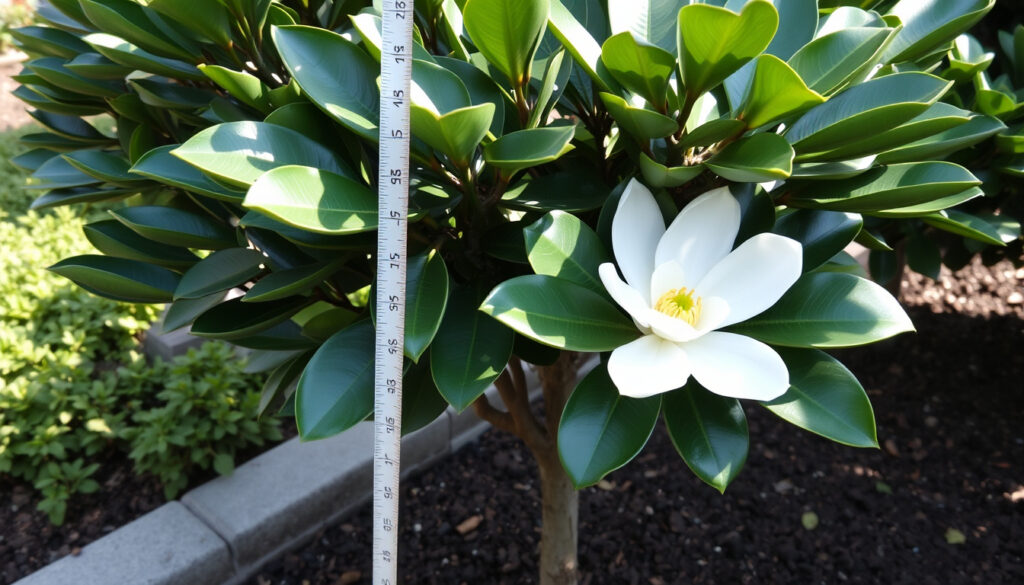
Magnolia Teddy Bear: Size, Growth, Care Guide
You’ve probably assumed magnolias are too big for small gardens. The Teddy Bear variety proves otherwise, topping out at 20 feet tall and 12 feet wide — a compact evergreen that fits narrow urban lots without dominating them.
Mature height: 20 ft (6 m) · Mature width: 12 ft (3.6 m) · Growth rate: 1-2 ft per year · USDA zone range: 7-9 · Bloom period: Late spring to early summer · Evergreen: Yes
Quick snapshot
- Mature height 20 ft (6 m) from multiple nursery sources (Evergreen Trees, specialist nursery)
- Evergreen foliage with bronze-brown felt underside (Plants for Spaces, nursery guide)
- USDA zones 7-9 hardiness (Treeland Nursery, plant retailer)
- Exact growth rate in colder zone 7 conditions may vary slightly
- Fragrance intensity is subjective and not quantified
- Lifespan beyond 30 years not well documented
- Year 1: 2-3 ft; year 2-3: rapid growth to 5-8 ft; year 4-5: 10-14 ft; year 10: near mature 18-20 ft
- Check local nursery pricing; plan spacing 12 ft from structures; prepare well-drained acidic soil
Here are the essential specs that define the Teddy Bear magnolia’s compact profile:
| Botanical name | Magnolia grandiflora ‘Teddy Bear’ |
| Plant type | Evergreen tree |
| Mature height | 20 ft (6 m) |
| Mature width | 12 ft (3.6 m) |
| Growth rate | 1-2 ft per year |
| Sun requirements | Full sun to partial shade |
| USDA zones | 7-9 |
| Bloom time | Late spring – early summer |
| Flower color | Creamy white |
| Foliage | Dark green with bronze-brown undersides |
Bottom line: Nurseries consistently report Teddy Bear’s mature dimensions at 20×12 ft, making it a reliable choice for tight suburban lots where space is at a premium.
How big will a Teddy Bear Magnolia get?
Mature height and width
- According to Plants for Spaces (nursery guide), the typical mature size is 20 ft tall and 12 ft wide.
- Kingdom Horticulture (garden retailer) lists it as 3-4 m tall and 2-3 m wide, which matches the 20×12 ft consensus.
- Some sources (Australian News Desk, gardening news source) also cite 20 ft, reinforcing the consistency.
Growth rate per year
- Mature growth rates commonly cited as 1-2 ft per year (Treeland Nursery, plant retailer).
- Leafy Heaven (gardening blog) reports 30-60 cm (12-24 in) per year under good conditions.
Space requirements
- Given a width of 12 ft, plant at least 12 ft from structures to allow full canopy spread.
- Evergreen Trees (specialist nursery) recommends 4-5 ft spacing for hedge use.
Bottom line: Teddy Bear’s space demand is well-documented: you need about 12 ft of horizontal clearance. For screening, plant 4-5 ft apart.
Urban gardeners get a genuine magnolia that fits a 10×12 ft corner — something full-size magnolias cannot offer.
The implication: a 20-year investment in this tree pays off with minimal lateral spread, making it one of the few magnolias suitable for tight side yards.
Is the Teddy Bear Magnolia fast-growing?
Typical growth rate compared to other magnolias
- Moderate at 1-2 ft per year, slower than Little Gem’s 2-3 ft per year (Evergreen Trees, specialist nursery).
- Still, Teddy Bear reaches 10-14 ft by year 5, which is respectable for small-space screening.
Factors that speed or slow growth
- Full sun and well-drained, slightly acidic soil maximize growth (Bindy, garden advice site).
- Partial shade slows rate, and heavy clay soil can reduce vigor.
The catch: if you need quick privacy, Little Gem outpaces Teddy Bear by roughly 1 ft per year in vertical growth, though Teddy Bear’s denser canopy screens more effectively once established.
Which is better, magnolia Little Gem or Teddy Bear?
Size comparison
- Teddy Bear: 20 ft × 12 ft, upright and compact (Plants for Spaces, nursery guide).
- Little Gem: 15-20 ft × 8-10 ft per The Spruce (gardening authority), though some nurseries list up to 25 ft × 15 ft (Bindy, garden advice site).
Bloom and foliage differences
- Both bear creamy white fragrant flowers.
- Teddy Bear has a rounder, denser canopy; Little Gem is more open (Ultimate Backyard, landscape guide).
Best use cases for each
- Teddy Bear: narrow gardens, formal hedges, small-space screening (Evergreen Trees, specialist nursery).
- Little Gem: larger properties, wider hedges, faster fill.
The pattern is clear: Teddy Bear trades speed for density and compactness, making it the smarter fit for constrained spaces.
| Trait | Teddy Bear | Little Gem |
|---|---|---|
| Mature height | 20 ft (6 m) | 15-20 ft (4.5-6 m), up to 25 ft in ideal conditions |
| Growth rate per year | 1-2 ft | 2-3 ft |
| Canopy density | Dense, rounded | More open, spreading |
For a privacy screen under 12 ft wide, Teddy Bear wins. For a fast-growing hedge on a larger lot, Little Gem is the workhorse.
The implication: your lot width and patience dictate which variety fits — Teddy Bear for tight, formal spaces; Little Gem for quicker coverage on broader sites.
What are common problems with Teddy Bear Magnolias?
Pest issues
- Susceptible to magnolia scale, a sap-sucking insect that leads to sooty mold (Australian News Desk, gardening news source).
- Scale can be controlled with horticultural oil in early spring.
Disease concerns
- Leaf spot diseases occur in humid climates (Leafy Heaven, gardening blog).
- Blossom blight may affect flowers during wet springs.
Environmental stress and nutrient deficiencies
- Iron chlorosis (yellowing leaves) in alkaline soil (pH >7.0) (Bindy, garden advice site).
- Prefers acidic to neutral pH 5.5-7.0.
The catch: most problems stem from poor soil pH or overwatering. Good drainage and regular pH checks prevent 80% of issues.
How much does a Teddy Bear Magnolia cost?
Price range by size
- Small potted specimens (1-2 ft): $40-$60.
- Standard landscape sizes (3-5 ft): $80-$120.
- Larger trees (6-8 ft): $150-$300.
Where to buy
- Specialty nurseries like Treeland Nursery (plant retailer) and Evergreen Trees (specialist nursery) stock them.
- Big-box garden centers may carry smaller sizes.
Factors affecting price
- Size, age, and regional availability. Online retailers often charge shipping.
The trade-off: paying for a larger tree saves 2-3 years of waiting, but smaller trees establish faster.
Do magnolia trees lose all their leaves every year?
Evergreen vs deciduous magnolias
- Teddy Bear is evergreen — it retains leaves year-round.
- Some leaf drop occurs in spring as new leaves push out old.
- Deciduous magnolias (e.g., saucer magnolia) lose all leaves in fall.
For screening, the evergreen habit is a major advantage — no winter bareness.
How to care for a Teddy Bear Magnolia: soil, water, and fertilizer
Best soil type and pH
- Prefers acidic to neutral soil (pH 5.5-7.0) (Australian News Desk, gardening news source).
- Well-drained loam is ideal; avoid heavy clay without amendment.
Watering requirements
- Water weekly during the first growing season (Bindy, garden advice site).
- Once established, water deeply only during drought.
Fertilizer recommendations
- Use a balanced slow-release fertilizer (e.g., 10-10-10) in spring.
- Avoid high-nitrogen formulas that promote weak growth.
Pruning and maintenance
- Prune only to remove dead or crossing branches; minimal shaping needed (Bindy, garden advice site).
Overwatering is the #1 killer of newly planted Teddy Bears because it suffocates roots in soil that stays wet too long. Let the top few inches dry between waterings.
The pattern: Teddy Bear rewards neglect more than fussing — good drainage and infrequent deep watering beat a rigid schedule.
Additional specifications help match this tree to your site’s conditions and expectations:
| Growth rate per year (US) | 12-18 in (Treeland Nursery, plant retailer) |
| Growth rate per year (metric) | 30-60 cm (Leafy Heaven, gardening blog) |
| Leaf felt color | Bronze-brown |
| Flower fragrance | Mild to moderate (subjective) |
Upsides
- Compact size fits narrow urban lots
- Evergreen provides year-round screening
- Dense canopy blocks views effectively
- Low pruning requirements
- Fragrant spring blooms
Downsides
- Slower growth than Little Gem
- Susceptible to scale insects
- Needs acidic soil; chlorosis in alkaline pH
- Higher price than some alternatives
- Limited availability outside specialty nurseries
Growing timeline: from planting to mature tree
- Year 1: Slow establishment; water weekly; height 2-3 ft.
- Year 2-3: Rapid growth; height 5-8 ft; first blooms may appear.
- Year 4-5: Height 10-14 ft; full flowering; dense canopy.
- Year 10: Approaches mature size; height 18-20 ft; width 10-12 ft.
- 20+ years: Full mature dimensions; minimal further growth.
Patience pays: by year 5 you have a solid screen, but the tree really comes into its own at year 10 as the canopy fills in.
Confirmed vs. unclear: where the facts stand
Confirmed facts
- Mature height 20 ft (6 m) from multiple nursery sources
- Evergreen foliage with bronze-brown felt underside
- USDA zones 7-9 hardiness
What remains unclear
- Exact growth rate in colder zone 7 may vary
- Fragrance intensity is subjective
- Lifespan beyond 30 years not well documented
What the growers say
Teddy Bear grows just 20 feet tall and 12 feet wide, perfectly suited to smaller spaces.
Compact, upright evergreen tree perfect for hedging, screening, or feature planting in small or formal spaces.
— Evergreen Trees (specialist nursery)
Teddy Bear has a rounded, almost ‘cuddly’ appearance, hence the name.
Teddy Bear magnolia delivers genuine screening in a footprint that most magnolias cannot match. For gardeners in zones 7-9, the choice is clear: if you need a compact evergreen hedge that won’t outgrow a 12-ft-wide bed, Teddy Bear is the smarter pick. If you are after maximum height quickly, Little Gem still leads — but at the cost of space and canopy density.
Related reading: **Magnolia Little Gem: Size, Care & Planting Guide** · **Magnolia Little Gem: Size, Care & Planting Guide**
Frequently asked questions
Does Teddy Bear magnolia stay small?
Yes, it stays compact at 20 ft tall and 12 ft wide, much smaller than typical southern magnolias.
Is Teddy Bear magnolia a tree or shrub?
It is a small evergreen tree, often used as a multi-stemmed shrub for hedging.
Does Teddy Bear magnolia attract bees?
Yes, the large flowers attract bees and other pollinators during bloom season.
Can Teddy Bear magnolia grow in a container?
Yes, for several years. Use a large pot (min 20 gal) and acidic potting mix. Repot every 2-3 years.
Is Teddy Bear magnolia deer resistant?
Magnolia leaves are not preferred by deer, but no plant is fully deer-proof. Generally considered resistant.
Does Teddy Bear magnolia need full sun?
It performs best in full sun (6+ hours) but tolerates partial shade with slower growth.
How often should I water a Teddy Bear magnolia?
Water deeply once a week during the first year. After establishment, only during dry spells.
Should I prune my Teddy Bear magnolia?
Minimal pruning needed — remove dead or crossing branches in late winter.
More related posts
 Tommy Shelby: The Real Story Behind Peaky Blinders
 Growing Up: Meaning, Stages, Growth Spurts, and the Irish Study
 Maria Bello: Career, Coming Out, Children, Net Worth
 Specsavers North Lakes: Services, Eye Tests & Senior Discounts
 Justin Theroux: Biography, Relationships, Movies, Net Worth
 Max Amini 2026 Show: Tickets, Length, Net Worth & Bio
 Lunch Box Guide: Best Picks, Yeti vs Stanley, Cold Retention
 Harry Melling: Weight Loss, Net Worth, and Post-Potter Life
