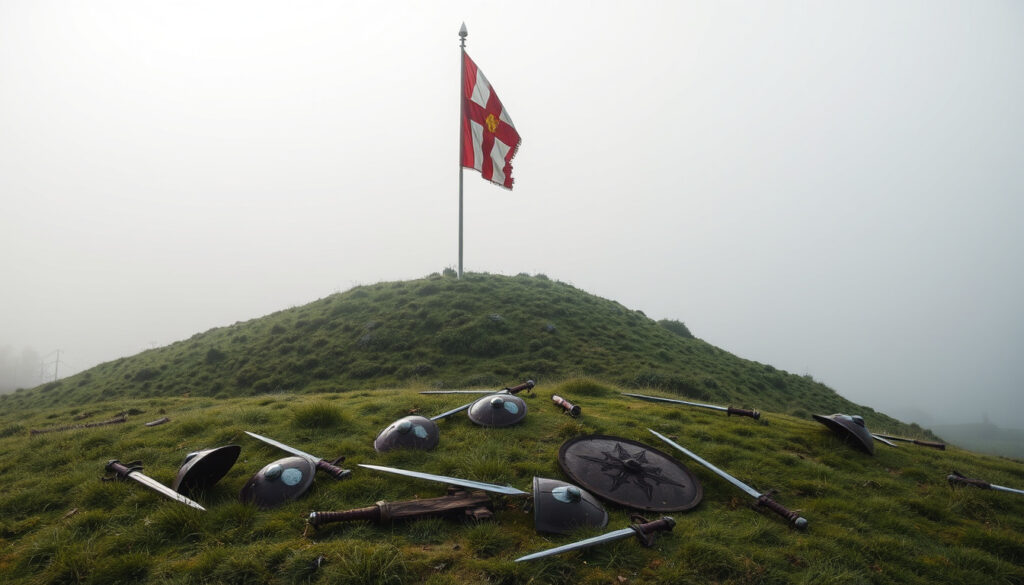
William the Conqueror: Claim, Family, Battle of Hastings & Legacy
Few dates in English history carry as much weight as 1066, but the story behind it is often told as a simple clash of kings. What gets lost is the human web: the families who lost fathers, the wives who identified bodies on a muddy battlefield, and the children who spent years in exile. This article follows both the Godwinsons and the Normans through the succession crisis, the Battle of Hastings, and its aftermath — with a special eye on the women and children who rarely make the headline.
Born: c. 1028, Falaise, Normandy ·
Crowned: 25 December 1066, Westminster Abbey ·
Reign: 1066–1087 (around 21 years) ·
Key battle: Battle of Hastings, 14 October 1066 ·
Died: 9 September 1087, Rouen, Normandy
Quick snapshot
- Edward the Confessor died on 5 January 1066 without a clear heir; Harold Godwinson was crowned on 6 January 1066; William was crowned King of England on 25 December 1066 (English Heritage (official heritage site)).
- Edward’s exact deathbed words; whether Harold’s oath to William was freely given or forced; whether Edward’s marriage was unconsummated; what happened to Harold’s wife Edith the Fair after Hastings (World History Encyclopedia (peer-reviewed history encyclopedia)).
- 28 September 1066: William lands at Pevensey; 14 October 1066: Harold killed at Hastings; 25 December 1066: William crowned; 1086: Domesday Book compiled (History and Culture (medieval timeline)).
- William reshapes England with castles, Norman feudalism, and the Domesday tax survey; his sons Robert Curthose, William Rufus, and Henry compete for power; Norman French becomes the language of the court and ruling class (Encyclopaedia Britannica (established reference work)).
These core facts set the stage for everything that follows.
| Label | Value |
|---|---|
| Full French name | Guillaume le Conquérant |
| Born | c. 1028, Falaise, Normandy |
| Wife | Matilda of Flanders |
| Reign | 1066–1087 |
| Coronation | 25 December 1066 |
| Death | 9 September 1087, Rouen |
What is the French name for William the Conqueror?
In French, William the Conqueror is Guillaume le Conquérant. He was born c. 1028 in Falaise, Normandy, to Robert I, Duke of Normandy, and Herleva. After his father’s death in 1035, William inherited the dukedom as a child and faced a violent minority before emerging as a formidable ruler.
Was William the Conqueror English?
No. William was Norman by birth, culture, and language. He became William I of England, but he never considered himself English. The Normans themselves were descendants of Viking settlers, and the name Normandy reflects that Norse heritage.
What was William the Conqueror famous for?
He is most famous for defeating Harold Godwinson at the Battle of Hastings on 14 October 1066 and becoming the first Norman king of England. His reign introduced Norman feudalism, the construction of castles (including the Tower of London), and the Domesday Book of 1086, a comprehensive tax survey.
Who ruled after William the Conqueror?
William was succeeded as King of England by his second son, William II (Rufus), while his eldest son, Robert Curthose, succeeded as Duke of Normandy. A third son, Henry, later became Henry I of England.
What did William the Conqueror’s family tree include?
William married Matilda of Flanders in the early 1050s. They had at least four sons and four daughters. Notable sons: Robert Curthose, William Rufus, and Henry. His maternal half-brothers included Odo of Bayeux and Robert, Count of Mortain, both key figures after the conquest.
What are 10 interesting facts about the Normans?
- The Normans were originally Viking settlers granted land in France in 911.
- They adopted French language and Christianity within a few generations.
- Norman military tactics relied on cavalry and the castle as a fortification.
- Their architecture introduced the Romanesque style to England.
- The Bayeux Tapestry is a Norman visual record of the conquest.
- Norman rule replaced most Anglo-Saxon bishops with Norman clergy.
- The Domesday Book remains the earliest surviving public record in England.
- Norman kings ruled England for over 80 years (1066–1154).
- Norman French influenced the English language heavily, especially legal and court terms.
- Many English surnames today derive from Norman place names.
This family background explains why the Norman conquest became a wholesale transfer of power, not just a dynastic shift.
Who had the better claim, Harold or William?
This question is the heart of 1066. The competing claims rest on different types of legitimacy: Harold had election by the Witan (the council of nobles) and a close family tie to the late king; William relied on a supposed promise from Edward and an oath sworn by Harold.
Two facts, one pattern: both men had strong arguments on paper, but neither had a clear legal precedent.
| Factor | Harold Godwinson | William of Normandy |
|---|---|---|
| Blood relation to Edward | None (brother-in-law via sister Edith) | Distant (great-nephew of Emma, Edward’s mother) |
| Election by Witan | Yes – crowned 6 Jan 1066 | No |
| Edward’s promise | No written evidence | Claimed by Norman sources; no Anglo-Saxon source confirms it |
| Oath sworn by Harold | Admitted to visiting Normandy; nature of oath disputed | Norman sources say Harold swore to support William’s succession |
| Political power pre-1066 | Dominant earl; led England’s government | Powerful duke but no authority in England |
What did Edward the Confessor say on his deathbed?
According to the Anglo-Saxon Chronicle, Edward commended the kingdom to Harold with the words “into Harold’s hand.” Norman chroniclers later claimed he had promised the crown to William. The exact words are lost — each side recorded what served its narrative.
Was Edward the Confessor celibate?
Edward married Edith of Wessex, Harold’s sister, in 1045. The couple had no children, and later chroniclers (especially Norman ones) claimed the marriage was chaste — possibly a vow of celibacy. Historians treat this cautiously; it may simply have been an infertile marriage.
Did Harold Godwin ever meet William the Conqueror?
Yes. Harold visited Normandy in 1064 or 1065 — possibly on a diplomatic mission for Edward. Norman sources claim that during this visit Harold swore an oath on holy relics to support William’s claim to the English throne. The Bayeux Tapestry depicts the scene prominently. Whether the oath was voluntary or coerced is unclear.
Which King of England died without a clear heir in 1066?
Edward the Confessor, who died on 5 January 1066. He had no children, and no direct named heir. His death triggered the succession crisis that led to Harold’s election and William’s invasion.
For anyone studying 1066, the competing claims show that medieval legitimacy was a blend of election, kinship, and force. The outcome was decided not by which claim was more just, but by who won the field.
The lesson of the succession crisis is that in medieval power struggles, the legal argument is often the last thing that matters.
What was William the Conqueror’s role in the Battle of Hastings?
William was the commander of the Norman invasion force. On 14 October 1066 at Senlac Hill, near Hastings, he led his army against Harold’s English troops. The battle lasted a full day and ended with Harold’s death — according to the Bayeux Tapestry, an arrow in the eye, though the exact manner remains debated.
Why did William invade England in 1066?
William claimed that Edward the Confessor had promised him the crown and that Harold had sworn an oath to uphold that promise. When Harold took the throne in January 1066, William assembled a fleet and secured papal support to press his claim by force.
How did William the Conqueror change England?
- He introduced Norman feudalism, replacing Anglo-Saxon lords with Norman barons.
- He built castles across England, including the Tower of London and Windsor Castle.
- He ordered the Domesday Book in 1086, a vast survey of land and resources.
- Norman French became the language of the court, law, and administration.
- The Church hierarchy was restaffed with Norman bishops and abbots.
When did William the Conqueror die?
William died on 9 September 1087 in Rouen, Normandy, after a reign of about 21 years. He was buried at the Abbey of Saint-Étienne in Caen.
How long did William the Conqueror rule England?
His English reign lasted from his coronation on 25 December 1066 until his death in 1087 — approximately 21 years. He spent much of that time in Normandy, managing his continental territories.
Was William the Conqueror a good king?
The answer depends on perspective. On the one hand, William brought strong central rule, a unified coinage, and the Domesday Book — a remarkable administrative achievement. On the other hand, he was brutal: the Harrying of the North (1069–1070) devastated vast areas of Yorkshire and the north, causing famine and displacing thousands. The Anglo-Saxon Chronicle records that he was fiercely oppressive to the native population.
The “good king” label is anachronistic. Medieval kingship was judged on strength and order, not modern ethics. By those standards, William succeeded. But his methods — especially the Harrying of the North — were unforgiving even by 11th-century norms.
The ambiguity of his legacy is as much a statement about medieval rulership as about William himself.
What did William the Conqueror do to Harold’s family?
After Hastings, Harold’s family lost everything. According to medieval tradition, Harold’s wife Edith the Fair (also known as Edith Swan-neck) identified his mutilated body on the battlefield. She was never allowed to hold power again.
What happened to Harold’s wife when he died?
Edith the Fair disappears from historical records after 1066. No chronicle states what became of her. The Anglo-Saxon Chronicle is silent. She likely lost all her lands and status, as the Normans confiscated the estates of every English family that had resisted.
What happened to King Harold’s children after 1066?
Harold’s sons — Godwine, Edmund, Magnus, and perhaps others — took refuge in Ireland and later in Norway. They launched raids along the south coast of England in 1068 and 1069, but failed to recover their father’s kingdom. By the 1070s they disappear from English records. Harold’s daughter Gytha reportedly married Vladimir Monomakh, Grand Prince of Kyiv, but this is based on later continental chronicles (FamilySearch (genealogical database)).
The personal tragedies of Harold’s family are often overshadowed by the battle, but they were among its most permanent consequences.
What happened to William the Conqueror’s wife after 1066?
William’s wife, Matilda of Flanders, was crowned Queen of England in 1068 — two years after the conquest. The delay likely reflects the chaos of securing England rather than any slight.
Who was William the Conqueror’s wife?
Matilda of Flanders, daughter of Baldwin V, Count of Flanders. The marriage, arranged in the early 1050s, strengthened William’s diplomatic position in northern Europe. Matilda was a capable ruler in her own right.
How did Matilda become queen after 1066?
She traveled to England in 1068 and was crowned at Westminster Abbey by the Archbishop of York. The ceremony affirmed her status as the new queen of a conquered kingdom.
What happened to Matilda while William ruled England?
Matilda frequently acted as regent of Normandy while William was in England. She managed the duchy’s affairs, corresponded with the Pope, and commissioned religious works. She died in 1083, four years before her husband.
Did Matilda and William have children?
Yes. At least four sons — Robert Curthose, Richard (died young), William Rufus, and Henry — and four daughters. Their children shaped the next generation of Anglo-Norman history: Robert became Duke of Normandy, William II and Henry I became kings of England.
Matilda’s invisibility in most histories of 1066 reflects a broader gap: we know much more about the conquerors’ battles than about the women who kept the duchies running. For readers interested in medieval queenship, she deserves far more attention.
The record of her regency proves that Matilda was a political actor in her own right, not just a king’s wife.
Comparison: Harold Godwinson versus William of Normandy — family, power, resources
Three dimensions, one pattern: Harold had native power and political control; William had a hereditary claim (however shaky) and a military machine ready to be unleashed.
| Dimension | Harold Godwinson | William of Normandy |
|---|---|---|
| Family network | Earl of Wessex; brother-in-law of Edward; children with Edith the Fair | Son of Duke Robert; married to Matilda of Flanders; half-brothers Odo and Robert |
| Claim basis | Elected by Witan; Edward’s deathbed commendation | Edward’s promise (claimed); Harold’s oath (Norman sources) |
| Military resources | English fyrd (army) and housecarls; fleet limited | Norman cavalry, archers, and a large invasion fleet; papal banner |
| Post-1066 fate | Killed in battle; family exiled | King of England; founded Norman dynasty |
The pattern is clear: Harold’s power was rooted in English political institutions, while William’s was built on a military edge and a network of allies.
Upsides of William’s rule
- Strong central government and unified coinage
- Domesday Book gave England an unprecedented administrative record
- Castle building improved defense and control
- Norman church reforms brought England closer to European standards
Downsides of William’s rule
- Harrying of the North caused mass starvation
- Anglo-Saxon nobility replaced wholesale
- Forest laws restricted commoners’ rights
- French became the language of power, alienating the English
These opposing lenses are why any verdict on William’s kingship depends on whose side you stand.
Timeline of William the Conqueror and 1066
- c. 1028 — Born at Falaise in Normandy
- 1035 — Became Duke of Normandy after his father’s death
- c. 1064/1065 — Harold visited Normandy; Norman sources say he swore an oath to William
- 5 January 1066 — Edward the Confessor died
- 6 January 1066 — Harold Godwinson crowned king
- 28 September 1066 — William landed in England at Pevensey
- 14 October 1066 — Harold killed at the Battle of Hastings
- 25 December 1066 — William crowned King of England
- 1086 — Domesday Book compiled
- 9 September 1087 — William died in Rouen, Normandy
The sequence shows how quickly the crown changed hands — and how many decades were needed to consolidate the conquest.
What we know — and what we don’t
Confirmed facts
- William was crowned on 25 December 1066; Harold was killed at Hastings on 14 October 1066; Matilda was crowned Queen of England in 1068; Matilda died in 1083; William died on 9 September 1087 (English Heritage (official heritage site)).
What’s unclear
- Edward the Confessor’s exact deathbed words; whether Harold’s oath to William was freely given or forced; whether Edward’s marriage was unconsummated; what happened to Harold’s wife Edith the Fair after Hastings; the precise later lives of Harold’s children after their recorded raids (World History Encyclopedia (peer-reviewed history encyclopedia)).
What remains unknown about 1066 is not a footnote — it is a reminder that chronicles always serve a point of view.
“Then King Edward gave up the kingdom to Harold, as he had done before, and departed this life on the eve of the Epiphany.”
— Anglo-Saxon Chronicle (contemporary English chronicle), entry for 1066
“William, duke of the Normans, after a battle of great slaughter, gained the victory and the kingdom of England.”
— William of Poitiers (Norman chaplain), Gesta Guillelmi
“The Bayeux Tapestry shows Harold taking an oath to William on holy relics, then later falling at Hastings.”
— Bayeux Tapestry (visual chronicle, c. 1070s)
“William was a stern man, fierce and powerful, who laid heavy taxes on the people and devastated the north.”
— Anglo-Saxon Chronicle (English chronicle), obituary entry for 1087
What is the Domesday Book?
The Domesday Book is a manuscript record of the “Great Survey” of much of England and parts of Wales, completed in 1086 on William’s orders. It was a comprehensive inventory of land, resources, and tax liabilities, and it remains a vital primary source for English medieval history.
Why did William the Conqueror build castles?
Castles served as military fortifications, administrative centers, and symbols of Norman power over a conquered population. William built dozens of motte-and-bailey castles, including the Tower of London, to control strategic points and suppress rebellion.
Where is William the Conqueror buried?
William is buried at the Abbey of Saint-Étienne (also known as Abbaye aux Hommes) in Caen, Normandy, which he had founded. His tomb was disturbed during the religious wars of the 16th century and again in the 18th, so only a few bones are believed to remain.
Did William the Conqueror speak English?
No. William spoke Norman French and Latin. He made no attempt to learn English, and the Anglo-Saxon Chronicle notes that he “could not speak much English.” Norman French became the language of the English court and legal system for centuries.
What was the Harrying of the North?
The Harrying of the North (1069–1070) was William’s brutal campaign to suppress rebellion in northern England. He ordered the deliberate destruction of crops, livestock, and entire villages, causing a famine that killed thousands. The Anglo-Saxon Chronicle describes it as a devastation from which Yorkshire took decades to recover.
Why did William face rebellions after 1066?
English nobles, especially in the north and the Fenlands, resisted Norman rule. Rebellions in 1067–1069, often supported by Harold’s sons and Danish invaders, were crushed by William’s mobile cavalry and scorched-earth tactics. The rebellions ended after the Harrying of the North broke resistance.
For readers who want to explore more of history’s fascinating figures, check out Al Capone: The Real Story of His Fortune, Power, and Death and Indira Gandhi: The Polarizing Legacy of India’s First Female PM.
The Norman Conquest of 1066 was not simply a change of kings — it was a violent social revolution that replaced one ruling class with another. For the descendants of Harold Godwinson, the choice was clear: exile or assimilation. For modern readers trying to understand English history, the lesson is just as sharp: every story of a conqueror is also a story of the conquered.
More related posts
 Claudia Jessie: Age, Husband, Eye Condition, and More
 Olivia Cooke: Relationship, Ethnicity, Wig, OCD, Net Worth & More
 Damien Hardwick: New Partner, Salary, and Why He Left Richmond
 Heidi Klum: Biography, Facts, Family, Career and Net Worth
 Kellie Sloane: Biography, Political Career & Personal Life
 Katie McGrath: Career, Personal Life, and Rumors — Facts vs. Speculation
 Sophie Dee: Biography, Nationality, Net Worth & Personal Life
