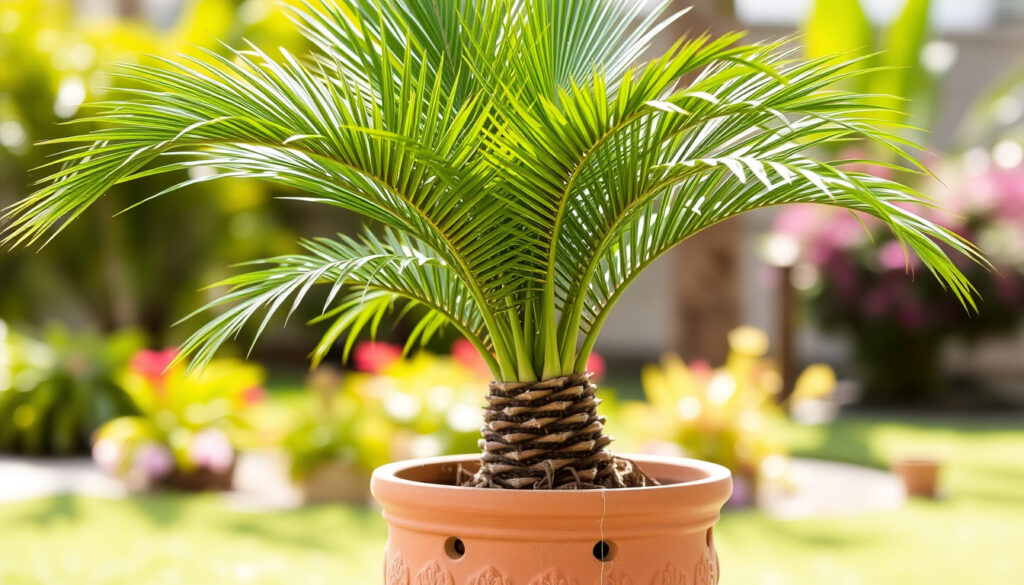
Bangalow Palm Guide: Size, Growth, Pots, and Roots
Anyone who has watched a Bangalow palm shoot up in a backyard has probably wondered: how does something that slender grow so fast? This guide lays out the real trade-offs of planting one — size, speed, mess, and whether it can thrive in a pot.
Scientific name: Archontophoenix cunninghamiana · Native range: Coastal NSW and Queensland, Australia · Maximum height: 30 meters (98 feet) · Growth rate: Fast (up to 1 meter per year in ideal conditions) · Common uses: Ornamental, subtropical gardens, potted displays
Quick snapshot
- Endemic to eastern Australia (Wikipedia (botanical reference))
- Maximum height of 30 meters in the wild (Palmeras y Jardines (species catalogue))
- Fibrous, non-invasive root system (Thursd (gardening resource))
- Exact safe planting distance from house foundations varies with soil type
- Long-term pot survival beyond 5 years depends on container size and care
- Fruit toxicity to pets or humans not widely studied
- Seedlings reach 1–2 meters in 3 years under good care (Norwich Gardener (care guide))
- Growth slows after 10–15 meters (Norwich Gardener (care guide))
- Repotting needed every 1–2 years for container plants (Growli (container guide))
- Check local regulations if planting in New Zealand — potential invasive status flagged (Tiakitamakimakaurau (Auckland Council guidance))
- Monitor for pests like spider mites in indoor or potted settings (Tiakitamakimakaurau (Auckland Council guidance))
- Plan for fruit drop and leaf litter near patios or pools (Tiakitamakimakaurau (Auckland Council guidance))
The following table provides a quick reference of key attributes.
| Attribute | Value |
|---|---|
| Scientific name | Archontophoenix cunninghamiana |
| Family | Arecaceae |
| Native to | Eastern Australia (NSW, Queensland) |
| Max height | 30 m (98 ft) |
| Growth rate | Fast (0.5–1 m per year) |
| Soil pH | 5.5–7.5 |
| Hardiness | USDA zones 10–11 |
| Fruit color | Green maturing to scarlet |
| Self-cleaning | Yes |
| Invasive status | Not invasive in native range; potentially in New Zealand |
How big does a Bangalow palm grow?
Maximum height and trunk diameter
In the wild, the Bangalow palm can reach a height of 30 meters (98 feet), according to the Wikipedia (botanical reference). The trunk remains slender and uniform in diameter, typically 20–30 cm wide, with prominent ring scars. In garden settings, most specimens top out between 10 and 20 meters — still tall enough to dominate a suburban backyard.
A 30-meter palm casting shade over a 6-meter house is a genuine spatial conflict. Plant it where vertical clearance is not an issue.
Growth rate per year
The Palmeras y Jardines species catalogue (horticultural database) classifies trunk growth exceeding 1 meter per year as “fast,” and this palm fits that category. The Norwich Gardener care guide (gardening resource) reports a typical rate of 2 to 3 feet (0.6–0.9 m) per year, with newly transplanted palms growing only about 1 foot in the first year as they establish roots.
How quickly does a Bangalow Palm grow?
Factors affecting growth speed
Growth rate depends on sunlight, water, and soil quality. In full sun with consistent moisture, the Thursd gardening guide (editorial resource) notes that ideal conditions can push growth toward the upper end of the range. Shade and poor drainage slow it down significantly. The Palmeras y Jardines catalogue (species database) defines medium trunk growth as 30–90 cm per year — the range most home gardeners can expect.
Typical timeline from seedling to mature
Seedlings raised in individual tubes or pots, as recommended by Hortdata (government horticultural database), can reach 1–2 meters within three years under good care. Growth remains vigorous until the palm hits about 10–15 meters, after which the rate tapers.
Comparison with other palms
Among commonly cultivated Australian palms, the Bangalow is one of the faster growers — outpacing the Kentia palm (Howea forsteriana) by a factor of 2–3× in yearly height gain, but slightly slower than the Alexander palm in warm, humid conditions.
Are the roots of the Bangalow palm invasive?
Root system characteristics
The Bangalow palm produces a fibrous, shallow root system. Thursd (gardening editorial) describes the roots as “shallow and non-aggressive,” meaning they spread laterally rather than diving deep. This contrasts with large trees like figs or willows, whose roots actively seek out pipes and foundations.
Risk to foundations and pipes
The same Thursd guide states the Bangalow palm is generally safe to plant near buildings, fences, and pipes. The fibrous roots rarely exert enough pressure to crack concrete or invade drainage lines. However, planting directly over underground pipes is still not recommended — the roots may follow moisture gradients and cause minor blockages in aging clay pipes.
Invasive potential as a species
Within its native range — coastal NSW and Queensland — the Bangalow palm is not classified as invasive. But outside Australia, the picture shifts. Tiakitamakimakaurau (Auckland Council, New Zealand government agency) has flagged the species as a potential environmental weed because it can naturalize in moist forest margins and outcompete native understorey plants.
Your foundation is safe — but if you live in New Zealand, Hawaii, or similar climates, the Bangalow palm’s seeds may travel beyond your garden. Check local weed lists before planting.
How close to a house should a palm tree be planted?
General rule for palm trees
Most horticultural sources recommend a minimum of 2–3 meters between a palm trunk and any building wall. This accounts for the crown spread, falling fronds, and future root expansion.
Specific recommendations for Bangalow palm
Given its non-aggressive root system, the Bangalow palm can be planted as close as 1.5–2 meters from a wall if a root barrier is installed. The Thursd guide (gardening advice) confirms that its roots are unlikely to damage foundations even at relatively close range. Still, the crown spread of 4–6 meters, noted by Growli (container growing guide), means the fronds may eventually brush against eaves or windows.
Vertical clearance for fronds and fruit
Falling fronds and fruit are the bigger concern near a house. The Bangalow palm is self-cleaning — it sheds old leaves naturally — but a 6-meter frond dropping onto a roof or patio can cause damage or mess. Plant it far enough that falling debris lands on garden beds, not on living areas.
Can Bangalow palms stay in pots?
Pots vs in-ground: pros and cons
Bangalow palms are surprisingly adaptable to container life. The Growli container guide (plant care resource) estimates that potted specimens may reach 15–20 meters in ideal conditions, but in most garden settings they top out at 10–15 meters — and in a pot, the height is further restricted by root volume. A container-grown Bangalow palm will stay smaller and grow slower than one in the ground, which can be an advantage for space-limited gardeners.
Recommended pot size and drainage
For young plants, a minimum pot diameter of 40–50 cm is recommended. Thursd (gardening resource) emphasizes that proper drainage holes are essential — waterlogged roots rot quickly. Plants Melbourne (nursery retailer) advises using well-drained pots and avoiding waterlogging. The Norwich Gardener guide (care resource) recommends loose, sandy-loam soil with high organic matter.
Repotting frequency and signs
The Growli guide (plant care resource) recommends repotting every 1 to 2 years, moving up only one pot size at a time. Greg (repotting guide) suggests using a pot about 2 inches (5 cm) larger in diameter than the current one. Signs that repotting is needed include roots showing through drainage holes and noticeably slowed growth.
Are Bangalow palms messy?
Fruit drop and leaf litter
The Bangalow palm produces small, green drupes that mature to scarlet. The fruit is abundant and can stain concrete, paving, and fabrics when it drops. The Thursd guide (editorial resource) notes that the self-cleaning habit — old fronds drop off naturally — means you do not need to prune, but you do need to rake. The mess level is moderate: less than a date palm, more than a Kentia palm.
Self-cleaning habit
Self-cleaning palms drop their old leaves automatically, which saves on pruning labor but creates a continuous litter of fronds and leaf bases around the base of the tree. The Palmeras y Jardines catalogue (species database) confirms this trait, making the Bangalow lower-maintenance than palms that require manual frond removal.
Comparison to other palms
On a messiness scale: Bangalow palm sits in the middle. It drops more fruit than the Alexander palm (which has a tidier crown) but fewer large fronds than the Canary Island date palm. If you are planting near a pool or outdoor dining area, factor in weekly sweeping during fruiting season.
The fruit stains. Plant the palm at least 2 meters from any light-colored surface or seating area, or accept that you will be cleaning up drupes for several weeks each year.
Bangalow palm vs Alexander palm: What are the differences?
Leaf and trunk appearance
The Alexander palm (Archontophoenix alexandrae) has a distinctive white ring at the base of its crownshaft, while the Bangalow palm has a green crownshaft and more pendulous (drooping) leaflets. The Wikipedia entry for Archontophoenix (botanical reference) describes both as closely related but visually distinct at close range.
Growth rate and final size
Both species grow to similar heights — 25–30 meters in the wild — but the Alexander palm tends to grow slightly faster in warm, humid conditions. The Bangalow is considered more cold-tolerant, handling brief dips to -2°C where the Alexander palm may suffer damage.
Preferred climate and soil
The Bangalow palm tolerates a wider range of soil types and can handle slightly cooler temperatures, making it the better choice for inland gardens and marginal subtropical climates. The Alexander palm prefers consistently warm, humid conditions and is more sensitive to drying winds.
The implication: if you garden in a borderline subtropical zone (e.g., Sydney’s inland suburbs or coastal northern NSW), the Bangalow palm is the more resilient choice. In tropical Queensland, either species will thrive.
Six key differences, one pattern: the Bangalow palm trades a little speed for cold tolerance and adaptability.
| Feature | Bangalow Palm | Alexander Palm |
|---|---|---|
| Crownshaft color | Green | White ring at base |
| Leaflet shape | Pendulous (drooping) | Stiffer, more upright |
| Max height | 30 m | 25–30 m |
| Growth rate | Fast (0.5–1 m/yr) | Very fast (up to 1.2 m/yr) |
| Cold tolerance | -2°C (brief) | -1°C (brief) |
| Best climate | Subtropical to warm temperate | Tropical to subtropical |
Bangalow Palm Specifications
Eight technical details that matter for planting decisions, drawn from verified horticultural sources.
| Specification | Detail |
|---|---|
| Botanical name | Archontophoenix cunninghamiana |
| Family | Arecaceae |
| Native range | Coastal NSW and Queensland, Australia |
| USDA hardiness | Zones 10–11 |
| Soil pH range | 5.5–7.5 |
| Light requirement | Full sun to partial shade |
| Water need | Moderate to high; keep soil moist |
| Mature crown spread | 4–6 m |
The pattern confirms that the Bangalow palm is a low-risk, high-reward choice for most subtropical gardens.
Pros and Cons of Planting a Bangalow Palm
Upsides
- Fast growing — visible results in 2–3 years
- Non-invasive roots — safe near foundations and pipes
- Self-cleaning — no manual pruning needed
- Adaptable to pots — suitable for patios and indoor spaces
- Cold-tolerant for a subtropical palm — handles brief frosts
Downsides
- Fruit drop stains paving and concrete — messy near structures
- Grows tall fast — may outgrow small gardens
- Potential invasive weed risk in New Zealand and similar climates
- Potted plants need repotting every 1–2 years
- Susceptible to spider mites in indoor or dry conditions
Consider how each factor aligns with your garden’s specific conditions.
How to Care for a Bangalow Palm
Planting
- Choose a spot with full sun to partial shade and well-draining soil
- Dig a hole twice the width of the root ball and the same depth
- Backfill with a mix of native soil and organic compost
- Hortdata (government horticultural database) recommends planting seedlings in individual tubes to avoid root disturbance
Watering
- Water deeply 2–3 times per week for the first 2 years
- After establishment, water weekly in dry periods
- For potted plants, Norwich Gardener (care guide) advises keeping soil moist but not soggy
Fertilizing
- Apply a slow-release palm fertilizer in spring and summer
- Look for a formula with micronutrients (magnesium, manganese, iron)
- Reduce fertilizing in winter when growth slows
Repotting
- Repot every 1–2 years, moving up one pot size at a time (Growli container guide)
- Use a pot 2 inches (5 cm) wider than the current one (Greg repotting advice)
- Look for roots showing through drainage holes or slowed growth as signs to repot
Pest and disease management
- Watch for spider mites, especially on indoor or potted palms
- Scale insects and mealybugs can appear on stressed plants
- Treat infestations with horticultural oil or insecticidal soap
- Ensure good air circulation around indoor specimens
Consistent care keeps the palm healthy and vigorous.
Step-by-Step Care Guide
- Choose a planting site with full sun to partial shade and well-draining soil.
- Dig a hole twice the width of the root ball and the same depth.
- Backfill with a mix of native soil and organic compost.
- Water deeply 2–3 times per week for the first two years.
- Apply a slow-release palm fertilizer in spring and summer.
- Repot container plants every 1–2 years or when roots show.
- Monitor for pests like spider mites and treat as needed.
What We Know vs What’s Unclear
Confirmed facts
- Bangalow palm (Archontophoenix cunninghamiana) is endemic to eastern Australia (Wikipedia botanical reference)
- Maximum height is 30 meters (Palmeras y Jardines species catalogue)
- Growth rate is among the fastest for palm species (Thursd gardening editorial)
- Roots are fibrous and not typically invasive to structures (Thursd root guide)
- It produces small red fruit (drupes) that can stain surfaces (Thursd gardening resource)
What’s unclear
- Exact safe distance from house that eliminates all root risk — varies with soil type and foundation depth
- Long-term survival of potted Bangalow palms beyond 5 years — depends on container size and care regime
- Cold tolerance below -2°C is not well-documented in practical trials
- Whether fruit toxicity applies to pets or humans — not widely studied
These gaps in knowledge underscore the importance of local observation and gradual planting.
Expert Perspectives
The Bangalow palm is self-cleaning, meaning it drops old leaves naturally — you don’t need to climb up and cut them off. That makes it a low-maintenance choice for homeowners who want a tropical look without the ladder work.
— Palms Online Australia (specialist nursery)
In New Zealand, Archontophoenix cunninghamiana has been identified as a species that can naturalize in forest margins. Gardeners should consider whether its seeds could spread into adjacent bushland.
— Tiakitamakimakaurau (Auckland Council, biosecurity guidance)
Archontophoenix cunninghamiana is endemic to the rainforests of coastal New South Wales and Queensland, where it grows as an understorey palm reaching up to 30 meters in height.
— Wikipedia (botanical reference)
For anyone considering a Bangalow palm, the choice comes down to space and maintenance tolerance. Gardeners with room for a 10–20 meter tree and a willingness to rake fruit once a year will find one of the fastest-growing, most adaptable palms available. For those with limited space, a container lifestyle is viable for 3–5 years — but eventually, that palm wants to go into the ground. The pattern is clear: the Bangalow palm is a high-reward specimen for the right setting, and a potential headache for the wrong one.
thursd.com, youtube.com, growpalmtree.wordpress.com, greg.app, plantsnap.com, hortdata.com.au
Frequently asked questions
How long does a Bangalow palm live?
In ideal conditions, a Bangalow palm can live 50–80 years. Potted specimens typically have shorter lifespans due to root restriction.
Can Bangalow palm grow indoors in low light?
It can survive in bright indirect light but will not thrive in low light. Growth will slow significantly, and the palm may become leggy. A south- or west-facing window is ideal for indoor specimens.
What is the best fertilizer for Bangalow palm?
A slow-release palm fertilizer with a ratio like 8-2-12 plus micronutrients (magnesium, manganese, iron) works well. Apply in spring and summer, following label directions.
How often should I water a potted Bangalow palm?
Water when the top 2–3 cm of soil feels dry. In summer, this may mean every 2–3 days. In winter, reduce to once a week. Always ensure the pot has drainage holes.
Does Bangalow palm attract birds or bees?
Yes. The red fruit attracts birds, especially in urban gardens. Bees may visit the flowers during the flowering season, but they are not a major attractant.
Is Bangalow palm resistant to pests like spider mites?
No, it is susceptible to spider mites, especially when grown indoors or in dry conditions. Scale insects and mealybugs can also appear. Regular misting and good air circulation help prevent infestations.
Where can I buy a Bangalow palm in Australia?
Major nurseries like Bunnings, specialty palm nurseries (e.g., Palms Online, Coast Palms), and local garden centres stock Bangalow palms. Prices range from A$15–30 for 200mm potted specimens to A$100–300 for advanced trees.
Related stories: Carolina Wilga: German Backpacker Found Alive in Outback and Nedd Brockmann: Ultramarathon Run Across Australia.
More related posts
 Scott Grimes: Biography, Career, Net Worth & Personal Life
 Stella Mickunaite: MAFS 2026 Engagement and PMU Career
 The Power of One: Book, Movie, True Story & Review
 Monash Health Careers – Vacancies, Application Guide & Benefits
 How to Make French Toast – Easy 15-Minute Recipe
 Emma Navarro: Tennis Ranking, Career, and Personal Life
 Sarah Millican: Biography, Tours & Personal Life Facts
 David Gilmour’s Biography, Net Worth, and Family Life
