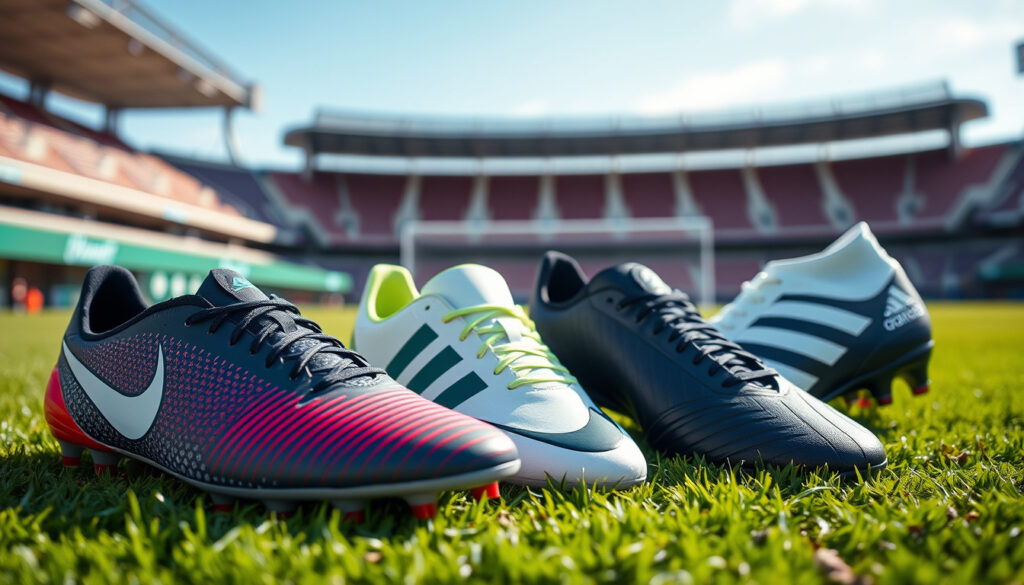
Football Boots Buying Guide 2025: Best Nike, Adidas & More
Every footballer has a pair of boots that felt perfect in the store and wrong on game day. The difference usually isn’t the badge on the tongue — it’s the stud pattern and the surface you play on. In Australia the market runs from A$50 value boots to the A$400 Nike Mercurial Superfly 11 Elite FG, so a little research pays for itself. Here’s how to match a boot to your pitch, position and foot shape.
Average price range: $50 – $250 AUD · Top brands: Nike, Adidas, PUMA, Asics · Most popular type: FG (Firm Ground) boots · Kids share of market: ~30% of searches
Quick snapshot
- Indoor football shoes use flat rubber outsoles (Nike Australia, football footwear page)
- PUMA offers football boots in slim, regular and wide fits (PUMA Australia, men’s football range)
- The exact impact of boot weight on sprint speed is still debated
- Whether synthetic uppers beat leather in wet conditions depends on the material
- Regular boots typically last one to two seasons; worn studs, stretched material and reduced traction say it’s time to replace (Intersport Australia, specialist sporting retailer)
- Junior multi-ground Academy boots run about A$100–A$160 — the sensible step for growing players (Nike Australia, football range)
Key facts at a glance
One stat jumps out before you even open a size chart: Nike leads the searches, the average Australian purchase lands near A$120, and the current Elite ceiling sits at A$400.
| Fact | Value |
|---|---|
| Most searched brand | Nike |
| Average boot price (AUD) | ~$120 |
| Top stud type | FG (Firm Ground) |
| Boot replacement frequency | Every 1–2 seasons, depending on use |
| Nike Elite FG price range | ~A$340 – A$400 |
| Free delivery threshold | A$100+ at PUMA Australia |
The takeaway: the average budget sits well below flagship prices, which is exactly where the value boots live.
What are the best football boots for different playing surfaces?
The quickest way to narrow a boot search is to ignore the colourway and check the sole. Australian pitches range from dry summer grass to synthetic all-weather turf, and each surface rewards a different stud pattern.
Which stud type works best on firm ground?
- FG (Firm Ground) — moulded fixed studs, built for dry natural grass.
- SG (Soft Ground) — longer studs, often metal, for wet or muddy pitches.
- AG (Artificial Ground) — shorter studs for synthetic turf.
PUMA Australia’s official football range is organised around exactly these three categories, and its guidance is blunt: match the stud to the pitch, not the brand. The same page cautions that AG boots should not automatically be treated as interchangeable with FG boots — a polite way of saying a turf boot on grass, or a grass boot on turf, will disappoint.
What boots suit artificial grass?
- AG boots use shorter, more numerous studs that grip synthetic fibres without digging in.
- Indoor shoes are a separate category — a flat rubber outsole for courts and hard floors, not outdoor studs.
Artificial turf is everywhere in Australia — school ovals, indoor centres, wet-weather training pitches — and an AG sole is the honest answer there. Indoor shoes are a different animal: the flat rubber outsole is built for sprung floors, and it is why the snapshot above separates them from outdoor football footwear.
Can you use football boots on hard ground?
- Yes — but SG boots with long metal studs are designed for wet, muddy pitches, not hard summer grass.
- FG and AG soles sit lower and bite better on dry, hard surfaces.
Hard ground is where a mismatched sole shows up fastest. Long studs sit on top of the surface instead of biting into it, so grip drops and the foot rolls.
A premium FG boot at A$400 can feel unstable on synthetic turf, because AG soles use shorter studs built for synthetic piles. The wrong sole turns a flagship purchase into a liability.
Which Nike football boots are on sale in Australia?
Nike’s Australian catalogue is the reference point for football boot prices, but the sale story is in the gaps between official listings and third-party retailers.
Where to find Nike football boot sales online?
- The official Nike Australia football footwear page — current models and prices.
- Rebel Sport’s football catalogue — the same lines at slightly different prices.
The first clue that “sale” needs checking: Nike Australia lists the Mercurial Superfly 11 Elite FG at about A$400 and the Mercurial Vapor 17 Elite FG at about A$360. Rebel Sport lists the Superfly 11 Elite FG at about A$399 — a small gap, but proof that opening a second tab changes the price.
Are there discounts on Mercurial or Phantom models?
- Mercurial Superfly 11 Elite FG — ~A$400 at Nike Australia, ~A$399 at Rebel Sport.
- Mercurial Vapor 17 Elite FG — ~A$360 at Nike Australia.
Those are current catalogue listings, not markdowns. Phantom models are not featured on clearance in the catalogues we checked, so watch the Mercurial and Tiempo lines for seasonal price drops instead.
How do Nike sale prices compare to PUMA?
- Puma Future 9 Ultimate FG — A$329.
- Puma Ultra Nitro 7 Match FG/AG — A$149.99.
- Puma Rapid FG/AG — A$79.99, with a lower member price in the search extract.
All three are in Rebel Sport Australia’s football catalogue. The Rapid’s lower member price appears on the men’s football boots page, and the arithmetic is stark: a current Nike Mercurial costs about five times as much as a Puma Rapid FG/AG.
At A$79.99, the Puma Rapid FG/AG at Rebel Sport covers most club footballers’ needs; the extra A$320 buys branding and marquee technology, not a different game.
How do I choose the right football boot size?
Size is the spec people get wrong most often, and it is the one that ends seasons. The rules are simple if you follow them at the store.
Should I size up for thicker socks?
- No — the boot should fit snugly around the heel and midfoot, without painful pressure or rubbing.
- Toes should sit close to the end of the boot, but never compressed.
Intersport Australia’s boot buying guide is clear on both points: a snug fit that locks the heel and leaves the toes with room to move is the target. Sizing up for thick winter socks usually creates heel slip, which turns every sprint into a battle with blisters.
The same lesson applies beyond football: brand lasts change how a size label fits, a point our guide to Lana Wilkinson’s shoe designs makes for everyday footwear.
What is the correct way to measure foot length?
- Measure both feet in centimetres, then compare with the brand’s size chart for the exact model.
- Shop in the afternoon, when feet have expanded after a day of walking.
Foot length is the starting number, but width and instep decide comfort. That is why the same “size 9” fits differently across Nike, PUMA and Adidas — each brand builds on its own last, so the model’s size chart beats any generic conversion table.
Do brand sizes run differently?
- Yes — and that makes heel lockdown the tie-breaker when you are between sizes.
If a boot is half a size too big, the heel lifts and the foot slides forward on every stop. Between two sizes, choose the one that holds the heel — a little extra toe room is fixable with insoles, but a slipping heel is not.
Sizing up for winter socks feels safe at the register but lets the heel lift on the pitch. Intersport’s rule is the better target: secure heel, close toes, no pressure points.
Are football boots for kids different from adult boots?
Junior boots are scaled-down adult designs, but the smart buying logic is different: kids outgrow boots before they wear them out.
What age should kids switch to adult boots?
- Nike’s junior multi-ground Academy models sit at roughly A$100–A$160, depending on the model.
As the snapshot above shows, that Academy pricing covers junior sizes — and the trigger for switching is fit, not age. When a junior size stops matching foot length and width, move to small adult sizes.
Do kids’ boots have the same stud patterns?
- Yes — FG, AG and indoor categories all exist in junior ranges, and multi-ground models are common.
For most families, one pair of AG or multi-ground boots copes with Saturday grass and weekday synthetic training, which is why the Academy tier is the default recommendation for junior players.
Are there safety differences for junior models?
- Softer materials reduce break-in pain for growing feet.
- SG metal studs are designed for wet adult pitches — the wrong default for most kids.
The safest and most economical choice for youth players is a well-fitted AG or multi-ground boot. SG boots with metal studs should stay in the bag unless the club explicitly permits them and the ground genuinely demands it.
Why this matters: kids outgrow a pair of boots in a season or two, and the Academy price tier exists precisely so a growing foot does not cost the same as a professional contract.
Where can I buy football boots online with free shipping?
The real price of a boot includes delivery, and Australian retailers have turned shipping thresholds into a quiet sales weapon.
Which Australian stores offer free shipping on boots?
- PUMA Australia — free delivery on orders over A$100.
- Nike Australia and Rebel Sport — compare the same models before checkout, because a few dollars of price difference plus delivery changes the deal.
PUMA Australia’s football site offers free delivery on orders over A$100. The seasonal pattern matters as much as the shipping policy — as our Australian winter coats buying guide shows, the biggest discounts land when a season turns over.
Do international sites ship to Australia duty-free?
- Most Australian retailers show AUD pricing upfront and handle local returns.
- International checkout pages rarely solve the fit problem, and returns are harder.
For a fit-sensitive product like football boots, the local return policy is worth more than an international discount. Duty-free thresholds change, and delivery adds time to a purchase that should be tested on grass, not guessed at from a screen.
Are there any exclusive online discounts?
- Rebel Sport shows member pricing on football boots.
- Seasonal clearance on last season’s Nike models is the most reliable discount pattern.
The member price on the Puma Rapid FG/AG, noted in the sale section above, takes about four minutes of account sign-up to unlock. The most consistent online “sale” in football boots is not a coupon code; it is last season’s colourway at model changeover.
What this means: free shipping changes the decision only when the boot price is already right — compare first, then ship.
The four boot types, compared
Four sole types share one pattern: the softer and wetter the pitch, the longer the stud — and the narrower the boot’s range of use.
| Boot type | Best surface | Stud pattern | Price signal | Example models |
|---|---|---|---|---|
| FG (Firm Ground) | Dry natural grass | Moulded fixed studs | Mid-range to premium | Nike Mercurial Superfly 11 Elite, Puma Future 9 Ultimate |
| AG (Artificial Ground) | Synthetic turf | Shorter, more numerous studs | Budget to mid-range | Puma Ultra Nitro 7 Match FG/AG, Puma Rapid FG/AG |
| SG (Soft Ground) | Wet or muddy grass | Longer studs, often metal | Premium | SG versions of flagship speed ranges |
| Indoor | Courts and hard floors | Flat rubber outsole | Entry to mid-range | Nike Tiempo Streetgato |
The takeaway: versatility sits in the middle — a FG/AG hybrid such as the Puma Ultra Nitro 7 covers more Australian scenarios than any single-surface flagship.
Spec check: 2025 football boot prices in Australia
Eight models reveal one pattern: the flagship price is mostly speed and marquee tech, while the “Match” and “Academy” tiers carry the same surface engineering for less.
| Model | Surface | Price (AUD) | Listed by |
|---|---|---|---|
| Nike Mercurial Superfly 11 Elite FG | FG | ~400 | Nike Australia |
| Nike Mercurial Vapor 17 Elite FG | FG | ~360 | Nike Australia |
| Nike Tiempo Maestro Elite FG | FG | ~340 | Nike Australia |
| Nike Tiempo Ligera Pro FG | FG | ~220 | Nike Australia |
| Nike Tiempo Streetgato | Indoor | ~150 | Nike Australia |
| Puma Future 9 Ultimate FG | FG | ~329 | Rebel Sport |
| Puma Ultra Nitro 7 Match FG/AG | FG/AG | ~149.99 | Rebel Sport |
| Puma Rapid FG/AG | FG/AG | ~79.99 | Rebel Sport |
The pattern: the gap between A$79.99 and A$400 is real, but the job of the boot — reliable grip on the surface under it — is the same. Spend on fit before you spend on flash.
Pros and cons of buying football boots online in Australia
Upsides
- Free-shipping thresholds — PUMA Australia delivers free on orders over A$100.
- Instant price comparison across Nike, PUMA and Rebel Sport catalogues.
- Clear junior pricing — Nike Academy boots from about A$100 to A$160 keep growing feet affordable.
Downsides
- Fit risk: you cannot test heel lockdown from a product photo, and fit is the spec that prevents injuries.
- Surface mismatch: an FG boot on synthetic turf, or an AG boot on grass, underperforms from game one.
- Premium prices outliving the product: a flagship boot stretches and loses grip within one to two seasons of regular use.
The trade-off: online buying wins on price and loses on feel — so choose a retailer with a sensible return policy and buy the surface you actually play on.
What’s confirmed, what’s still unclear
Confirmed facts
- FG moulded studs suit dry natural grass; SG longer studs suit wet, muddy pitches; AG shorter studs suit synthetic turf.
- Indoor football shoes use rubber outsoles.
What’s unclear
- Whether a lighter boot meaningfully improves sprint speed — the performance evidence is still debated.
- Whether synthetic uppers outperform leather in wet conditions — it depends on the specific material.
- Whether an AG boot can fully substitute for an FG boot on natural grass — PUMA itself cautions against treating them as interchangeable.
The pattern: the confirmed items are physical specifications, and the unclear items are performance claims. Buy the specs; treat the marketing claims with suspicion.
What the brands say
Brand slogans sell outcomes, not specifications. Two product lines show how the marketing frames the same category.
“Designed for explosive speed.”
— SPT Football, describing the Nike Mercurial line
“Score huge savings on the PUMA Football Boots Sale.”
— PUMA Australia, sale page
The implication: both speakers sell outcomes — speed and savings — and neither mentions stud patterns. The stud pattern is the part you actually play on.
Decision time: what to buy
The data points one way: surface, fit and price, in that order. For the average club footballer in Australia, the A$79.99 Puma Rapid FG/AG or a junior Nike Academy boot at A$100–A$160 beats a flagship at A$400, because the flagship’s advantage shows up only on the surface it was designed for. The decision is clear: match the stud to your home pitch and let fit set the budget — or spend A$400 on a boot that slips on game day.
Frequently asked questions
Do football boots come in wide fit options?
Yes. PUMA Australia lists football boots in slim, regular and wide fits. If a brand does not list width options, search for the specific model plus “wide” before ordering.
Can I use football boots for rugby?
Not really. Football boots are built for football’s cutting and ball feel, while rugby boots place studs differently and add toe protection for scrums. If rugby is the main sport, buy rugby-specific boots.
What is the best way to clean football boots?
Remove mud after each match, let them air dry away from direct heat, and check the studs for wear. Intersport Australia notes that worn studs, stretched material and reduced traction are the signs that the boots need replacing.
Are metal studs allowed in youth leagues?
Rules vary by state and association, so check with the club before fitting SG metal studs. They are designed for wet adult pitches, not junior matches on dry grass.
How much do professional football boots cost?
In Australia, current Nike Elite FG models run from about A$340 to A$400 — the price table above lists each model. PUMA alternatives at Rebel Sport start at A$79.99 and reach about A$329.
Which football boot is best for a defender?
Control-oriented boots like the Nike Tiempo line prioritise ball touch and passing over raw speed. The price table above shows the entry points: about A$220 for the Tiempo Ligera Pro FG and A$340 for the Tiempo Maestro Elite FG. Position is preference, not a rule.
More related posts
 Avan Jogia: ethnicity, Halsey relationship & career facts
 Canberra Public Holidays – 2024 & 2025 Full List
 Antonia Thomas: The Good Doctor Exit & Career Explained
 Alyssa Milano: Biography, Activism, and 2024 Updates
 Larisa Oleynik’s Quiet Journey After Childhood Fame
 Sub-Zero: Meaning, Powers, and Real-World Cold Survival
 Andy Cooks: Biography, Career, and Key Facts
 Nick Daicos: Complete Profile – Salary, Stats, Family
