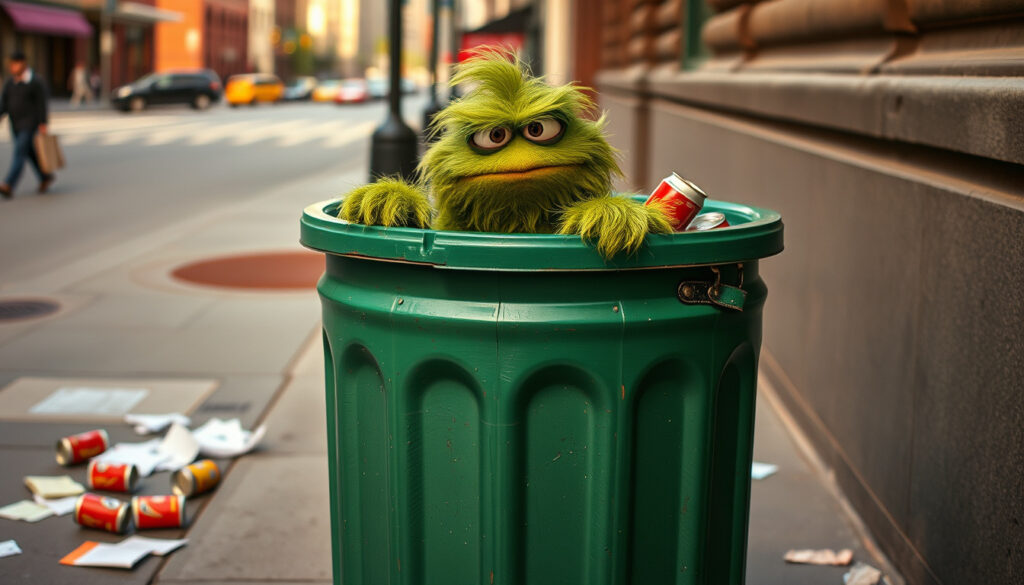
Oscar the Grouch: History, Color Change, Catchphrases and More
Few children’s television characters have ever gotten away with being this grumpy, and none have spent more than five decades inside a trash can, singing about garbage and refusing to be cheered up. Oscar the Grouch first appeared as an orange Muppet in 1969 before turning green a year later, per the Smithsonian National Museum of American History (museum collection records), and a character built on saying “go away” became one of TV’s most enduring emotional lessons.
First Appearance: 1969 · Color Change: Orange to Green (1970) · Pet Worm: Slimey · Catchphrase: “I love trash” · Oscar the Grouch Day: August 14
Quick snapshot
- Debuted in 1969 with orange fur, changed to green in Season 2 (Smithsonian (museum collection records)) (Sesame Workshop (official character page))
- Pet worm is named Slimey (Sesame Workshop (official character page))
- Caroll Spinney originated the role (Muppet Wiki (fan-run character database))
- Exact reason for the color change — a documented TV-tech influence blended with production lore (Smithsonian (museum collection records)) (ClickOrlando (Florida news outlet))
- The restaurant that inspired Oscar’s personality: the name varies by account (ClickOrlando (Florida news outlet))
- Whether Oscar was ever removed from Sesame Street — no evidence so far (Sesame Workshop (official character page)) (ClickOrlando (Florida news outlet))
- 1969: debuts orange; 1970: turns green (Smithsonian (museum collection records))
- 2015: Eric Jacobson begins regular performing work (ClickOrlando (Florida news outlet))
- 2019: Caroll Spinney dies (ClickOrlando (Florida news outlet))
- Eric Jacobson continues as the current performer (Sesame Workshop (official press page))
- Oscar the Grouch Day: August 14 (Muppet Wiki (fan-run character database)) (Sesame Workshop (official press page))
Seven details, one pattern: Oscar’s whole identity is built on being the opposite of what a children’s TV icon is supposed to be — and the museum records plus Sesame Workshop’s own character guide agree on the basics.
| Detail | Value |
|---|---|
| Full name | Oscar the Grouch |
| First appearance | 1969, Sesame Street Season 1 |
| Color | Green (originally orange) |
| Residence | Trash can at 123 Sesame Street |
| Pet | Slimey, a worm |
| Catchphrase | “I love trash” |
| Original performer | Caroll Spinney (1969–2018) |
Why was Oscar the Grouch changed from orange to green?
Oscar didn’t debut green, and the change happened fast — and mostly without fanfare. The Smithsonian National Museum of American History (museum collection records) documents the sequence: orange fur in the first season, green from the second, with early color-television limitations shaping the original orange design. Reference trackers, including Wikipedia (open encyclopedia covering Grouch lore), commonly identify Oscar’s first appearance as November 10, 1969, in one of the earliest Season 1 episodes.
The most famous Muppet color change in television history is usually told as a TV-tech accident. The documentary record is more layered: a puppet rebuild, shaped partly by early color-TV limits, turned a magenta concept into an orange season and finally into the green icon nobody now questions.
When did Oscar the Grouch change color?
- Season 1 (1969–70): orange fur, per the Smithsonian (museum collection records)
- Season 2 (1970): green fur — the same museum records document the switch
- Earlier concept art: a spiky magenta monster in Jim Henson’s original drawings, also noted in the Smithsonian’s records
The switch between seasons was a redesign, not a story event: the rebuilt puppet simply came back green. That makes Oscar one of the few major Muppets whose defining look arrived after the debut season.
Why did Sesame Street redesign Oscar’s puppet?
- Documented: early color-TV limits influenced the orange debut design, per the Smithsonian (museum collection records)
- Reported: the puppet was rebuilt for aesthetic and technical reasons — the exact decision is production lore
In practice, the redesign erased its own history: for most viewers, Oscar has simply always been green.
The takeaway: Oscar’s green fur was a production decision, not a plot point — and it worked so cleanly that generations never noticed the difference.
Is there an Oscar the Grouch Day?
Yes — and the grouch calendar has more than one marked date. Oscar the Grouch Day is observed on August 14, a fan-built celebration that Sesame Street has at times acknowledged, with the date tracked by Muppet Wiki (fan-run character database). There’s also a wider October observance — National Grouch Day — covered by ClickOrlando (Florida news outlet) as a holiday honoring the trash-loving Muppet.
When is Oscar the Grouch Day?
Oscar the Grouch Day: August 14 · National Grouch Day: October · Status: fan-built, occasionally acknowledged by Sesame Street
August 14 is the date fans adopted, and it tends to be an excuse to revisit Oscar’s best moments — the songs, the grumbles, and the worm. It’s a low-stakes holiday with a clear function: making room for grouchiness on the calendar.
How is Oscar the Grouch Day celebrated?
- The format: a fan-built occasion, not an official Sesame Workshop holiday
- The spirit: celebrating grouchiness the way Oscar would — loudly and unapologetically
In practice, the day works as an excuse to stream the classic songs and say “I love trash” out loud without irony.
The implication: Oscar is one of the few Sesame Street characters with a fan-built calendar of his own — a quiet signal of how much affection the grouch actually gets.
What is the name of Oscar the Grouch’s pet worm?
For a character who claims to hate everything, Oscar keeps one clearly loved companion: Slimey, a small orange worm who lives in the trash can and serves as his closest friend, as documented by Sesame Workshop (official character page).
Who is Slimey the Worm?
- Type: a small orange worm
- Home: Oscar’s trash can
- Role: Oscar’s best friend
The running joke was always the contrast: the show’s grumpiest Muppet, completely soft for a worm named Slimey. That stubborn affection is part of why Oscar reads as lovable instead of hostile.
What is Slimey’s relationship with Oscar?
- Best friend: the consistent framing across the show’s history
- Household companion: the worm shares Oscar’s trash can
The takeaway: Oscar’s bond with Slimey is the emotional proof that grouchiness and love are not opposites — they can live in the same trash can.
What is Oscar the Grouch famous for saying?
One line beats everything else: “I love trash.” Sesame Workshop (the nonprofit behind Sesame Street) describes Oscar as defined by his preference for trash, and Wikipedia (open encyclopedia covering Grouch lore) notes the character’s recurring association with the song “I Love Trash” — easily his most famous on-screen moment.
What does “I love trash” mean?
- Public meaning: a declaration of identity — Oscar loves what everyone else throws away
- Educational edge: the catchphrase doubles as a gentle recycling nudge
The song’s structure is what makes it work: Oscar sings joyfully about his favorite subject, and the joy is the joke. He isn’t complaining, he’s celebrating — which is precisely why children remember it.
What are other Oscar catchphrases?
- “Go away!” — the standard Oscar greeting
- Grumbling and abrupt dismissals — the default setting
The useful way to read Oscar’s vocabulary: it gives children a script for a feeling adults usually suppress — the desire to be left alone. And the show never punishes him for it.
A song about loving garbage has done more for recycling awareness than most public-service campaigns — and it worked because Oscar never once tried to be inspirational.
The trade-off: Oscar gets to be rude, and the show gets to teach — because his rudeness is framed as honest instead of cruel.
What does Oscar the Grouch symbolize?
The surface reading: Oscar is the grump who makes everyone else look sunny. The useful reading: he is one of the most effective emotional-education tools in children’s television. Sesame Workshop (the nonprofit behind Sesame Street) describes him as disliking rainbows, candy, and chocolate — a character whose entire personality is built against the show’s own sweetness.
Is Oscar the Grouch actually grouchy?
- By design: Sesame Workshop says Oscar dislikes rainbows, candy, and chocolate
- By identity: grouchiness is his personality, not a phase he is going through
The show never “cures” Oscar, and that’s the point: his grumpiness is treated as valid, even lovable. The other characters keep him around without demanding he change — which is exactly the acceptance children need to see modeled.
Which Muppet is homeless?
- Oscar’s home: a trash can at 123 Sesame Street, by his own choice
- The framing: the trash can is his castle, not his hardship
Occasionally, viewers read Oscar as unhoused. The show’s framing is the opposite: his home is deliberately ugly and deliberately his — a can that keeps the world out and his treasure close.
What ethnicity is Oscar the Grouch?
- Character type: Oscar is a Muppet, not a human, with no assigned ethnicity
- Design intent: his identity is personality-based rather than demographic
Questions about Oscar’s background surface in searches from time to time, but the record is settled: he is a green Muppet whose defining traits are emotional, not ethnic. That openness is itself the inclusivity — a character anyone can map onto.
A character whose entire job is to say “go away” became one of children’s TV’s most effective emotional-education tools — a grouch who stays grouchy and is still loved is living proof that bad moods are survivable.
Oscar the Grouch through the decades
Five turning points, one pattern: every major change in Oscar’s story came from production reality, not from a plot about him.
| Year | Event |
|---|---|
| Oscar debuts in Season 1 with orange fur (Smithsonian (museum collection records)) | |
| Oscar returns in green for Season 2 — the switch is documented in the Smithsonian (museum collection records) | |
| Eric Jacobson begins regular performing work as Oscar (ClickOrlando (Florida news outlet)) | |
| Caroll Spinney announces his retirement from Oscar and Big Bird, per Wikipedia (open encyclopedia covering Grouch lore) | |
| Caroll Spinney dies in December (ClickOrlando (Florida news outlet)) |
The long middle of that timeline is the real signal: one performer carried Oscar from 1969 until the 2010s — an unusually stable run for a children’s-TV character.
What this means: Oscar’s history is a reminder that the most beloved characters are often the most stable — the puppet changed color once, and then barely anything else changed for fifty years.
What’s confirmed, what’s still unclear
A fact-first look at Oscar separates the documented record from the folklore that follows the green Muppet everywhere.
Confirmed facts
- Oscar changed from orange to green in 1970 (Smithsonian (museum collection records))
- His pet worm is Slimey (Sesame Workshop (official character page))
- “I love trash” is his signature line (Sesame Workshop (official character page))
- Caroll Spinney originated the role (ClickOrlando (Florida news outlet))
What’s unclear
- The exact reason for the color change: documented TV-tech influence, but the full decision is production lore (Smithsonian (museum collection records))
- Whether Oscar was ever removed from Sesame Street: no evidence; he is still listed among current characters (Sesame Workshop (official character page))
- The restaurant that inspired his personality: the name varies between Oscar’s Salt of the Sea and Oscar’s Tavern (Muppet Wiki (fan-run character database))
- Oscar’s ethnicity: never defined
The pattern: the most repeated Oscar stories — the restaurant, the color fix, and the “removal” — are exactly the ones with the thinnest documentation.
The catch: Oscar is a rare case where the folklore makes the character better — a grouch thrives on rumors that refuse to be tidied up.
The voices behind Oscar the Grouch
The Smithsonian National Museum of American History (museum collection records) preserves two origin stories for Oscar — one for his voice, one for his personality — both tied to Caroll Spinney.
Oscar’s voice was inspired by a cranky New York taxi driver who drove Spinney to work on his first day performing the character.
— Caroll Spinney, as told to the Smithsonian National Museum of American History
That detail lives in the museum’s records as a first-person account from the performer himself — about as close to primary documentation as Oscar lore gets.
The commonly repeated account is that Oscar’s personality came from a rude waiter at a Manhattan restaurant named Oscar’s Salt of the Sea.
— Caroll Spinney, via the Smithsonian’s collection records
The catch: the restaurant’s name isn’t stable across accounts. The Smithsonian version says Oscar’s Salt of the Sea; Muppet Wiki (fan-run character database) says Oscar’s Tavern; and ClickOrlando (Florida news outlet) treats the whole story as production lore with details that vary.
Oscar the Grouch dislikes conventionally pleasant things such as rainbows, candy, and chocolate.
— Sesame Workshop (the nonprofit behind Sesame Street), official character description
The implication: even the origin story of the world’s most famous grouch is a little grouchy — a tale that refuses to sit still, like the character it explains.
For parents and educators, the choice is clear: keep Oscar where kids can find him — grumpy, unapologetic, singing about trash — or let another generation grow up without learning that a bad mood is just a feeling, not a flaw. Oscar never needed to be fixed, cheered up, or turned into a lesson about happiness. He only needed to be seen, loved, and allowed to love his garbage in peace. That is the whole trick of the green Muppet in the can: he taught millions of children that you can be grouchy and still be worthy of love.
Frequently asked questions
Why does Oscar the Grouch live in a trash can?
Because the trash can is his chosen home. Sesame Workshop (the nonprofit behind Sesame Street) presents it as the residence that fits his identity — a home that keeps the world out and his treasures in.
Who created Oscar the Grouch?
Oscar was created for Sesame Street by Jim Henson and head writer Jon Stone, per Sesame Workshop (official character page).
Who originally performed Oscar the Grouch?
Caroll Spinney performed Oscar from the character’s debut in 1969 until his retirement, per the Smithsonian (museum collection records). He died in December 2019 (ClickOrlando (Florida news outlet)). Eric Jacobson performs the character today (Sesame Workshop (official press page)).
Is Oscar the Grouch still on Sesame Street?
Yes. Sesame Workshop still lists Oscar among its current characters, and Eric Jacobson is the active performer, per the Sesame Workshop (official press page).
Why is Oscar the Grouch called a grouch?
Because grouchiness is his defining trait. Sesame Workshop’s official description says Oscar dislikes rainbows, candy, and chocolate — he is, by design, the show’s lovingly grumpy contrarian (Sesame Workshop (official character page)).
More related posts
 Dr. Chris Brown Vet: Bio, Relationship, Career & News
 Jacob Elordi: Height, Relationships, and the Wuthering Heights Accusation Explained
 Dhar Mann: Accusations, Fame, and Safety for Kids (2025)
 Escape Room: What Happens, Rules, Safety, and Myths Debunked
 Nedd Brockmann: Ultramarathon Run Across Australia
 Vittoria Ceretti: Age, Relationship with Leonardo DiCaprio, Net Worth
 Stanley Tucci: Oscar Nomination, Marriage, Health, and Net Worth
 Jamie Foxx Health Update: Stroke Recovery and Family
