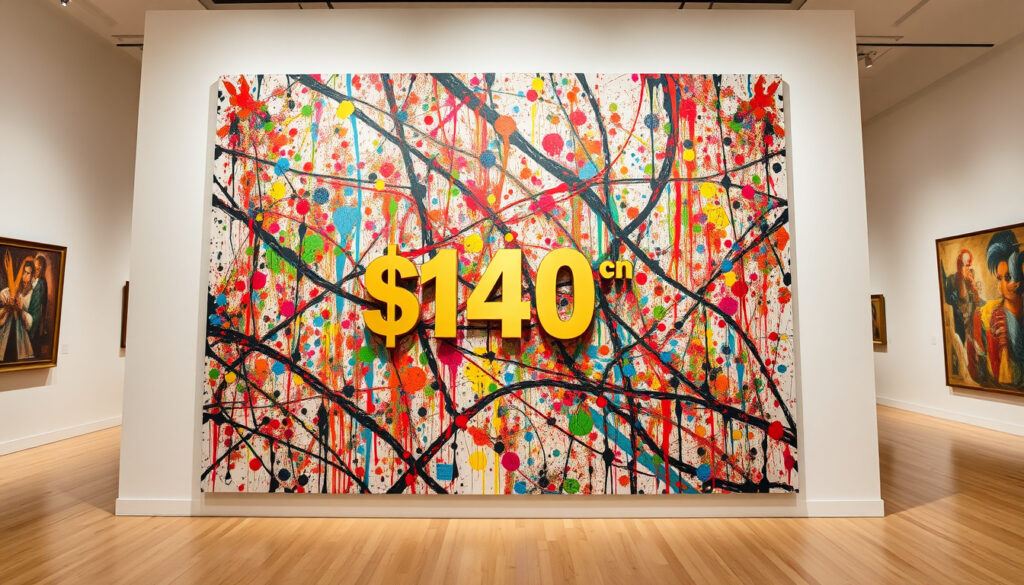
Jackson Pollock: Drip Paintings and $140 Million Sales
There’s a painting that looks like a tangled mess of house paint that someone dribbled and splattered across a canvas. It sold for $140 million — a paradox that explains why Jackson Pollock still fascinates.
Born: January 28, 1912, Cody, Wyoming ·
Died: August 11, 1956, Springs, New York ·
Known for: Drip painting, Abstract Expressionism ·
Most famous painting: Number 5, 1948 ·
Most expensive sold: Number 5, 1948 — $140 million (2006, private sale) ·
Total known works: Approximately 350 paintings
Quick snapshot
- Pollock pioneered the drip technique around 1947 (Encyclopaedia Britannica)
- He died in a single-car crash on August 11, 1956 (Australiainsight)
- Number 5, 1948 sold privately for $140 million in 2006 (Singulart)
- Exact sale price of Number 5, 1948 is unconfirmed by auction records (Singulart)
- Whether Pollock had bipolar disorder is debated by biographers (Encyclopaedia Britannica)
- Total number of authentic Pollock paintings remains uncertain due to forgeries (Encyclopaedia Britannica)
- 1947: Began drip technique; 1949: Life magazine feature; 1956: fatal crash; 2006: $140 million sale (Encyclopaedia Britannica)
- Authentication challenges persist; the market waits for the next major Pollock to surface (Encyclopaedia Britannica)
Eight facts that define the artist, from birth to posthumous market value:
| Label | Value |
|---|---|
| Full name | Paul Jackson Pollock |
| Birth | January 28, 1912, Cody, Wyoming |
| Death | August 11, 1956, Springs, New York |
| Movement | Abstract Expressionism |
| Spouse | Lee Krasner (m. 1945) |
| Key technique | Drip painting / action painting |
| Most expensive work | Number 5, 1948 — $140 million (private sale) |
| Number of known works | ~350 paintings |
Why is Jackson Pollock’s art so famous?
The drip technique and action painting
- Pollock pioneered the drip technique in the late 1940s, placing canvases on the floor and working from all angles (CBS News).
- He used liquid household enamel paints, often thinned with turpentine, and employed splashing, dripping, flinging, and pouring (Artalistic).
- His method was documented by photographer Hans Namuth in 1950 (Wikipedia (French)).
The result was a radical break from traditional painting—a technique that emphasized the physical act of creation over the final image. Critic Clement Greenberg called it “action painting,” and the label stuck.
Influence on Abstract Expressionism
- Pollock is considered a leading exponent of Abstract Expressionism (The Museum of Modern Art).
- His all-over composition style influenced a generation of artists who followed.
- MoMA identifies Full Fathom Five (1947) as one of his earliest drip paintings (The Museum of Modern Art).
The connection: without Pollock’s floor-based experiment, the entire Abstract Expressionist movement might have looked very different.
Cultural notoriety beyond the art world
- The Life magazine article in 1949 asked “Is he the greatest living painter in the United States?” (Encyclopaedia Britannica).
- That question pushed Pollock into mainstream consciousness, turning him into a celebrity.
- His nickname “Jack the Dripper” became part of pop culture.
Pollock’s fame rests on a technique that many dismissed as “messy,” yet the market now treats his drips as blue-chip assets. The cultural notoriety created the demand, not the other way around.
What was Jackson Pollock’s most famous painting called?
Number 5, 1948 — the iconic drip painting
- Number 5, 1948 is widely cited as Pollock’s most famous work (Singulart).
- It was painted on a four-by-eight-foot sheet of fiberboard in 1948, at the height of his drip period (Singulart).
- It sold privately for $140 million in 2006, making it one of the most expensive paintings ever sold.
Blue Poles: Number 11, 1952 as a rival
- Blue Poles (Number 11, 1952) was purchased by the National Gallery of Australia for $1.3 million in 1973—then a record for a contemporary American painting (Encyclopaedia Britannica).
- Adjusted for inflation, that’s roughly $9 million today, but its estimated current value is in the tens of millions.
One: Number 31, 1950 at MoMA
- MoMA’s collection includes Number 1A, 1948, the first drip painting to enter its collection (acquired in 1950) (The Museum of Modern Art).
- One: Number 31, 1950 is another monumental drip canvas that hangs at MoMA.
The pattern: Pollock’s most famous work is also his most expensive, but the institutional favorites—Blue Poles and MoMA’s holdings—carry the academic weight that keeps his reputation alive.
How much is a real Jackson Pollock worth?
Record sale: Number 5, 1948 at $140 million
- The private sale of Number 5, 1948 to David Geffen in 2006 is the highest price ever paid for a Pollock (Singulart).
- Because it was a private transaction, the exact price is unconfirmed by auction records—the $140 million figure is widely reported but not independently verified.
Blue Poles: $1.3 million in 1973, now worth much more
- The National Gallery of Australia paid $1.3 million for Blue Poles in 1973, a record at the time (Encyclopaedia Britannica).
- Today, the painting’s insurance value is estimated at over $50 million.
Auction prices for smaller works and drawings
- Pollock’s highest public auction price is $58.4 million for Number 17, 1948, sold at Christie’s in 2016.
- Smaller works on paper and drawings typically sell for $1–5 million at auction, depending on provenance and condition.
- Authentication is strictly controlled by the Pollock-Krasner Foundation, which has rejected many purported Pollocks (Singulart).
The market for Pollock is bifurcated: museum-quality drip paintings command tens of millions, but the Foundation’s authentication process has created a “verified vs. orphan” gap that makes buying a Pollock a high-stakes gamble.
What happened to Jackson Pollock?
Car crash on August 11, 1956
- Pollock died at age 44 in a single-car crash near his home in Springs, New York (Australiainsight).
- He had been drinking heavily that evening; his blood alcohol level was above the legal limit.
- One passenger, Edith Metzger, also died. Ruth Kligman survived.
Alcohol and depression preceding the crash
- Pollock had struggled with alcoholism since his late teens (Encyclopaedia Britannica).
- He underwent Jungian psychoanalysis in the late 1930s with Dr. Joseph L. Henderson to address his drinking and emotional instability.
- After 1950, his creative output slowed, and his drinking increased.
Legacy and posthumous recognition
- Despite his tumultuous end, Pollock’s reputation grew exponentially after his death.
- In 1973, Blue Poles set a record; in 2006, Number 5, 1948 set the private sale record.
- His work now hangs in every major modern art museum worldwide.
The crash ended a life that was already in decline, but it also cemented Pollock’s myth—the tortured genius who died young. The market reacted by elevating his work to untouchable status, a pattern repeated with other artists who died tragically.
What illness did Jackson Pollock have?
Alcoholism and its effects
- Pollock’s alcoholism was well documented; he was known to binge drink for days, often disappearing from his studio.
- His wife, Lee Krasner, described his drinking as a “plague” that ravaged their marriage and his productivity.
- The condition is a central factor in his creative decline after 1950.
Possible bipolar disorder symptoms
- Some biographers have suggested that Pollock exhibited symptoms of bipolar disorder, including manic episodes of intense work followed by deep depression.
- However, no formal diagnosis exists, and the claim is debated among scholars.
Mental health treatment history
- Pollock underwent Jungian psychoanalysis with Dr. Joseph L. Henderson in the late 1930s, focusing on his dreams and his art (Encyclopaedia Britannica).
- He also had periods of sobriety, particularly when he was in therapy, but they were short-lived.
- No evidence exists that he was ever formally diagnosed with a mental illness beyond alcoholism.
Pollock’s psychological struggles are often romanticized as fuel for his creativity, but the evidence points to the opposite: his drinking disrupted his work, not enhanced it. The myth of the “mad genius” doesn’t hold up under scrutiny.
Timeline
The key events in Pollock’s life and posthumous market value are listed below.
| Date | Event | Source |
|---|---|---|
| 1912 | Born in Cody, Wyoming | Encyclopaedia Britannica |
| 1930 | Moved to New York City to study at Art Students League | Encyclopaedia Britannica |
| 1943 | First solo exhibition at Peggy Guggenheim’s Art of This Century gallery | Encyclopaedia Britannica |
| 1947 | Began using drip technique on canvas laid on floor | CBS News |
| 1949 | Life magazine feature: “Is he the greatest living painter in the United States?” | Encyclopaedia Britannica |
| 1950 | Hans Namuth filmed Pollock painting; peak creative period | Wikipedia (French) |
| 1956 | Died in car crash on August 11 | Australiainsight |
| 1973 | Blue Poles purchased by National Gallery of Australia for $1.3 million | Encyclopaedia Britannica |
| 2006 | Number 5, 1948 sold privately for $140 million | Singulart |
The pattern: Pollock’s active career spans just 13 years (1943–1956), but his market value continued to climb for decades after his death.
Clarity check
Confirmed facts
- Pollock died in a single-car crash on August 11, 1956 (Australiainsight)
- Number 5, 1948 sold for $140 million in a private transaction (Singulart)
- He used a drip technique from 1947 onward (CBS News)
- He was diagnosed with alcoholism (Encyclopaedia Britannica)
What’s unclear
- Exact price of Number 5, 1948 sale is unconfirmed by auction records
- Whether he had bipolar disorder is debated by biographers
- Total number of authentic Pollock paintings remains uncertain due to forgeries
The implication: while core facts are solid, the lack of auction confirmation and the authentication gray zone leave room for market speculation.
Voices from the era
“When I am in my painting, I’m not aware of what I’m doing. It is only after a sort of ‘get acquainted’ period that I see what I have been about.”
— Jackson Pollock, quoted in Hans Namuth’s film notes (1950)
“Pollock’s work is a kind of action painting, where the canvas becomes the arena of the artist’s gestures.”
— Clement Greenberg, critic, in Art News (1955)
“The drinking was like a plague. It took everything from him.”
— Lee Krasner, in an interview with ARTnews (1984)
“I was in the car. I survived. I still don’t know why.”
— Ruth Kligman, in Love Affair: A Memoir of Jackson Pollock (1974)
These voices—the artist, the critic, the wife, the survivor—frame the same man from radically different angles. The contradictions are part of his legacy.
Pros and Cons of the Pollock myth
Upsides
- His work is instantly recognizable and commands premium prices
- The drip technique is a genuine artistic breakthrough
- His story attracts broad public interest, keeping his art in museums
Downsides
- The romanticized “tortured genius” narrative obscures his real struggles
- Authentication issues create a minefield for collectors
- The market’s focus on his death outweighs the depth of his actual work
The trade-off: Pollock’s market success depends on his myth, but that myth also distorts how his art is understood and collected.
Related reading: Quincy Jones: The Michael Jackson Bond and Its Fracture
en.wikipedia.org, artincontext.org, artanddesigninspiration.com, guggenheim.org, digital.nga.gov.au
Frequently asked questions
Is Jackson Pollock’s art considered trash or treasure among critics?
Most critics now consider Pollock a foundational figure in modern art. The “trash” label comes from public misunderstanding of the drip technique, but the art world widely regards him as a treasure.
What is Jackson Pollock’s painting style called?
His style is called Abstract Expressionism, specifically action painting, characterized by spontaneous, gestural application of paint.
How many Jackson Pollock paintings exist?
Approximately 350 paintings are known, but the exact number is uncertain due to forgeries and lost works.
What is the top 1 most expensive painting in the world?
As of 2025, the most expensive painting ever sold is Salvator Mundi attributed to Leonardo da Vinci, which sold for $450.3 million in 2017. Pollock’s Number 5, 1948 ranks among the top ten.
What is the saddest painting of all time?
There is no definitive answer, but Pollock’s Number 5, 1948 is sometimes described as bleak or chaotic. Other contenders include Picasso’s Guernica and Munch’s The Scream.
Did Jackson Pollock have any formal art training?
Yes, he studied at the Art Students League of New York under Thomas Hart Benton from 1930 to 1933.
Where can I see Jackson Pollock’s paintings in person?
Major museums with Pollock holdings include the Museum of Modern Art (MoMA) in New York, the National Gallery of Australia in Canberra, and the Art Institute of Chicago.
For collectors, the choice is clear: buy a verified Pollock from the drip period, or accept the risk of a forgery. For museum-goers, the story is simpler—the paintings are worth the trip.
Related reading: Quincy Jones: The Michael Jackson Bond and Its Fracture
More related posts
 Rolex Day Date – History Models Prices Presidents Watch
 Nick DiGiovanni: Fact vs Fiction on Net Worth & Career
 Alex Lloyd: Biography, Legal Battles, and Australian Story
 Cristiano Ronaldo Jr.: Age, Height, Mother, and Facts
 Justin Theroux: Biography, Relationships, Movies, Net Worth
 One Direction Members: Names, Ages, and What Happened to Them
 Tommy Shelby: The Real Story Behind Peaky Blinders
 Pick Me Girl – Meaning, Origin and TikTok Trend
