Lord Shiva: God of Destruction, Power, and History Explained
Every few months, someone stumbles across Lord Shiva online and wonders if he is a benevolent god, a terrifying judge, or a Bible character no one mentioned before — but the fuller answer is stranger than either extreme. Shiva is a supreme deity whose so-called destruction is a form of cosmic housekeeping, and by 1911 the Encyclopædia Britannica already identified him with Rudra of the Vedas.
Shiva at a Glance
- Destroyer and Transformer in the Trimurti (Encyclopaedia Britannica, general reference encyclopedia)
- Lord of the Cosmic Dance, or Nataraja (BBC Religions, religion and ethics portal)
- Supreme Yogi and ascetic (Encyclopaedia Britannica, general reference encyclopedia)
- Roots in the Vedic deity Rudra (1911 Encyclopædia Britannica, historical reference text)
- Developed into a major Puranic god (Encyclopaedia Britannica, general reference encyclopedia)
- Considered one of the Trimurti (Encyclopaedia Britannica, general reference encyclopedia) (1911 Encyclopædia Britannica, historical reference text)
- Consort: Parvati, also called Shakti, Uma, or Gauri (Encyclopaedia Britannica, general reference encyclopedia)
- Mount: Nandi, the bull (Encyclopaedia Britannica, general reference encyclopedia)
- Family: Ganesha and Kartikeya (Encyclopaedia Britannica, general reference encyclopedia)
- Not a demon in Hindu mythology (Encyclopaedia Britannica, general reference encyclopedia)
- Not a figure from the Bible (1911 Encyclopædia Britannica, historical reference text)
- His destructive side is constructive (BBC Religions, religion and ethics portal)
The pattern: Shiva starts as a one-word label and immediately expands into a tradition with multiple roles, histories, and families.
Key Facts About Lord Shiva
Shiva’s identity stretches across several registers at once: mythic, ascetic, married, dangerous, and gentle all at the same time.
| Label | Detail |
|---|---|
| Principal deity in Hinduism | One of the Trimurti, with Brahma and Vishnu (Encyclopaedia Britannica, general reference encyclopedia) |
| Known as | Mahadeva, meaning “Great God,” and Shankara, meaning “Beneficent” |
| Primary role | Destroyer and Transformer within the cosmic cycle (BBC Religions, religion and ethics portal) |
| Consort | Parvati, also called Shakti, Uma, or Gauri |
| Mount | Nandi, the bull |
| Name in Sanskrit | शिव, meaning “Auspicious One” (1911 Encyclopædia Britannica, historical reference text) |
| Scriptural origin | Rigveda, through the deity Rudra; later expanded in the Puranas (1911 Encyclopædia Britannica, historical reference text) |
| Principal festival | Maha Shivaratri, the “Great Night of Shiva” |
The implication: Shiva’s label “destroyer” only makes sense inside a cycle that includes creation and preservation.
What is Shiva the god of?
Shiva’s role in the Hindu Trimurti
In the Trimurti, the trio of major Hindu gods, Shiva is the figure who closes one cosmic phase so that another can begin. Encyclopaedia Britannica, general reference encyclopedia describes him as one of the most important gods in Hinduism and a member of that three-god group along with Brahma and Vishnu.
- Creator companion: He is an ascetic god, not a domesticated householder in every myth.
- Cosmic dancer: In his Nataraja form he dances the rhythm of creation and dissolution.
- Yogi and householder: He combines extremes that would be contradictory in most religious traditions.
Understanding Shiva as the Destroyer and Transformer
Encyclopaedia Britannica, general reference encyclopedia summarizes the familiar title this way:
“He is ‘the destroyer’ because his role is to bring the world to dissolution so the cycle can restart.”
The BBC Religions, religion and ethics portal adds that the destruction is not a violent outburst. It is a constructive dismantling that clears away illusion and imperfection so that change can happen.
Why is Lord Shiva so powerful?
The same deity who dissolves the universe also meditates like a mountain ascetic. For Shaiva devotees, Shiva performs creation, preservation, and dissolution; Britannica calls him both the destroyer and the restorer, the great ascetic and the symbol of sensuality.
The pattern: one deity, several registers, and a power that shows up as both dissolution and renewal.
Is Shiva a god or a demon?
Distinguishing Shiva from demonic figures in Hindu mythology
No. Encyclopaedia Britannica, general reference encyclopedia identifies Shiva as a principal god of Hinduism, not as an evil or demonic being. His fierce forms can look intimidating, but in Hindu storytelling those forms are protective: they destroy obstacles, delusion, and spiritual blindness.
Addressing common Western misinterpretations
Some popular internet pages also claim that Shiva is really a character from the Bible, or that NASA “proved” something about him. The actual scholarly record points in a different direction. The 1911 Encyclopædia Britannica, historical reference text treats Shiva as a Hindu deity whose roots go back to the Vedic god Rudra, not as a figure from the biblical world.
The implication: his fierce iconography is protective work, not evil.
Who came first, Shiva or Jesus?
Archaeological evidence places Shiva’s story much earlier than the Christian era. The Pashupati seal of the Indus Valley (c. 2500–1500 BCE) is read by many scholars as a proto-Shiva figure, and the Vedas place Rudra, later identified with Shiva, well before the 1st century CE. Jesus is the central figure of a tradition that began in the 1st century CE; the two religious worlds are separate.
Is Lord Shiva mentioned in the Bible?
The idea that Shiva appears in the Bible is popular online, but it does not come from the biblical text. When the 1911 Encyclopædia Britannica, historical reference text describes Shiva as a post-Vedic god identified with Rudra, it places him inside Hindu history, not inside ancient Israelite scripture.
That does not mean Shiva is “untrue” or less real as a figure of worship. It simply means the Bible and Shiva are two separate religious worlds that should not be flattened into each other.
The implication: the historical and archaeological record supports a Hindu development for Shiva, not a biblical one.
What makes Shiva angry?
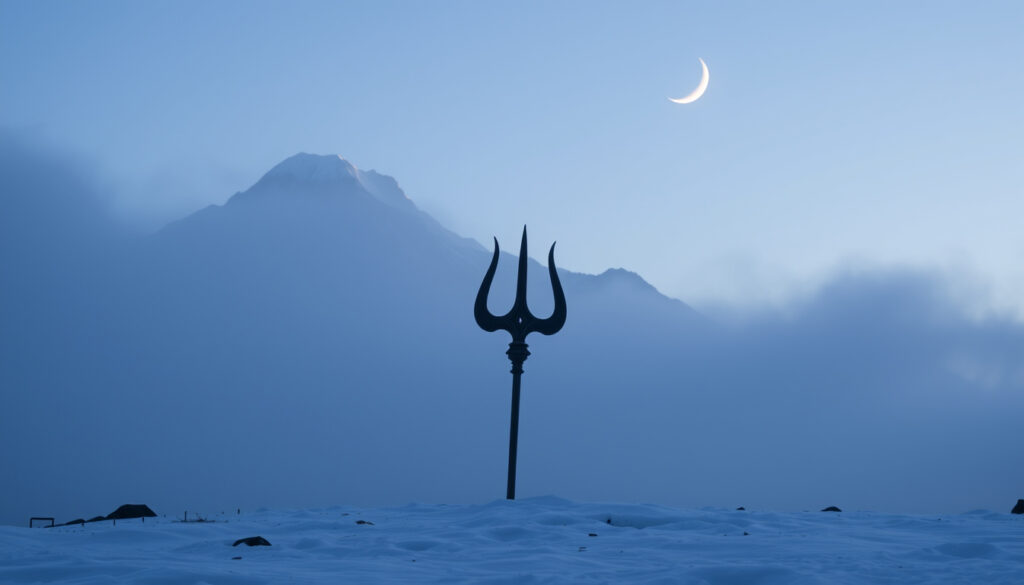
Shiva is often shown with a blue throat, a crescent moon, and a third eye. In many stories, when his fierce energy becomes necessary, it is not a childish loss of control. The BBC Religions, religion and ethics portal explains that Shiva’s destruction destroys illusion and imperfection in order to enable beneficial change.
That framework helps explain the anger. It is better understood as cosmic grammar: some things must dissolve so that newer, better things can appear.
The catch: anger in Shiva’s mythology is an instrument of restoration, not a temper tantrum.
What are the signs that Lord Shiva is with you?
Devotional traditions do not offer a single scriptural checklist. The commonly reported signs — finding rudraksha beads, hearing “Om Namah Shivaya,” dreams of Shiva, or a sudden sense of calm during prayer — are personal experiences rather than formal doctrine.
The pattern: signs are anecdotal and devotional, not a test of divine favor.
Additional Important Questions About Lord Shiva
Does NASA believe in Lord Shiva?
No. NASA’s public record contains no theological statement about Shiva; viral claims that the agency “proved” him are unsupported.
Can females touch a Shivling?
There is no scriptural prohibition against women touching a Shivling. The restriction some hear about is a social custom, not a Vedic law.
What’s Confirmed and What Isn’t
Confirmed:
- Shiva is one of the three most influential deities in the Hindu Trimurti (Encyclopaedia Britannica, general reference encyclopedia).
- He is called “the destroyer” because the world dissolves so the cycle can restart (Encyclopaedia Britannica, general reference encyclopedia).
- His destructive role is constructive because it removes illusion and imperfection (BBC Religions, religion and ethics portal).
- The 1911 Encyclopædia Britannica identifies him with Rudra of the Vedas (1911 Encyclopædia Britannica, historical reference text).
Not confirmed:
- The claim that Shiva is a demon conflicts with his place as a major Hindu deity.
- The claim that Shiva is a character in the Bible is not supported by the 1911 Britannica’s description of his Vedic roots.
- The claim that a single exact list of “signs” of Shiva appears in the Hindu texts is not something the historical sources themselves resolve.
- The claim that NASA “proved” Shiva is a deity has no support in NASA’s public record.
The pattern: memes spread fast, but the historical record is more layered than the shorthand.
Quotes to Keep With You
“He is ‘the destroyer’ because his role is to bring the world to dissolution so the cycle can restart.”
— Encyclopaedia Britannica, general reference encyclopedia
“Destruction is not arbitrary but constructive, used to destroy illusions and imperfections and enable beneficial change.”
— BBC Religions, religion and ethics portal
The implication: destruction is a phase in a cycle, not the final word.
Follow the worship, not the meme: Shiva’s destructive title is actually a creative force, and when someone tells you he is an evil figure or a hidden Bible character, the weight of the historical record says otherwise.
Related reading: Indira Gandhi: The Polarizing Legacy of India’s First Female PM · Severus Snape: Hero or Villain? The Character’s True Morality
britannica.com, newbritannicaencyclopedia.blogspot.com, britannica.com, britannica.com, en.wikipedia.org, britannica.com, shaivam.org
Frequently Asked Questions
Does the name Shiva mean “Auspicious One”?
Yes. The Sanskrit name Śiva carries the meaning “auspicious one,” and the 1911 Encyclopædia Britannica, historical reference text treats that as part of his name and character.
Are Shiva and Rudra the same deity?
The 1911 Encyclopædia Britannica, historical reference text identifies Shiva with Rudra, a Vedic deity. That means modern Shiva worship likely grew from earlier Vedic roots.
Is Lord Shiva a demon?
No. Encyclopaedia Britannica, general reference encyclopedia lists Shiva as one of the most important Hindu gods. His fierce forms are protective, not demonic.
Does the Bible mention Shiva?
There is no mainstream biblical evidence for Shiva as a biblical figure. The 1911 Encyclopædia Britannica, historical reference text places Shiva in Hindu tradition, connected to the Vedic god Rudra.
Why is Shiva called the destroyer if he is not evil?
Because “destroyer” in this context means the one who removes the old so that the new can appear. Encyclopaedia Britannica, general reference encyclopedia says his role is to bring the world to dissolution so the cycle can restart.
Why does the BBC describe Shiva’s destruction as constructive?
The BBC Religions, religion and ethics portal explains that Shiva’s destructive energy clears away illusion and imperfection, which allows positive change to happen.
More related posts
 Ashton Kutcher’s Vasculitis, Relationships, and Family
 Buddy Hield: Nickname Origin, Trade to Hawks, Career
 Rowan Atkinson: Net Worth, Stutter & Current Projects
 Bob Hawke: Biography, Death & Legacy of Australia’s PM
 Alan Dale: From Neighbours to Lost, Dynasty and More
 All Might: Biography, Powers, and Key Moments in My Hero Academia
 Tina Turner’s Cause of Death: Her Final Years & Legacy
 Polo Ralph Lauren Australia: Stores, Sales, Online & Stockists
