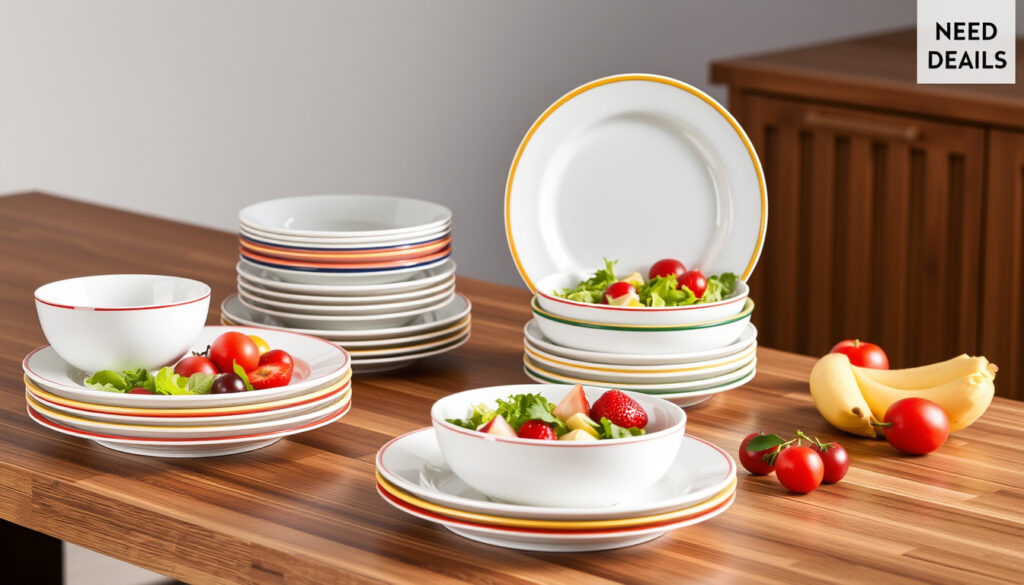
Corelle Dinner Set: Durability, Health & UK Deals
Drop a dinner plate and watch it shatter—you know the sound. Corelle is the dinnerware that survives that moment, and owners from UK parents to motorhome enthusiasts report sets lasting decades without a chip. The brand has been producing Vitrelle laminated glass dinnerware since the 1970s, and buyers still have straight questions about whether it is safe, healthy, and worth the price.
Durability Claim: 3x more durable than ceramic · Weight Advantage: Half the weight of ceramic · Common Set Size: 18 pieces (6 dinner plates, 6 bread plates, 6 bowls) · Storage Benefit: Takes half the space · UK Availability: Sold via Popat Stores and Klarna
Quick snapshot
- Corelle earned top durability scores in Good Housekeeping lab tests (Good Housekeeping Lab)
- Plates survived sharp steak knife contact without scratches or border damage (Reviewed)
- Up to 80% recycled glass content confirmed on Corelle’s official FAQ (Corelle Official FAQ)
- Precise country of manufacture for current production runs (factory locations have shifted over time)
- Whether every vintage pattern sold in UK thrift shops has been tested for lead content
- Exact composition percentages of the Vitrelle laminating layers (patented formula, not public)
- Corelle introduced patented Vitrelle three-layer glass in the 1970s (Reviewed)
- UK motorhome user acquired their set in 2023 and reports it looking new (MotorhomeFun Forum)
- Corelle’s official site still emphasises “dishes made to last” as of 2026 (Corelle Official)
- Corelle remains under the Corelle Brands umbrella alongside Pyrex
- UK buyers can purchase through Popat Stores; Klarna pay-later available
- Demand for lightweight motorhome and caravan dinnerware keeps Corelle relevant in the UK market
Five key questions surface repeatedly in UK buying searches, and each one touches on a real decision point for anyone considering a Corelle dinner set.
| Label | Value |
|---|---|
| Material | Vitrelle tempered glass |
| Brand Owner | Corelle Brands |
| Origin | USA (Corelle Brands) |
| Key Feature | Break and chip resistant |
| Popular Sizes | 18pc, 72pc, 76pc |
| Recycled Content | Up to 80% recycled glass |
| Microwave Safe | Yes (except stoneware mugs) |
| Dishwasher Safe | Yes |
Why is Corelle expensive?
Corelle commands a higher price than basic ceramic dinnerware for one reason its makers can back up with data: the Vitrelle material is a three-layer laminated glass engineered to resist chips and cracks in ways that standard stoneware simply cannot match. Good Housekeeping’s testing division ran Corelle plates through scratch and impact trials and gave them top durability scores, noting that the laminated glass construction holds up even under aggressive knife contact.
That does not mean Corelle is indestructible. The stoneware mugs that ship inside most sets are not made from Vitrelle—they are produced in China and lack the chip-resistant properties of the plates. Drop a mug on a hard floor and it behaves exactly like ordinary ceramic. The plates, however, are a different story. A reviewer at Reviewed tested a Corelle plate by dropping it from a balcony, and the plate survived. That kind of performance is what justifies the price tag for buyers who want dinnerware that will still look presentable after years of daily use. A solid set of plates that survives years of meals makes this investment practical for families who eat together daily.
Budget-conscious UK buyers should note that a standard 18-piece Corelle set covers six dinner plates, six bread plates, and six bowls. Larger 72-piece or 76-piece collections are available for households that entertain frequently, though the per-piece cost does not change dramatically between set sizes. Popat Stores stocks popular patterns in the UK and offers Klarna Instalments for buyers who want to spread the cost.
The mug component of every Corelle set is the weak link—if you are buying a set specifically because you want chip-resistant everything, the mugs will disappoint.
Are Corelle plates healthy to eat off of?
Corelle’s official FAQ states that Vitrelle glass contains no health warnings and that the dinnerware is safe for food contact. The material is made from up to 80% recycled glass, which might raise an eyebrow for anyone wondering whether recycled content introduces contaminants—but Corelle describes the recycling process as part of the Vitrelle manufacturing, not as a post-consumer reuse of unverified materials.
Corelle Brands has not published independent third-party laboratory test results for heavy metals such as lead or cadmium in the public-facing section of their website. For vintage sets found in charity shops or secondhand markets, the picture is less clear. Older Corelle patterns from before the 1990s sometimes used glazes that have since raised concerns in the wider dinnerware industry. If you are buying vintage Corelle specifically for daily food use, it is worth asking the seller whether any testing or provenance information is available, or whether you are comfortable using those pieces for decorative purposes instead.
Modern Corelle dinnerware made in the United States is subject to FDA regulations for food-contact surfaces, which provides a baseline reassurance that the dinner plates themselves meet established safety standards.
Current-production Vitrelle plates carry official safety backing and contain mostly recycled glass—but vintage patterns warrant closer inspection before you put food on them.
Are Pyrex and Corelle the same thing?
Both brands sit under the Corelle Brands corporate umbrella, but they make fundamentally different products. Pyrex refers to the heat-resistant glassware kitchen—bowls, measuring cups, baking dishes—originally invented by Corning in the early twentieth century. Corelle is the laminated-glass dinnerware line that launched in the 1970s with the Vitrelle patent.
The confusion arises partly because Pyrex changed its US glass formulation in 2009 from borosilicate to soda-lime glass, which affected its thermal-shock resistance. Corelle dinnerware is not subject to the same thermal-stress demands as oven-safe glassware, so the material difference does not translate into a quality problem for either brand—it simply reflects different engineering goals. If you are comparing dinnerware options, Corelle belongs in the same conversation as ceramic or stoneware sets, while Pyrex competes with other glass kitchen tools.
Pyrex and Corelle share a corporate parent, but they solve different problems—do not assume that because a brand makes durable ovenware, its plates will share those exact material properties.
Are old Corelle dishes worth anything?
Vintage Corelle does have a collector following, but the market is uneven. Certain patterns from the 1970s and 1980s—particularly those with bold geometric borders or iconic mid-century motifs—command higher prices on secondhand platforms than plain white sets. The same durability that makes Corelle practical for everyday use also means vintage pieces in good condition are relatively common, which keeps prices modest for most patterns.
UK charity shops frequently stock Corelle in their kitchenware sections, often priced between £5 and £20 for a mixed collection of plates and bowls. Collectors tend to look for pieces with intact patterns and no chips or scratches, but a single crack or chip significantly reduces value. If you inherit a box of old Corelle from a relative, sorting it into two piles—worth keeping for daily use and worth selling to a collector—before washing it is a practical first step.
How to spot vintage Corelle patterns
Most vintage Corelle pieces carry a backstamp that indicates the pattern name and approximate decade of production. Pattern names were typically printed on the base of each piece rather than embossed into the design itself. Online pattern archives maintained by Corelle enthusiasts can help you match a design to its era. The most sought-after vintage patterns include those with earth-tone speckled finishes and the classic Butterfly Gold series, both of which have appeared in UK charity shops with enough regularity that collectors have built specific pricing guides around them.
If you are trying to determine whether a vintage set is safe for food use, a visual inspection for crazing—fine cracks in the glaze—is more practical than laboratory testing. Crazing does not necessarily mean the piece is hazardous, but it can affect stain resistance and is a sign of age-related wear that most collectors consider when assessing value.
The pattern that emerges from UK charity shop sightings suggests that specific 1970s and 1980s designs hold collector value while plain white sets remain affordable for everyday use.
Should I throw away my Corelle dishes?
If your Corelle dishes are modern, undamaged, and free from crazing, there is no compelling reason to replace them. ConsumerAffairs has verified over 4.4 million reviews for Corelle products, and the pattern that emerges across those reviews is consistent: plates last for years without chipping, cleaning is straightforward, and storage is easy because the stackable design takes roughly half the cabinet space of equivalent ceramic sets.
The exception applies to stoneware mugs with visible cracks or chips. A damaged mug, like any chipped ceramic item, can harbour bacteria in the micro-fissures and presents a minor laceration risk if it breaks in the hand. Replacing a single mug is less costly than replacing an entire set, and Corelle’s UK customer service has reportedly sent replacement items for individual pieces without requiring a full set purchase.
For vintage Corelle purchased secondhand for regular food use, the decision comes down to visual condition and personal comfort. If the glaze looks intact and the piece has no chips, using it daily is generally low-risk. If there are signs of crazing or the glaze appears worn, relegating those pieces to decorative use is a practical compromise.
For most UK buyers, keeping undamaged modern Corelle makes sense—the mugs warrant replacement if cracked, but the plates themselves will outlast ceramic alternatives.
Corelle vs Alternatives
Three comparison points come up repeatedly in buying decisions, and each one reflects a genuine trade-off rather than a marketing claim.
| Comparison | Corelle Vitrelle | Stoneware / Ceramic | Melamine |
|---|---|---|---|
| Weight | Half the weight of ceramic | Heavy, solid feel | Very lightweight |
| Chip resistance | Highly chip-resistant plates | Prone to chipping on impacts | Flexible, rarely chips |
| Microwave safe | Yes (except mugs) | Usually yes | No |
| Recycled content | Up to 80% recycled glass | Varies by brand | Plastic; rarely recycled content |
| UK outdoor use | Good for caravans, picnics | Too heavy and fragile | Popular for outdoor dining |
| Typical cost | Mid-range | Wide range, cheaper options | Cheapest option |
The pattern is straightforward: if you want something that weighs less than ceramic, survives being dropped, and can go in the microwave, Corelle beats standard stoneware. Melamine is lighter still and nearly unbreakable, but it cannot handle microwave heat and does not have the same recycled-glass eco profile.
Key Specifications
Buyers comparing set options need the concrete numbers rather than general descriptions.
| Specification | Detail |
|---|---|
| Material | Vitrelle three-layer laminated glass |
| Plate manufacturing | Corning, New York |
| Mug manufacturing | China (stoneware, not Vitrelle) |
| Set sizes available | 16-piece, 18-piece, 72-piece, 76-piece |
| Standard 18-piece composition | 6 dinner plates, 6 bread plates, 6 bowls |
| Microwave compatibility | Yes for plates and bowls; not for stoneware mugs |
| Dishwasher compatibility | Yes, top rack recommended |
| Oven compatibility | Preheated oven safe for plates; not for mugs |
| Recycled glass content | Up to 80% |
| Stackability | Stackable; takes roughly half standard ceramic cabinet space |
One specification that surprises buyers: the mugs included in Corelle sets are explicitly excluded from the chip-resistance warranty and the thermal-safety recommendations that apply to Vitrelle plates. This matters most for buyers who assume that everything in the box shares the same material benefits.
Pros and Cons
Upsides
- Earned top durability scores in Good Housekeeping lab tests
- Plates survived knife contact and fall-from-balcony testing without damage
- Half the weight of equivalent ceramic sets, easy to stack and store
- Up to 80% recycled glass content with official eco-friendly claims
- UK motorhome owners report sets lasting years without chipping
- Microwave and dishwasher safe for plates and bowls
- Budget-friendly compared with premium ceramic alternatives
Downsides
- Stoneware mugs are fragile and made in China, unlike Vitrelle plates
- Some users find the plates feel too light for a “quality” dining experience
- Modern Vitrelle production location is not publicly confirmed
- Vintage patterns sold in UK charity shops have unclear lead-testing history
- Cannot stack heavy objects on Corelle without risking damage to surface decoration
What Customers Say
Laminated glass (the material Corelle uses) is quite durable and will last a long time—it also performed well in our scratch tests.
Good Housekeeping Lab (Independent testing authority)
Given that my mum has had her Corelle set for almost 50 years and my new ones mostly survived a fall from my balcony, they are a no-brainer purchase.
Reviewed (Product testing outlet)
I’ve been using Corelle for years with my kids, and not only are they beautiful, but they are practically indestructible.
YouTube Reviewer (Parent user)
Related reading: Pad Thai Recipe · How to Make French Toast
Frequently asked questions
What is Corelle dinnerware made of?
Corelle dinnerware is made from Vitrelle, a patented three-layer laminated glass. The outer layers are tempered for strength while the middle layer absorbs impacts. The material contains up to 80% recycled glass and is free from the lead and cadmium warnings found in some older dinnerware glazes.
How durable are Corelle dinner sets?
Corelle Vitrelle plates earned top performance scores in Good Housekeeping lab durability tests, survived sharp knife contact without scratches, and a reviewer at Reviewed documented a plate surviving a fall from a balcony. UK motorhome owners report sets lasting three years or more without chipping. However, the stoneware mugs included in most sets are not Vitrelle and behave like ordinary ceramic when dropped.
Where to buy Corelle dinner sets in the UK?
Popular UK retailers include Popat Stores, which stock a range of patterns in common sizes and offer Klarna Instalments for payment flexibility. The Corelle official site lists authorised UK stockists. Set sizes range from 18-piece starter sets to 76-piece collections for larger households.
What are the best Corelle dinner set patterns?
Classic White remains the best-selling pattern because it works with any table setting and does not date. For buyers who want visual interest, the Ocean Blues, Mystic Grey, and Indigo Speckle patterns are consistently stocked in UK retail. Square collections offer a modern shape but fit standard kitchen cabinet dimensions.
Are Corelle dishes microwave safe?
Yes for Vitrelle plates, bowls, and the dinnerware pieces themselves. The stoneware mugs that ship with most sets are not microwave safe because they are made from fired stoneware rather than Vitrelle glass. Corelle’s official guidance confirms this distinction on their FAQ page.
What country manufactures Corelle today?
Vitrelle plates have historically been produced in Corning, New York. However, production locations may have shifted over time as manufacturing operations have changed. The exact current country of manufacture is not publicly confirmed on Corelle’s consumer-facing materials. Stoneware mugs are confirmed as made in China.
Is Corelle dinnerware stackable?
Yes, and this is one of Corelle’s most practical advantages. The plates and bowls stack flat and take roughly half the storage space of equivalent ceramic sets. This makes Corelle a popular choice for UK households with limited kitchen cabinet space and for motorhome owners who need to maximise storage in small living areas.
For UK buyers weighing up dinnerware options, the calculation is fairly simple: if you want something that survives being dropped, stacks compactly, and costs less than premium ceramic, Corelle Vitrelle plates deliver on those promises. The mugs are the weak link, and vintage enthusiasts should verify pattern condition before paying collector prices. For families with young children, caravan owners, or anyone tired of watching ceramic shatter on impact, the set is worth considering seriously.
More related posts
 Blueberry Ash Tree: Complete Guide for Australian Gardeners
 Cadbury Marvellous Creations Recall: Jelly Popping Sharebag 2025
 Tommy Shelby: The Real Story Behind Peaky Blinders
 Ranbir Kapoor: Net Worth, Relationships & Family
 Sanjeev Gupta: The Rise and Fall of a Steel Tycoon
 Jessica Radcliffe Orca Attack Hoax: AI-Generated Video Debunked
 Austin Swift: Age, Net Worth, Career, Relationship with Taylor
 Hyundai i30 N: Performance, Specs and Buyer’s Guide
