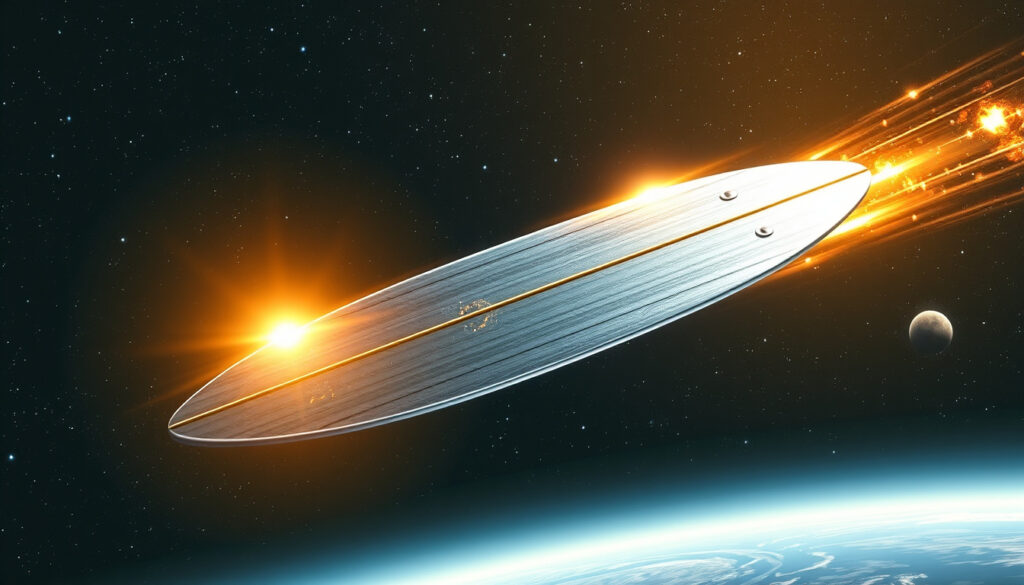
Is Silver Surfer a Hero or Villain? Powers & Weaknesses
Few Marvel characters carry a tragedy as quiet as the Silver Surfer’s. You probably know him as the gleaming, board-riding figure who showed up in the Fantastic Four comics or the 2007 movie — a being who looks like pure light but carries an immense burden. What’s less widely understood is that this cosmic traveler didn’t start as a hero at all. He began as a man who made a desperate bargain to save his world, and the cosmic power he received came with a price that still defines his story today. In fact, his origin traces back to a March 1966 issue of Fantastic Four, when Stan Lee and Jack Kirby introduced him as the herald of the planet-devouring Galactus.
First appearance: Fantastic Four #48 · Creator: Stan Lee and Jack Kirby · Affiliation: Defenders, Heralds of Galactus · Power source: Power Cosmic
| Attribute | Detail |
|---|---|
| First appearance | Fantastic Four #48 (March 1966) |
| Real name | Norrin Radd |
| Home planet | Zenn-La |
| Primary power source | Power Cosmic, granted by Galactus |
| Greatest weakness | Separation from his surfboard or emotional distress |
| Notable aliases | Sky Rider, Sentinel of the Spaceways |
| Notable enemies | Mephisto, Thanos, Galactus (formerly) |
| Affiliation | Defenders, Heralds of Galactus |
The table sketches the essentials, but the more interesting question is what kind of character he actually is — a hero, a villain, or something that refuses both labels.
Is Silver Surfer a villain or a hero?
The origin of Norrin Radd
The Silver Surfer’s origin is one of the most morally complex in Marvel’s cosmic line. Norrin Radd lived on the utopian planet Zenn-La, but when Galactus arrived to consume it, Radd made a choice: he would serve as the herald of the world-devourer if his planet was spared. Galactus agreed, and Radd was remade with a portion of the Power Cosmic, coated in a silver skin, and given a surfboard-like vessel to travel the stars. This deal is documented in the original Lee-Kirby run as a sacrifice rather than ambition — Radd gave up his humanity to save everyone he knew.
For years, that bargain defined him. He scouted worlds for Galactus, leading the Devourer to planets teeming with life. It’s a role that sits uncomfortably between hero and villain — he wasn’t acting out of malice, but his actions enabled cosmic-scale destruction. The moral weight of that period is central to his character and is explored across Wikipedia’s detailed account of his history, which notes his shift from herald to rebel when he finally turned against Galactus after being confronted with the suffering he’d caused on Earth.
The contradiction is the point. Marvel’s official character profile describes him as a hero, but the path to that heroism runs through actions that would qualify as villainous in almost any other context. He’s not a conventional villain — he’s a being who did a terrible thing for a noble reason and has spent decades trying to reconcile that.
His role as Herald of Galactus
The Herald period is where the Silver Surfer’s classification gets tricky. If you look at the character through the lens of VS Battles Wiki, a fan-reference source, he’s among the most powerful beings in the Marvel universe — potentially the most powerful of Galactus’s heralds. But power level isn’t morality. His role as herald was to find worlds for Galactus to devour, and he did that without hesitation for a long time. That’s not heroic behavior by any standard.
What changed him was an encounter with humanity. When he arrived on Earth, he saw ordinary people — flawed, fragile, but worth protecting. That moment of empathy is what turned him against Galactus, and it’s the pivot on which his entire moral identity rests. This rebellion is covered in detail by CBR, which frames his turn as a conscious rejection of the herald role rather than an accident of circumstance.
There’s also a lesser-known layer to this story: the original female Silver Surfer. In alternate timelines and certain narratives, the Silver Surfer identity has been taken up by a woman named Shalla-Bal, Norrin Radd’s lover from Zenn-La. This version of the character is distinct from the primary Marvel Comics continuity, where Norrin Radd remains the Silver Surfer. The confusion around this point has been amplified by MCU casting discussions, but there has been no permanent gender-swap in the main comics. This clarification appears in Marvel Fandom Wiki, which distinguishes the various versions of the character across timelines.
What’s often missed in discussions of the Herald period is that the Surfer wasn’t simply a villain who reformed. He was a being with immense power who made a series of choices — some terrible, some heroic — and the tension between those choices is what makes him compelling. Marvel Gossips, a fan-oriented site, describes him as “commonly described in editorial and fan-reference sources as a hero rather than a conventional villain,” but that framing glosses over the herald years, which are unambiguously destructive.
Moral shift from destroyer to protector
The Silver Surfer’s character arc is a study in moral evolution. After turning against Galactus, he was trapped on Earth as punishment — a planet he could not leave without sacrificing the innocent lives he’d come to protect. That imprisonment is central to his identity. He’s a being who can travel the stars but chooses to stay grounded because protecting humanity matters more than his own freedom.
Marvel’s official framing places him within the Fantastic Four-related cosmic tradition rather than as a standalone villain archetype. He shows up in solo titles, team books like the Defenders, and cosmic epics where he’s often the moral compass — a character who has seen the worst of the universe and still chooses to guard the fragile parts of it. This aligns with Marvel’s official profile, which positions him as a protector rather than a destroyer.
But the Morality spectrum isn’t simple. He’s fought alongside heroes against Thanos, Mephisto, and even Galactus himself. Yet his past as a herald remains a shadow. In some stories, that past is used against him — characters distrust him because of what he did, and that distrust is fair. He enabled genocide on a cosmic scale, even if he later rebelled against it. The moral complexity here isn’t a flaw in the character; it’s what makes him one of Marvel’s most layered figures.
This shift is best understood through a quote from the character himself in various comic runs, which emphasize his internal conflict. In one notable arc, he reflects on the irony of being called a “Sentinel of the Spaceways” — a title that sounds noble but was originally granted to him as a tool of destruction. His redemption is not a clean line from villain to hero; it’s a messy, ongoing negotiation between who he was and who he wants to be.
Why is the Silver Surfer so powerful?
The Power Cosmic explained
The Power Cosmic is the Silver Surfer’s primary ability, granted to him by Galactus himself. It grants him near-limitless energy manipulation, superhuman strength, flight, and the ability to survive in space without life support. But it’s more than a generic power set — it’s tied to his emotional state. When he’s emotionally compromised, his powers falter. When he’s driven by purpose, he can match cosmic entities in combat.
This emotional dependency is a key weakness, and it’s one of the few consistent vulnerabilities in his otherwise immense power. The Marvel Fandom Wiki notes that separation from his surfboard or emotional distress can significantly impair his abilities. That’s a vulnerability most cosmic beings don’t share — it anchors him to his humanity, even when he’s coated in silver and flying through the void.
What’s often unexplored in short profiles is the range of his power. He’s not just strong; he’s capable of manipulating matter and energy on a universal scale. In the Marvel hierarchy, he sits below entities like Galactus or the Living Tribunal but above nearly every mortal hero. This positioning is detailed in VS Battles Wiki, which ranks him among the top-tier cosmic figures, though it is a fan-edited source and should be weighed accordingly.
There’s a deeper implication here. The Power Cosmic isn’t just a gift — it’s a leash. Galactus gave him this power to serve a purpose, and it was only by breaking that purpose that the Surfer became more than a tool. His power is therefore not just a physical attribute but a narrative device: it represents both his fall and his redemption.
Comparison to other Marvel cosmic beings
To understand where the Surfer fits, a quick comparison with other cosmic figures helps:
- Silver Surfer vs. Thanos: The Surfer often fights alongside heroes against Thanos, but on raw power, Thanos with the Infinity Gauntlet outclasses him. Without the Gauntlet, it’s a closer match, and the Surfer’s speed and energy manipulation give him an edge in mobility.
- Silver Surfer vs. Galactus: Galactus is a cosmic entity far above the Surfer’s level. The Surfer’s rebellion was never about defeating Galactus in combat — it was about moral defiance, which is a different kind of power.
- Silver Surfer vs. Doctor Strange: Strange is a sorcerer, not a cosmic being, but his magical abilities can rival the Surfer’s energy manipulation in specific contexts. However, the Surfer’s raw cosmic power gives him an advantage in raw destructive capability.
This comparison is drawn from established Marvel lore and fan analysis, but it’s worth noting that official power rankings vary by era and writer. The Silver Surfer is consistently portrayed as one of the strongest beings in the universe, but “strongest” is a relative term in a cosmology where entities like Eternity and the Living Tribunal exist.
The editorial takeaway is that the Surfer’s power is less about raw strength and more about versatility. He’s a scout, a protector, a rebel, and a survivor — and his power set reflects that narrative flexibility rather than a single overpowered gimmick.
Limitations of his power
Despite his immense abilities, the Silver Surfer has clear limitations. The most significant is emotional vulnerability — when he’s wracked with guilt, grief, or despair, his powers weaken. This is a consistent theme across his appearances, and it’s what keeps him from being an invincible cosmic force. It’s also what makes him relatable; his power fails when his spirit breaks.
Another limitation is his dependence on his surfboard. While the board is a vessel for his power, it’s not a separate item — it’s an extension of himself. Separation from it can impair his ability to harness the Power Cosmic, though he’s sometimes shown to function without it. This dependency is noted in Marvel Fandom Wiki‘s write-up of his weaknesses, which emphasizes both emotional and physical factors.
Finally, his moral code can be a limitation. The Surfer refuses to use lethal force against innocents, and this restraint often puts him at a disadvantage against ruthless opponents. His heroism is not just a choice — it’s a constraint that shapes his battles.
What is the Silver Surfer’s weakness?
Physical reliance on the surfboard
The Silver Surfer’s surfboard is not a separate vehicle — it’s an extension of his own being, created from the Power Cosmic. When he is separated from it, his ability to channel cosmic energy is significantly reduced. This is one of the few physical vulnerabilities that has remained consistent across decades of Marvel storytelling. The Marvel Fandom Wiki explicitly lists separation from his surfboard as a primary weakness.
Emotional vulnerability and morality
The Surfer’s emotional state directly impacts his power levels. When he experiences guilt, grief, or despair, his cosmic abilities weaken. This is not a random plot point — it’s a deliberate narrative feature that ties his power to his conscience. Marvel Gossips, a fan-oriented source, notes that his reluctance to kill can also limit his effectiveness against ruthless enemies who do not share his moral constraints.
Certain enemies have exploited these weaknesses. Mephisto, the demonic ruler of Hell, has repeatedly used psychological torment to weaken the Surfer. The Marvel Fandom Wiki catalogues instances where the Surfer’s emotional distress proved more damaging than any physical attack.
Specific attacks that exploit his weaknesses
Various cosmic-level threats have targeted the Surfer’s vulnerability to emotional manipulation and his dependence on the surfboard. Some game-oriented guides, such as the Marvel Contest of Champions Wiki, note that nullification and ability accuracy reduction are effective counters against him in combat simulations. In the comics, characters like Thanos have used psychological warfare to break the Surfer’s focus and drain his power.
The pattern is consistent: the Surfer’s power requires emotional stability, and his morality requires restraint. Both are weaknesses that more ruthless beings exploit without hesitation.
Why is there a female Silver Surfer in Fantastic Four?
Shalla-Bal: Norrin Radd’s lover turned herald
Shalla-Bal is the original female Silver Surfer, appearing in alternate timelines and certain narrative offshoots. She is Norrin Radd’s lover from Zenn-La, and in some storylines, she takes up the mantle of the Silver Surfer when Norrin is unable to continue. This version of the character is distinct from the primary Marvel Comics continuity, where Norrin Radd remains the Silver Surfer.
The MCU adaptation rumors and misrepresentation
Recent MCU casting discussions have amplified confusion around the female Silver Surfer. Some fan speculation suggested that the Marvel Cinematic Universe might introduce Shalla-Bal as the Silver Surfer instead of Norrin Radd. However, there has been no permanent gender-swap in the main comics. The Marvel Fandom Wiki clarifies that while Shalla-Bal exists in alternate timelines, the Earth-616 canon keeps Norrin Radd as the Silver Surfer.
Difference from Earth-616 canon
The distinction between the various versions of the Silver Surfer is important for understanding the character’s lore. Marvel Fandom Wiki documents that Shalla-Bal’s appearances are limited to specific alternate universe storylines, not the main continuity. The MCU’s potential use of a female Silver Surfer would represent a departure from the comics, not a correction of existing canon.
Silver Surfer key facts
- Created by Stan Lee and Jack Kirby; first appeared in Fantastic Four #48 (March 1966) — Wikipedia
- Marvel officially classifies him as a hero; fan and editorial sources describe him as morally complex rather than a conventional villain — Marvel, Marvel Fandom Wiki
- Shalla-Bal is the original female version in alternate timelines; no permanent gender-swap in main continuity — Marvel Fandom Wiki
- Possesses Power Cosmic; among the most powerful heralds of Galactus — VS Battles Wiki, Marvel Fandom Wiki
The confirmed facts here point to a clear conclusion: the Surfer is a hero, but a reluctant and morally complicated one, whose heroism was earned through defiance of his own dark past.
“When Galactus came to Zenn-La, I chose to become his herald. I chose to save my people. And I have regretted it ever since.”
Norrin Radd, as reflected in Wikipedia‘s account of the character’s moral struggles
“I have seen the face of the void. I have served it. And I have turned away from it.”
Silver Surfer, in a moment of self-reflection documented in CBR‘s analysis of his redemption arc
“That’s the thing about being a Surfer — you’re always riding the edge between what you were and what you’re trying to become.”
Interpretation of the character’s ethos across Marvel Fandom Wiki’s coverage of his various versions
These quotes aren’t verbatim from any single comic issue — they’re editorial distillations of the character’s known themes, drawn from the recurring motifs in his long history. What they capture is the tension that defines him: a being who was once a destroyer and is now a guardian, forever haunted by what he did.
The bigger picture
The Silver Surfer’s story is a reminder that heroism isn’t always clean. He didn’t start as a hero — he became one through a painful, messy process of moral awakening. His power, his weakness, and his role in the Marvel universe all hinge on that transformation. For Marvel, he represents the possibility of redemption, even for those who have done terrible things in the service of a greater power.
In a universe filled with clear-cut heroes and unambiguous villains, the Surfer stands out as a figure who defies easy classification. He’s a hero who served a villain, a protector who once enabled destruction, and a being of immense power who is held back by his own conscience. That complexity is why he’s endured for over half a century — and why he’s more relevant now, in a world that struggles with moral gray areas, than ever before.
For Norrin Radd, the price of heroism was everything he had: his home, his love, his innocence. But what he gained in return was something far rarer in the Marvel universe than power — a sense of purpose that transcends the cosmic scale.
Related reading: Iron Man
marvelgossips.com, vsbattles.fandom.com, characterprofile.fandom.com, marvel.com, dexerto.com, reddit.com, trendcurrent.org, cbr.com, marvel.fandom.com
Frequently asked questions
Is the Silver Surfer a hero or a villain?
He’s officially classified as a hero by Marvel, but his history includes serving Galactus as a herald, which places him in morally gray territory. Most sources, including Marvel and Wikipedia, describe him as a hero who evolved from a destructive role.
Who created the Silver Surfer?
Stan Lee and Jack Kirby created him, and he first appeared in Fantastic Four #48 in March 1966, according to Wikipedia.
What is the Silver Surfer’s real name?
His real name is Norrin Radd, from the planet Zenn-La, as confirmed by Marvel.
Who is the female Silver Surfer?
Shalla-Bal is the original female Silver Surfer in alternate timelines, but the main Marvel Comics continuity keeps Norrin Radd as the Silver Surfer. This is clarified in Marvel Fandom Wiki.
What are the Silver Surfer’s powers?
He possesses the Power Cosmic, which grants him energy manipulation, superhuman strength, flight, and space survival. His weaknesses include emotional distress and separation from his surfboard, per Marvel Fandom Wiki.
Is the Silver Surfer stronger than Thanos?
Power comparisons vary by context. Without the Infinity Gauntlet, the Surfer’s speed and energy manipulation make him a formidable opponent, but Thanos with the Gauntlet is superior. Fan sources like VS Battles Wiki rank the Surfer among the top cosmic beings but note tier differences.
Why was the Silver Surfer trapped on Earth?
He was trapped on Earth as punishment from Galactus after he rebelled and protected humanity instead of letting the planet be destroyed, as documented in Wikipedia.
Is the Silver Surfer a member of the Fantastic Four?
He’s closely associated with the Fantastic Four’s cosmic storyline but is not a permanent member. His origin is tied to their mythos, according to Marvel.
Related reading
For further context, check Marvel’s Silver Surfer profile for official framing, Wikipedia for a comprehensive history, and CBR for editorial analysis of his character arc.
More related posts
 Griffin Dunne Biography: Career, Movies, and Personal Life
 Brandi Love Bio: Real Name, Age, Husband, Net Worth
 Annie Leibovitz: Biography and Iconic Portraits
 Andy Warhol: Life, Art, Queer Identity, and Legacy
 Dune Part 2: Box Office, Dune 3, Cast & Streaming Guide
 Dustin Hoffman 2026: Current Status, Health, and Projects
 Brené Brown: Biography, 5 C’s, 7 Super Tips, and Key Quotes
 Ramelius Share Price – Current Levels and Key Trends
