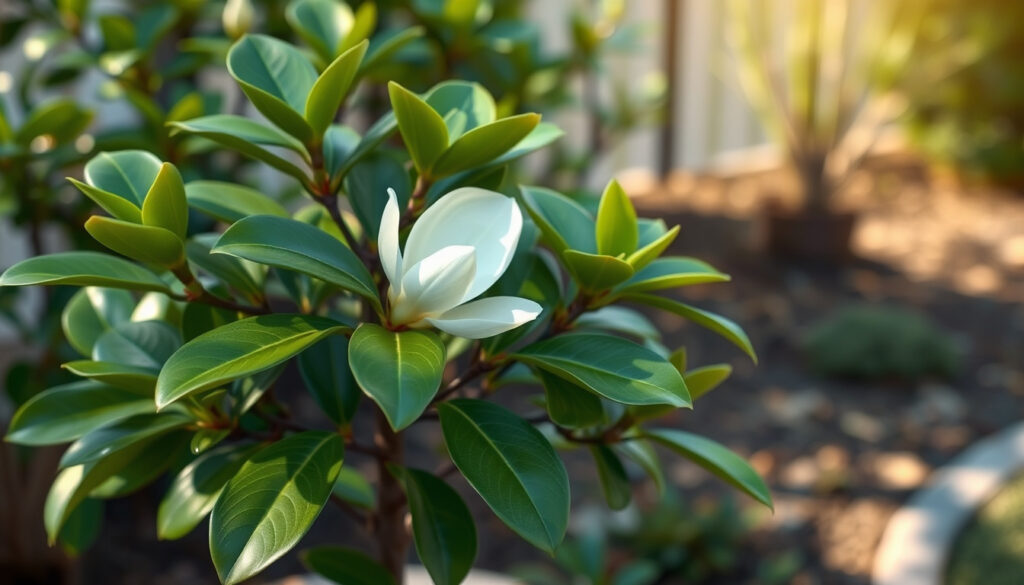
Magnolia Little Gem: Size, Care & Planting Guide
The Little Gem is the compact magnolia that fits into a smaller garden without sacrificing those iconic creamy-white flowers. This compact evergreen cultivar of Magnolia grandiflora has become a favourite among Irish gardeners who want structure and fragrance without the space demands of a full-sized Southern Magnolia.
Mature height: 4–8 m ·
Growth rate: Slow (15–30 cm per year) ·
Flower period: Late spring to autumn ·
Leaf length: Up to 12 cm ·
Hardiness zone: 7–9
Quick snapshot
- Mature height 4–8 m, spread 2.5–4 m (Royal Horticultural Society)
- Slow growth rate 15–30 cm per year (RHS) (Royal Horticultural Society)
- Evergreen, glossy leaves with copper-brown underside (RHS) (Royal Horticultural Society)
- Fragrant white flowers up to 10 cm across (RHS) (Royal Horticultural Society)
- Exact time to reach full height varies with site conditions
- Consistency of flowering in cooler Irish summers not fully documented
- Long-term effects of pruning on flowering not fully documented
- Takes 10–20 years to reach ultimate height (RHS)
- Choose a sheltered, sunny spot with well-drained soil
- Protect young trees from frost for first 2–3 years
Here are the key specifications at a glance.
| Attribute | Value |
|---|---|
| Height | 4–8 m |
| Spread | 2–4 m |
| Growth rate | Slow (15–30 cm/year) |
| Flower color | White |
| Leaf color | Dark green with copper-brown underside |
| Hardiness zones | 7–9 |
How big will a Little Gem magnolia get?
Mature height and spread of Magnolia grandiflora ‘Little Gem’
The Magnolia grandiflora ‘Little Gem’ is a compact, narrowly columnar tree. According to the Royal Horticultural Society (UK gardening authority), it reaches up to 8 metres tall with a spread of 2.5 to 4 metres. Irish nurseries give similar figures: Clarenbridge Garden Centre (Irish specialist nursery) lists 4–8 m high and 2.5–4 m wide, while D&M Garden Centre (Irish retailer) quotes 4–6 m tall and 2–3 m wide. The variation reflects local conditions, but the tree stays narrow — a key advantage for tight spaces.
Growth rate and time to reach full size
This is a slow grower. The RHS states it takes 10 to 20 years to reach its ultimate height. Expect 15–30 cm of new growth per year. Promesse de Fleurs Ireland (online nursery) notes that in less favourable soils it may stay as low as 2.5 m, but can reach 4 m in optimum conditions. The trade-off for patience is a beautifully proportioned tree that won’t outgrow its welcome.
Irish gardeners often face limited space. The Little Gem’s columnar habit means it fits into a 2 m wide planting strip while still delivering classic magnolia flowers. The slow growth also means less pruning over the years.
The implication: Little Gem is a practical choice for tight spaces.
Where is the best place to plant a Little Gem magnolia tree?
Soil and sunlight requirements
Plant in full sun to partial shade. The Caragh Nurseries (Irish specialist) recommend moist, organically rich, well-drained loam. The soil should be acidic to neutral — avoid alkaline chalk. Promesse de Fleurs Ireland specifically advises against ericaceous (lime-free) compost because it is too nutrient-poor for this cultivar. The key is consistent moisture but not waterlogging.
Spacing from structures and other plants
Because the spread is only 2–4 m, you can plant closer to buildings than you would with a standard magnolia. The RHS confirms a non-invasive root system. Even so, allow at least 1.5–2 m from walls to give the canopy room to develop. That distance also prevents rain shadows that might dry out the soil.
Hardiness zones and microclimates in Ireland
Rated for zones 7–9, the Little Gem is hardy in most of Ireland. However, young plants need protection from cold winds and heavy frost. Promesse de Fleurs Ireland advises shielding new trees for the first two or three winters. A sheltered spot near a south-facing wall works well.
Irish summers can be cool and wet, which may delay flowering. While the tree is hardy, the flower buds need warmth to open fully. Planting in the warmest, most sheltered part of your garden gives the best chance of a reliable display.
The pattern: careful siting is essential for consistent flowering.
What are the pros and cons of a Little Gem magnolia tree?
Upsides
- Compact, columnar shape suits small gardens
- Fragrant flowers appear at a young age (RHS)
- Evergreen foliage provides year-round interest
- Non-invasive roots — safe near foundations
- Low maintenance: minimal pruning required
Downsides
- Slow growth – takes 10–20 years to reach full size
- Susceptible to scale insects and sooty mould (RHS)
- Can suffer leaf spot in wet conditions
- Messy seed pods drop in autumn
- Flowering may be inconsistent in cooler Irish summers
Five advantages, four drawbacks — the balance tips in favour of the Little Gem for urban and suburban gardens where space is at a premium. The trade-off is patience: you wait longer for the full effect, but the tree stays manageable for decades.
Which is better, a Teddy Bear or a Little Gem magnolia?
Two compact evergreen magnolias, one key difference: final size. The comparison below uses data from UK and Irish nurseries.
| Feature | Little Gem | Teddy Bear |
|---|---|---|
| Mature height | 4–8 m | 6–10 m |
| Mature spread | 2.5–4 m | 3–4 m |
| Growth habit | Narrowly columnar | Upright, oval |
| Leaf underside | Copper-brown | Rusty-brown felt |
| Flower size | ~10 cm across | ~15 cm across |
| Fragrance | Light | Strong |
| Best for | Very tight spaces | Medium gardens |
The pattern: Teddy Bear grows taller and has larger, more fragrant flowers, but Little Gem stays narrower. For a garden where width is the limiting factor, Little Gem wins. If you can spare an extra metre, Teddy Bear gives more impact.
Can you cut back magnolia Little Gem?
Best time to prune Little Gem magnolia
Prune in late winter or early spring, just after the main flowering period. Promesse de Fleurs Ireland notes that pruning is rarely necessary and should be done sparingly. Heavy cutting reduces the next season’s flowers.
Pruning techniques for shape and size control
- Remove dead, damaged, or crossing branches first.
- Thin out crowded interior growth to improve air circulation.
- Shorten long shoots by one-third to maintain the columnar shape.
- Avoid topping the leader — it ruins the natural form.
For young trees, the best approach is to let it grow naturally. If you must limit size, prune every second year rather than annually.
Can Little Gem magnolia be planted next to a house?
Yes, due to its non-invasive root system and compact spread, Little Gem can be planted closer to buildings than standard magnolias. Allow at least 1.5–2 m from the wall to give the canopy room to develop and prevent rain shadows that may dry the soil.
What this means: for small urban plots, this tree is a safe choice near foundations provided you respect that minimum distance.
What are the common problems with Little Gem magnolias?
Pest issues: magnolia scale, aphids
Magnolia scale insects are the most common pest. They produce sticky honeydew that leads to sooty mould. The RHS advises controlling scale with horticultural oil in early spring. Aphids may also appear on new growth, but they are rarely damaging.
Disease issues: leaf spot, sooty mould
Leaf spot fungi thrive in wet Irish conditions. Remove affected leaves and improve air circulation through pruning. Sooty mould is a secondary issue from honeydew — treat the pest and the mould washes off naturally.
Environmental issues: frost damage, chlorosis
Young trees are vulnerable to heavy frost. Promesse de Fleurs Ireland recommends fleece protection for the first few winters. Yellowing leaves (chlorosis) often indicate iron deficiency in alkaline soils — test the pH and feed with chelated iron if needed.
Confirmed facts
- Scale insects cause sticky honeydew (RHS)
- Leaf spot occurs in wet conditions
- Frost protection needed for young trees
What’s unclear
- Exact susceptibility to specific fungal strains in Ireland
- Long-term performance of the tree in exposed coastal gardens
What gardeners are saying
“Magnolia grandiflora ‘Little Gem’ is a compact, narrowly columnar, evergreen tree with glossy, dark green leaves and a deep brown felt on the underside.”
— Royal Horticultural Society (UK horticultural authority)
“Best grown in moist, organically rich, well-drained loams in full sun to part shade. It does not like being too wet or too dry.”
Two expert voices, one consistent message: Little Gem thrives with consistent moisture, good drainage, and a sheltered position. The RHS confirms its compact size; Irish nurseries validate it as a practical choice for local gardens.
paramountplants.co.uk, gardenia.net, futureforests.ie, monrovia.com, dobies.co.uk, plantref.org, trees.com
Frequently asked questions
Does Magnolia Little Gem need acid soil?
No, it prefers neutral to slightly acidic soil. Promesse de Fleurs Ireland advises against ericaceous compost because it is too nutrient-poor. Rich, well-drained loam is ideal.
How often should I water a newly planted Little Gem magnolia?
Water deeply once a week during the first growing season, more often in dry spells. The soil must stay moist but not waterlogged.
When does Little Gem magnolia flower in Ireland?
Flowers appear from late spring through autumn, with the main flush in early summer. Cool Irish summers may delay the start.
Can Little Gem magnolia grow in a pot?
Yes, for the first few years, but it will eventually need planting in the ground. Choose a large container (at least 45 cm) with drainage holes.
Is Little Gem magnolia deer resistant?
Deer generally avoid magnolias because of the leathery leaves, but no plant is completely deer-proof.
How do I protect Little Gem magnolia from frost?
Wrap the trunk with horticultural fleece and mulch the root zone. Promesse de Fleurs Ireland recommends protection for the first 2–3 years.
Should I fertilize my Little Gem magnolia?
A balanced slow-release fertilizer in spring (e.g., 10-10-10) is sufficient. Avoid high-nitrogen feeds that promote leafy growth at the expense of flowers.
For Irish gardeners seeking a compact, evergreen magnolia, the Little Gem offers proven performance in limited spaces. Its slow growth and narrow habit make it a reliable long-term choice.
More related posts
 Austin Swift: Age, Net Worth, Career, Relationship with Taylor
 Muscle Man: Real Name, Strength, and Green Skin Mystery
 Eddie Van Halen Cause of Death, Sobriety, Love Life & Legacy
 Flea RHCP: His Nickname, Friendship with Kiedis & Near Quit
 Shaynna Blaze: Age, Net Worth, Partner, Kids and Salary
 Dustin Martin’s Retirement, Net Worth & Father’s Deportation
 Rome to Rio: Flights, Time, Distance & Planner Guide
 David Gilmour’s Biography, Net Worth, and Family Life
